 Wednesday, October 07, 2026
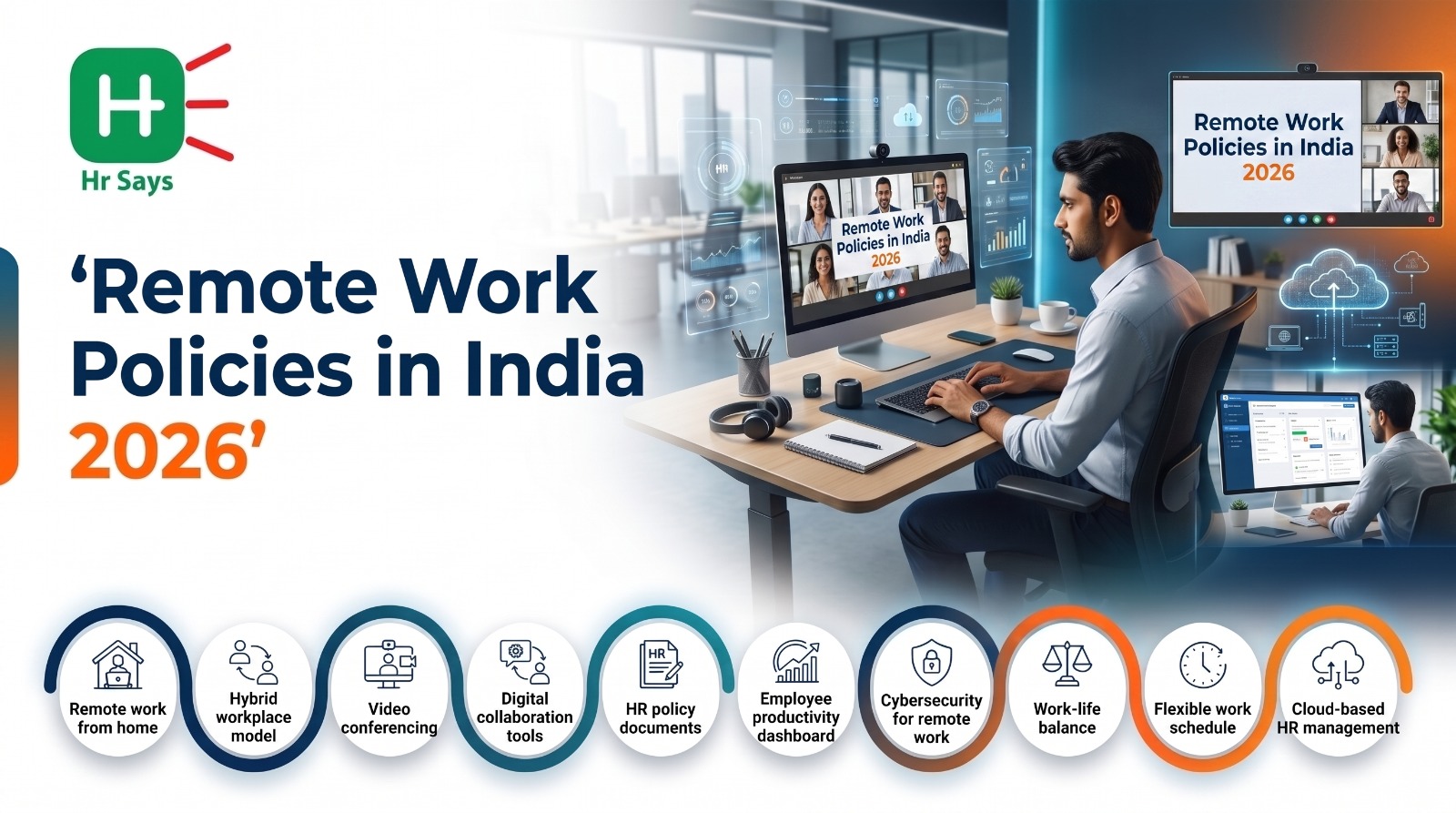
 Indian companies in 2026 are tightening remote work policies, with major IT firms mandating office attendance while hybrid models remain widespread elsewhere, shaped by evolving labour law and employee retention pressures.





Remote Work Policies in India 2026: What Companies Are Actually Doing
Introduction
Remote work in India has entered a new and more complicated phase. The early pandemic years brought sweeping work-from-home mandates, and the years right after brought equally sweeping predictions that hybrid work was the permanent future of Indian business. Neither extreme captured what is actually happening in 2026. Companies are not abandoning flexibility, but they are also not leaving it unstructured. Instead, organisations across sectors are writing detailed policies, adding attendance tracking, and in several cases, quietly walking back the remote-first promises made a few years ago.
For HR leaders, founders, and professionals trying to make sense of this shift, the question is no longer whether remote work will survive. It is which version of remote work companies are choosing to keep, and why. This article looks closely at the current state of remote and hybrid work policies among Indian employers, the data behind these decisions, the legal framework that now governs them, and what this means for people managing workplaces today.
Understanding Where Indian Companies Stand Today
The broad picture is one of hybrid work becoming the default, but with meaningfully less flexibility than it had in 2022 or 2023. Industry data from NASSCOM indicates that nearly 70 percent of organisations in India's technology industry have adopted a hybrid work model. A separate Mercer India survey found that 57 percent of Indian companies now operate hybrid work models, with the average employee spending 2.8 days per week in the office, and this figure rises to 73 percent among IT and ITeS companies specifically.
However, the direction of movement in 2026 is toward tighter structure rather than continued openness. Global data shows a similar pattern of stated flexibility not matching actual hiring behaviour. In the first quarter of 2026, 77 percent of new job postings globally were fully on-site, compared to only 19 percent hybrid and 4 percent fully remote, even though 88 percent of employers claim to offer some hybrid options. This gap between policy on paper and practice on the ground is one of the defining tensions in workplace planning this year.
Employee sentiment, meanwhile, remains firmly in favour of flexibility. Survey data shows that 83 percent of employers globally say remote work is important for employee happiness and retention, and this figure is especially high in India at 88 percent. A Randstad India study cited in industry reporting found that 68 percent of Indian professionals would consider leaving an employer that mandated full-time office attendance without offering any flexibility. This tension between what employees want and what companies are choosing to implement sits at the centre of HR decision-making this year.
The IT Sector Is Leading a Quiet Return to Office
Nowhere is this tension clearer than in India's technology sector, which set the tone for remote work adoption during the pandemic and is now setting the tone for its retreat. Several major IT services companies have introduced or tightened office attendance requirements through late 2025 and into 2026.
Tata Consultancy Services has taken one of the firmer positions in the industry. According to reporting on the company's updated policy, TCS has mandated a full five-day office week for many of its employees, and physical attendance is now directly linked to variable pay and promotion decisions. This marks a shift from earlier hybrid frameworks toward a model where in-office presence carries direct financial consequences.
Infosys has moved more gradually but with a similar underlying direction. Employees at certain job levels are now expected to meet minimum monthly attendance targets, and the company allows remote work for no more than five days in an entire quarter for employees at Job Level 5 and below, who represent a large share of its engineers and consultants; these employees must be physically present in the office for at least ten days every month, and automated systems flag anyone who falls short. By March 2026, this had extended further, with Infosys expanding its return to office policy to employees at job level 6A and above, mandating four office days weekly with HR monitoring, even as company leadership continued to describe the approach as a hybrid balance rather than a full mandate.
Wipro has adopted a comparable but slightly less rigid standard. Reports indicate that starting January 2026, Wipro employees must spend at least six hours in the office on a minimum of three days each week, a requirement designed to ensure sustained, meaningful time on-site rather than brief symbolic appearances. HCL Technologies and Cognizant have introduced similar three-day office minimums, with disciplinary consequences for non-compliance in HCL's case.
Industry commentary suggests this shift is being driven by more than nostalgia for pre-pandemic office culture. Analysts point to the need for closer collaboration, faster adoption of AI tools, and better mentoring for junior staff as the primary business reasons cited by IT firms for tightening attendance rules, alongside what some industry experts describe as a "collaboration debt" built up over years of limited in-person engagement. Whether this justification fully explains the shift or whether cost and workforce management also play a role remains a subject of debate among HR commentators, but the practical result for employees is the same: less flexibility than existed just two years ago.
Why Hybrid Still Dominates Outside Pure IT Services
Not every sector is following the same script. Even within India's own IT industry, the picture is not uniform. NASSCOM's overall figure of roughly 70 percent hybrid adoption sits alongside sector-specific data showing lower flexibility in sectors with heavier physical operations. According to workplace research, sectors like BFSI, manufacturing, and healthcare have historically shown lower hybrid adoption due to higher on-site operational requirements, though the figure is trending upward as digital infrastructure matures across these industries.
For India's broader workforce, the numbers show that fully remote work remains a minority arrangement even as hybrid work has become mainstream. One analysis of the current landscape notes that around 12.7 percent of full-time Indian employees worked fully remote in 2024, while 28.2 percent worked hybrid, with the IT and tech sectors leading this trend. This suggests that when Indian companies talk about "remote work policies" today, they are usually describing structured hybrid arrangements rather than the anywhere-anytime model that defined 2020 and 2021.
Retention data offers one explanation for why many companies, particularly outside IT services, are reluctant to abandon hybrid work altogether. Research on employer outcomes found that 69 percent of employers reported improved employee retention after introducing hybrid policies, with companies that required only one day a week in the office seeing retention improve by an average of 41 percent. For sectors competing hard for skilled talent, particularly outside the metro-heavy IT hubs, this retention benefit is difficult to walk away from even as larger IT services firms tighten their own rules.
What the Law Actually Says About Remote Work in India
One area that HR teams frequently underestimate is the legal framework governing remote and hybrid arrangements. India does not have a single, dedicated remote work statute, but the country's four consolidated labour codes, which came into force through notifications from November 2025 onward, now formally recognise flexible work arrangements for the first time.
Legal analysis of the new framework explains that under the Draft Model Standing Orders framed under the Industrial Relations Code Rules 2025, work from home, remote work, and virtual workplaces are formally recognised as valid employment arrangements, with employers permitted to structure such arrangements based on the terms of employment or mutual agreement. This is a meaningful shift, since it moves remote work from an informal management decision to a documented, legally recognised employment structure, at least for establishments that fall within the relevant thresholds.
Employers should also be aware that existing protections do not disappear simply because an employee is working from home. Legal commentary on the POSH Act is explicit that the Act defines "workplace" to include any place visited by an employee in the course of employment, as well as a dwelling place or house, meaning that employer obligations and protections against sexual harassment extend fully to virtual and home office environments. Organisations with ten or more employees are still required to maintain a functioning Internal Complaints Committee regardless of how much of the workforce works remotely, and non-compliance can lead to fines of up to fifty thousand rupees or more for repeat violations, along with potential cancellation of business licenses.
Practical HR compliance guidance published this year also points to the growing legal importance of having a written work-from-home policy rather than relying on informal understanding. According to one detailed template resource, a proper policy needs to cover eligibility criteria, working hours and availability, attendance tracking, communication protocols, data security requirements, equipment and expense reimbursement, performance evaluation, and compliance with Indian labour laws including the OSH Code 2020 and IT Act 2000. The same resource notes that courts and labour tribunals are increasingly looking at internal company policies when adjudicating disputes related to remote work terms, working hours, and reimbursements, which makes documentation a genuine legal safeguard rather than a box-ticking exercise.
Building a Remote or Hybrid Policy That Actually Works
Given this shifting landscape, HR teams designing or revising remote work policies in 2026 have to balance several competing pressures: business demands for in-person collaboration, employee expectations around flexibility, and a legal environment that now expects clearer documentation than before.
A few practical considerations stand out for organisations working through this right now.
- Attendance expectations should be specific and consistently enforced, since inconsistency between stated policy and actual practice is one of the biggest sources of employee frustration and legal risk highlighted in current research.
- Written policies need to address data security and confidentiality explicitly, particularly given the added obligations introduced under India's evolving data protection framework for anyone handling company or customer information from outside a secured office environment.
- POSH compliance mechanisms, including the Internal Complaints Committee, need to be reviewed for how they function when a meaningful share of the workforce is not physically present in the office, since the legal obligation itself does not change based on work location.
- Reimbursement and equipment policies for home offices should be documented clearly, since ad hoc arrangements are harder to defend consistently if disputes arise later.
None of this requires companies to pick one extreme or the other. What the current data suggests is that the businesses managing this transition most successfully are the ones treating remote and hybrid work as a formal HR policy area with clear documentation, rather than an informal privilege that shifts depending on team or manager preference. Platforms like HRSays exist precisely to help HR leaders track these shifts as they happen and translate broader industry trends into practical policy decisions for their own organisations.
What This Means for Employees and Job Seekers
For professionals evaluating job offers or considering a move, the practical takeaway is that "remote friendly" no longer means the same thing across every employer. Some organisations, particularly in India's largest IT services firms, are now linking office attendance directly to compensation and career progression outcomes. Others, especially in sectors with tighter talent markets or more distributed operations, continue to treat hybrid or remote arrangements as a genuine retention tool.
This makes it more important than ever for candidates to ask specific questions during the hiring process rather than relying on a company's general reputation from a few years ago. Questions worth asking include how attendance is tracked, whether office presence affects appraisal or promotion decisions, and whether the policy differs by job level or team. Given how quickly several major employers have revised their stated policies over the past year, a policy described during recruitment should ideally be confirmed in writing as part of the offer or employment contract.
Conclusion
Remote work in India has not disappeared, but it has matured into something more structured, more monitored, and in several high-profile cases, more restrictive than it was during the years immediately following the pandemic. Large IT services companies are leading a visible shift back toward office-centred models, often tying attendance to pay and promotion. At the same time, a majority of Indian companies across sectors continue to operate hybrid arrangements, supported by both employee preference data and measurable retention benefits. India's labour codes have caught up to this reality by formally recognising flexible work arrangements, while making clear that protections like POSH compliance apply regardless of where an employee sits on any given day.
For HR leaders, the responsible path forward is neither blind attachment to full remote work nor an uncritical embrace of return-to-office mandates. It is building policies that are documented, consistently enforced, legally sound, and honest about the trade-offs involved, so that both the organisation and its people know exactly what to expect.
Frequently Asked Questions
Q1: Is remote work still common in Indian companies in 2026?
Yes, though hybrid arrangements are now more common than fully remote setups. Industry data shows a large share of Indian companies, particularly in IT and ITeS, operate hybrid models with a set number of required office days each week, while fully remote roles have become comparatively less common than they were in 2021 and 2022.
Q2: Why are companies like TCS, Infosys, and Wipro tightening their work-from-home policies?
Companies have cited the need for stronger in-person collaboration, faster adoption of AI tools, and better mentoring opportunities for junior employees. Some IT firms have also linked office attendance directly to variable pay and promotion decisions as part of their revised policies.
Q3: Does Indian law require companies to allow remote work?
No, there is no standalone law that mandates remote work. However, India's labour codes and the Draft Model Standing Orders now formally recognise remote and hybrid arrangements as valid employment structures when agreed upon between employer and employee.
Q4: Does the POSH Act apply to employees working from home?
Yes. The POSH Act's definition of workplace includes any location connected to the course of employment, including an employee's home. Employers must maintain their Internal Complaints Committee and related protections regardless of how much of the workforce works remotely.
Q5: What should HR teams include in a written remote work policy?
A strong policy should cover eligibility, working hours, attendance tracking methods, data security requirements, communication expectations, equipment or expense reimbursement, and how performance will be evaluated, all aligned with applicable Indian labour law requirements.