 Thursday, October 01, 2026
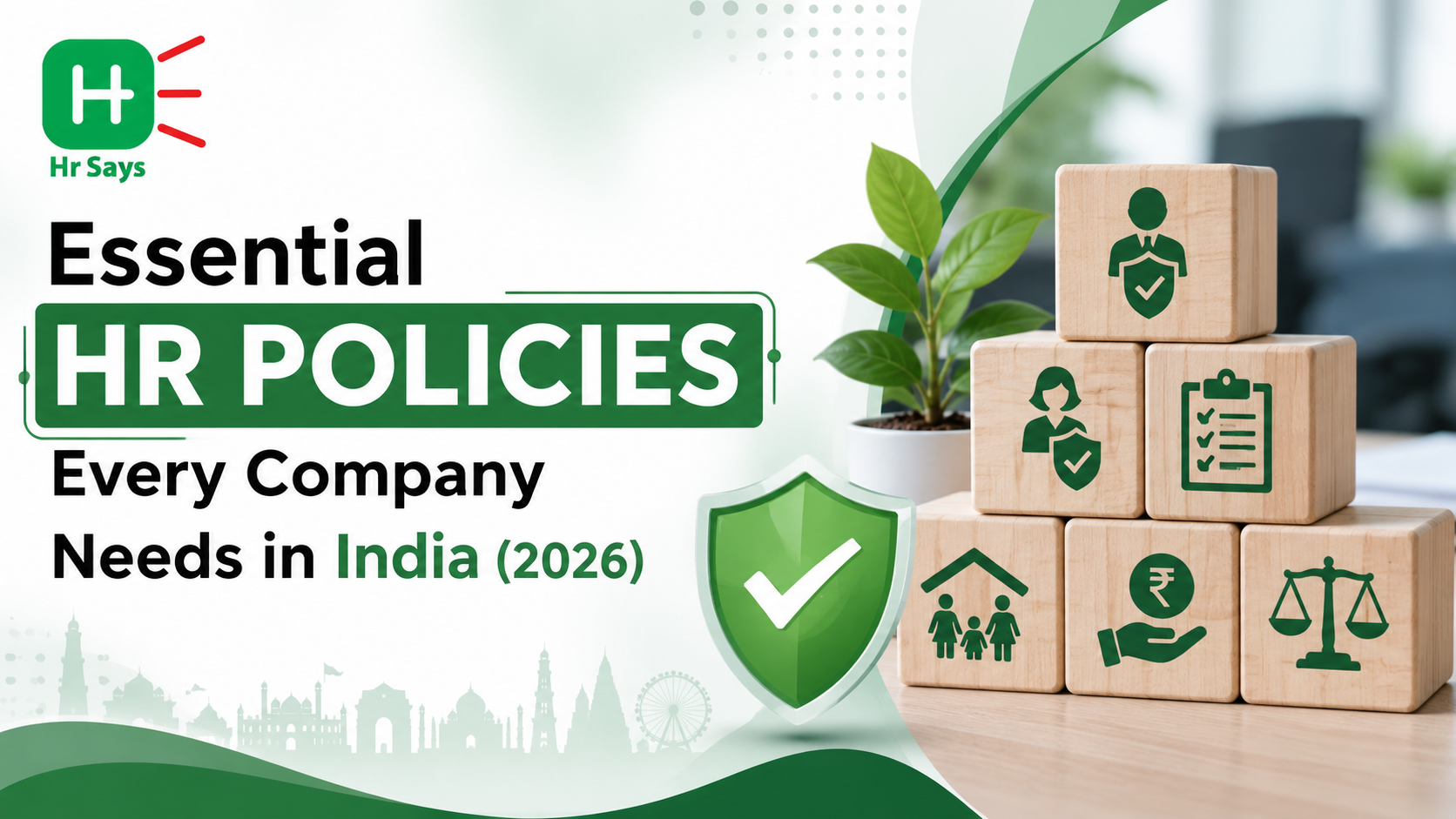
 This guide outlines the essential HR policies Indian companies need in 2026, covering legally mandatory requirements like POSH and equal opportunity, alongside operational and emerging policy areas for compliant, well-managed workplaces.





Every organisation, whether a five-person startup or a five-thousand-person enterprise, runs on decisions about people. Who gets hired, how leave is granted, what happens when a dispute arises, and how an employee exits the company are not one-time events. They are recurring situations that need consistent answers. HR policies exist to provide those answers before the situation arises, not after.
In India, this is not simply good practice. It is also a legal necessity. With the four new Labour Codes now shaping the compliance landscape alongside long-standing laws such as the POSH Act and the Payment of Wages Act, companies that operate without documented policies are exposed to real risk. This guide walks through the HR policies that matter most for Indian organisations in 2026, why each one matters, and how to think about building a policy framework that actually works in practice rather than sitting unread in a folder.
Why HR Policies Matter More Than Most Founders Realise
Many founders and business owners think of HR policies as paperwork that can wait until the company is larger. This thinking often backfires. A missing POSH policy, an undefined leave structure, or an unclear termination process tends to surface exactly when it is most costly, during a dispute, an audit, or a sudden resignation.
Well-written policies do three things at once. They protect the company legally, they give employees clarity about what to expect, and they help managers make consistent decisions instead of relying on personal judgment case by case. Research on workplace clarity has repeatedly shown that a large share of employees do not feel confident about what is expected of them at work. Policies close that gap.
For growing Indian companies specifically, policies also become the backbone of the employee handbook, the reference point during onboarding, and the document that HR and legal teams turn to when a difficult situation needs to be resolved fairly.
Legally Mandatory HR Policies in India
Certain policies are not optional. They are required by law, and the absence of a written policy can itself become a compliance failure during an inspection or a legal dispute.
Prevention of Sexual Harassment (POSH) PolicyUnder the Sexual Harassment of Women at Workplace Act, 2013, every organisation in India, regardless of size, must have a POSH policy along with a functioning Internal Complaints Committee. The policy should clearly define what constitutes sexual harassment, describe the complaint process, and specify how the committee is composed and how confidentiality is maintained throughout an investigation.
Many smaller companies assume this requirement applies only to larger firms. It does not. Even a team of five employees is covered under the law, and the absence of a policy or committee is a direct violation.
Equal Opportunity and Non-Discrimination PolicyCompanies with twenty or more employees are required under the Rights of Persons with Disabilities Act, 2016, along with constitutional non-discrimination principles, to maintain an equal opportunity policy. This should address non-discrimination in hiring, promotions, compensation, and daily treatment, covering gender, religion, caste, disability, and other protected characteristics.
Beyond the legal requirement, this policy signals to employees and job seekers that the organisation takes fairness seriously, which increasingly influences hiring outcomes in a competitive Indian job market.
Payment of Wages and Compensation PolicyUnder the Payment of Wages Act and the newer Code on Wages, 2019, employers must clearly define pay schedules, salary structure, overtime calculations, and permissible deductions. For companies with fewer than one thousand employees, wages must generally be disbursed before the seventh of each month. A written compensation policy prevents ambiguity around bonuses, deductions, and the timing of salary revisions, which are common sources of employee grievances.
Health and Safety PolicyThe Occupational Safety, Health and Working Conditions Code, 2020, along with the older Factories Act for manufacturing units, requires organisations to maintain documented safety procedures. This includes risk assessments, emergency response protocols, fire safety measures, and processes for reporting workplace hazards or injuries. Companies with five or more employees are generally expected to have this in writing, and it becomes especially critical for manufacturing, warehousing, and field-based businesses.
Leave Policy Aligned with State LawsIndia does not have a single uniform leave law. Casual leave, earned leave, sick leave, and public holidays vary by state, and companies operating across multiple states need to account for these differences rather than applying one blanket policy nationwide. Maternity leave, governed by the Maternity Benefit Act, and the more recently discussed provisions around menstrual leave in some states, also need explicit coverage.
Core Operational HR Policies Every Company Should Have
Beyond the legally mandatory policies, a set of operational policies keeps day to day HR functioning smooth and predictable. These are not always mandated by a specific act, but their absence creates friction that compounds over time.
Code of conduct: This sets the tone for professional behaviour, ethics, and the values the organisation expects employees to uphold. It becomes the reference point when addressing conduct issues that do not clearly fall under harassment or discrimination.
Attendance and punctuality policy: This defines working hours, how late arrivals are recorded, and what happens when absenteeism becomes a pattern. Many Indian companies now manage this through Employee Self Service portals, which also creates a digital trail useful during disputes.
Grievance redressal policy: Employees need a defined, confidential channel to raise concerns, whether about a manager, a colleague, or a workplace practice. A policy that specifies response timelines, typically within a few working days, builds trust that concerns will not be ignored.
Performance management policy: This outlines how appraisals are conducted, how feedback is documented, and how promotions or corrective action follow from performance reviews. Without this, appraisals often feel arbitrary to employees, which directly affects retention.
Confidentiality and data protection policy: With India's Digital Personal Data Protection Act reshaping how organisations must handle personal data, companies need policies covering both employee data and company confidential information, including trade secrets and client information. This should specify what data is collected, how it is stored, and who has access.
Remote and hybrid work policy: As flexible work arrangements remain common across Indian tech, services, and even some manufacturing support functions, a policy addressing eligibility, communication expectations, equipment provisions, and data security for remote work has become close to essential rather than optional.
Disciplinary procedure: This describes the sequence of steps, typically starting with a verbal warning and progressing through written warnings before more serious action, ensuring consistency and giving employees a fair opportunity to correct behaviour.
Employee separation and offboarding policy: This covers resignation notice periods, exit interviews, final settlement timelines, and the return of company property. A structured offboarding process reduces disputes and protects both the departing employee and the organisation.
Emerging Policy Areas Companies Should Not Ignore
A few newer policy areas are becoming increasingly relevant for Indian companies, particularly as workplaces adopt new technology and as employee expectations shift.
Artificial intelligence use in the workplace is one such area. As employees increasingly use AI tools for drafting, analysis, and recruitment support, companies benefit from a clear policy on acceptable use, required human oversight, and how confidential information should be handled when using external AI tools.
Social media conduct is another area that continues to evolve, particularly around how employees represent the organisation online, both professionally and personally, and what constitutes a conflict with company interests.
Bring your own device arrangements, increasingly common as employees use personal laptops and phones for work, need policies covering security requirements, data access, and company rights if a device is lost or an employee exits.
Building a Policy Framework That Actually Works
Having policies documented is only half the task. A policy that sits unread in a shared drive provides little protection. A few practices make the difference between policies that function and policies that exist only on paper.
Policies should be written in plain, accessible language rather than dense legal text, so that every employee, regardless of role or seniority, can understand what applies to them. They should be communicated clearly during onboarding, with employees signing an acknowledgement that they have read and understood the handbook. Managers, particularly those handling disciplinary matters or grievances, need specific training on applying policies fairly and consistently.
Annual review is a reasonable minimum, but reviews should also be triggered by events such as a change in labour law, expansion to a new state, or significant workforce growth. With the four Labour Codes now shaping the compliance landscape, many existing policy documents across Indian companies need a fresh look to ensure wage definitions, working hour limits, and leave calculations remain aligned with current law.
Startups scaling quickly often find it useful to start with a lean but legally sound foundation, covering POSH, leave, attendance, conduct, confidentiality, and payroll, and then build out more detailed governance as the organisation grows. Larger organisations, by contrast, typically need more comprehensive documentation, clearer approval structures, and stronger internal controls given the scale of decisions being made.
This is also where the conversations happening across the HR community add real value. Understanding how other HR leaders and organisations are approaching policy design, compliance updates, and workplace culture helps professionals avoid reinventing the wheel and instead apply practices that have already been tested across similar organisations.
Conclusion
HR policies are not bureaucratic overhead. They are the operating rules that let a company treat people fairly, respond to disputes consistently, and stay within the boundaries of Indian labour law. For a small business, the priority is a lean set covering POSH, leave, attendance, wages, and conduct. For a growing or established organisation, the framework needs to expand into performance management, data protection, remote work, and disciplinary procedures, all kept current with the evolving Labour Codes.
The organisations that treat policy building as an ongoing practice, rather than a one-time document exercise, tend to see fewer disputes, more consistent management decisions, and a workplace culture that employees genuinely trust.
Frequently Asked Questions
Q1: What are the most important HR policies a small business in India should start with?
A small business should begin with a POSH policy, a leave and attendance policy, a code of conduct, a payment of wages policy, and a basic health and safety policy. These cover the most immediate legal requirements and set clear expectations for a small team.
Q2: Is a POSH policy mandatory for all companies in India regardless of size?
Yes. Under the Sexual Harassment of Women at Workplace Act, 2013, every organisation in India must have a POSH policy and an Internal Complaints Committee, irrespective of the number of employees.
Q3: How often should companies review and update their HR policies?
HR policies should be reviewed at least once a year, and additionally whenever labour laws change, the company expands to a new state, or the workforce grows significantly.
Q4: Do India's new Labour Codes change how HR policies should be written?
Yes. With the four Labour Codes now in effect, companies need to revisit wage definitions, working hour limits, leave calculations, and social security provisions to ensure existing policies align with the consolidated framework.
Q5: Can a startup use generic HR policy templates instead of custom policies?
Templates are a useful starting point, but they should always be adapted to the company's state of operation, industry, workforce size, and specific risks. Generic templates alone may miss state-specific leave rules or sector-specific safety requirements.