 Monday, September 28, 2026
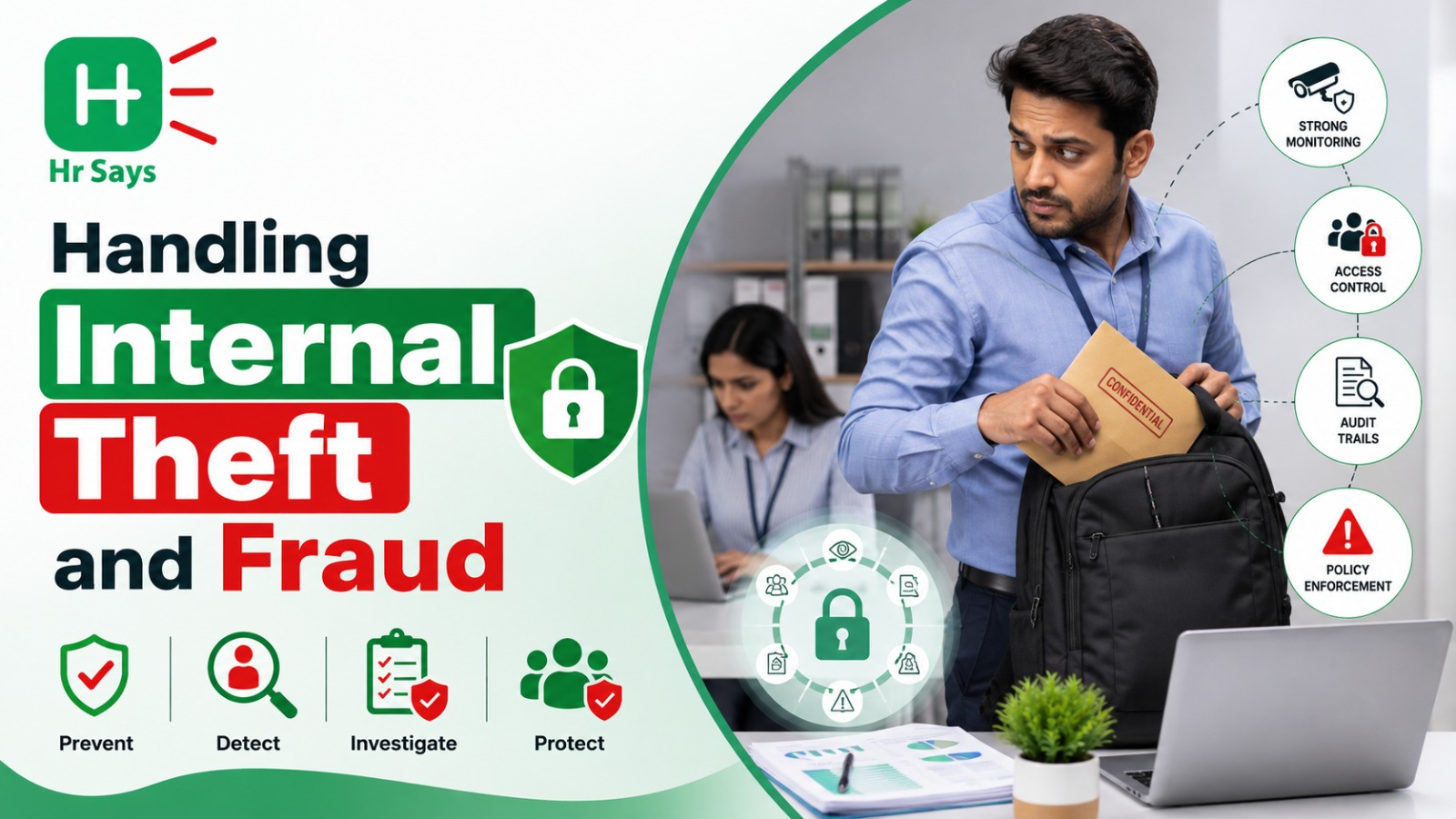
 Managing workplace fraud requires evidence preservation, impartial domestic enquiries, natural justice, documented findings, and coordinated legal action to protect organizational assets while ensuring fair, legally defensible employee disciplinary procedures.




Internal theft, embezzlement, data exfiltration, and financial fraud represent severe operational risks to any commercial enterprise. Beyond immediate financial loss, unaddressed workplace misconduct undermines organizational culture, degrades trust, and creates potential regulatory liabilities.
However, terminating an employee accused of fraud without strictly following legal procedures and due process can expose the organization to legal challenges, including wrongful termination claims, labor union disputes, and court-ordered reinstatement mandates with back pay.
To mitigate these risks, Legal and HR leaders must follow a structured framework that balances immediate corporate asset protection with strict adherence to legal standards and procedural fairness.
1. The Legal and Investigative Roadmap
When internal financial fraud or theft is detected, the organization must initiate a step-by-step investigation to preserve evidence and maintain procedural integrity:
2. Conducting a Legally Defensible Domestic Enquiry
A domestic enquiry is an internal, quasi-judicial proceeding designed to investigate employee misconduct while upholding the Principles of Natural Justice. Skiping or mishandling this process is the leading reason courts invalidate disciplinary terminations.
A. Appointing an Independent Enquiry OfficerThe management must appoint an unbiased Enquiry Officer—either an external legal expert or a senior internal executive completely disconnected from the department where the fraud occurred. The Officer must have no personal bias, interest in the outcome, or involvement as a witness.
B. Issuing the Charge-Sheet / Show-Cause NoticeThe charge-sheet must clearly articulate:
- Specific details of the alleged theft or fraud (dates, amounts, missing assets, altered documents).
- The specific clauses of the company's Code of Conduct, employment agreement, or Standing Orders violated.
- A clear timeline (typically 48 to 72 hours) for the accused employee to submit a written explanation.
During the formal enquiry hearings:
- Notice & Disclosure: The employee must receive copies of all documentary evidence and witness statements relied upon by management.
- Opportunity to Cross-Examine: The employee has the right to present their defense, produce supporting witnesses, and cross-examine management witnesses.
- Reasoned Findings: The Enquiry Officer must draft a detailed report outlining findings of fact based strictly on evidence presented during the hearings, evaluating guilt on the standard of preponderance of probabilities (rather than the criminal trial standard of "beyond a reasonable doubt").
3. Structural Comparison: Informal Action vs. Legally Binding Domestic Enquiry
Evaluating how uncoordinated internal actions compare to a structured, legally sound domestic enquiry highlights why organizations must follow formal protocols:
- Legal Validity: Informal terminations face high risk of being set aside by labor courts for lack of due process. Formal enquiries provide strong legal defensibility under employment laws and principles of natural justice.
- Standard of Proof: Informal actions often rely on suspicion, hearsay, or unverified managerial reports. Formal enquiries require documented evidence evaluated on a preponderance of probabilities.
- Employee Defense Rights: Informal actions offer minimal or no formal defense opportunity for the accused. Formal enquiries ensure full disclosure of evidence, witness presentation, and cross-examination rights.
- Criminal Reporting Interoperability: Informal findings lack structured documentation needed to support criminal complaints (e.g., FIRs). Formal enquiry reports provide documented evidence for law enforcement agencies.
- Financial Asset Recovery: Informal approaches rely on verbal demands that are easily contested. Formal enquiries create an official record to support legal recovery suits and civil claims.
4. Criminal Proceedings vs. Internal Disciplinary Action
Organizations facing severe fraud often navigate two parallel legal pathways: internal disciplinary proceedings and criminal reporting to law enforcement (e.g., filing a police complaint or First Information Report / FIR):
- Parallel Execution: Internal domestic enquiries and criminal proceedings can legally proceed simultaneously. The company does not need to wait for a criminal trial verdict (which may take years) to conclude internal termination proceedings.
- Protective Suspension: If the employee's presence on the floor poses a threat to ongoing investigations, evidence preservation, or physical assets, management can issue a Suspension Pending Enquiry order, paying statutory subsistence allowances as mandated by local labor legislation.
- Preserving Digital & Physical Evidence: Legal teams must maintain an unbroken chain of custody for all physical documents, forensic IT audits, database logs, and video surveillance footage to ensure admissibility in both internal hearings and court proceedings.
5. Execution Strategy: Termination Order and Recovery Protocols
Once the Enquiry Officer submits a report confirming guilt, the disciplinary authority (e.g., HR Director or Management Board) executes the final administrative actions:
- Issuing a Reasoned Order of Termination: Draft a formal dismissal letter citing the Enquiry Officer's findings. Specify that the termination is for gross misconduct involving moral turpitude, which legally waives notice period pay or severance entitlements under standard employment frameworks.
- Withholding Gratuity & Final Settlement Adjustments: Subject to regional statutory labor laws (e.g., Payment of Gratuity Act provisions in India), an employer may forfeit statutory gratuity or adjust final salary dues to the extent of financial loss suffered due to proven employee theft or fraud.
- Initiating Civil Recovery & Legal Remedies: If final settlement adjustments do not cover the full extent of financial loss, the organization can file a civil suit for financial recovery, damages, and breach of trust.
10 Frequently Asked Questions (FAQs)
Q1. Can an employee be terminated immediately without a domestic enquiry upon confessing to theft?If an employee provides a voluntary, written, and signed confession detailing the theft or fraud, a formal domestic enquiry may be waived. However, HR must verify that the confession was not obtained through coercion, duress, or threats, and issue a formal termination letter referencing the admission of guilt.
Q2. What is the standard of proof required to terminate an employee for internal fraud?Internal disciplinary proceedings do not require proof "beyond a reasonable doubt" (which is the criminal court standard). The standard of proof in a domestic enquiry is the preponderance of probabilities—meaning the evidence reasonably demonstrates that the misconduct is more likely to have occurred than not.
Q3. Can an employer withhold an employee's salary or final settlement to cover stolen funds?Subject to local labor regulations, an employer can adjust proven financial losses against final salary dues or forfeit statutory benefits (like gratuity) if the employee has been found guilty of fraud or property damage through a formal disciplinary inquiry.
Q4. What happens if the accused employee refuses to participate in the domestic enquiry?If the employee receives proper notice of the hearing dates but fails to appear without a valid medical or emergency reason, the Enquiry Officer can proceed ex-parte (in the employee's absence). All evidence must still be presented and recorded to establish guilt fairly.
Q5. Can an employee bring an external lawyer to represent them during a domestic enquiry?In standard internal domestic enquiries, employees generally do not have an absolute legal right to be represented by an external advocate or lawyer, unless company standing orders explicitly allow it or management appoints a legally qualified prosecutor. The employee is typically allowed to be assisted by a co-worker.
Q6. Is filing a police complaint (FIR) mandatory before firing an employee for theft?Filing a police complaint is not a legal prerequisite for initiating internal termination proceedings. An employer can conduct an internal investigation and terminate the employee through a domestic enquiry independently of criminal law enforcement actions.
Q7. How does "Suspension Pending Enquiry" differ from disciplinary suspension?Suspension Pending Enquiry is a temporary, non-punitive administrative measure used to keep the employee away from the workplace during an ongoing investigation. Disciplinary suspension is a formal punishment imposed after misconduct is proven through an inquiry.
Q8. What should an employer do if an employee resigns immediately after being caught committing fraud?Management is not required to accept a resignation submitted to bypass disciplinary action. The company can refuse the resignation, issue a charge-sheet, conduct the domestic enquiry, and proceed with a formal termination order if charges are substantiated.
Q9. What legal risks does an employer face if they terminate an employee without due process?Terminating an employee without following proper procedures or principles of natural justice can lead to labor court challenges, claims for wrongful termination, orders for full back pay, mandatory employee reinstatement, and public reputational damage.
Q10. How long should an organization maintain domestic enquiry records after termination?Organizations should archive all investigation files, charge-sheets, hearing transcripts, evidence logs, enquiry reports, and termination orders for at least 3 to 7 years (or until all pending litigation, labor court disputes, and criminal proceedings are fully resolved).