 Monday, October 19, 2026
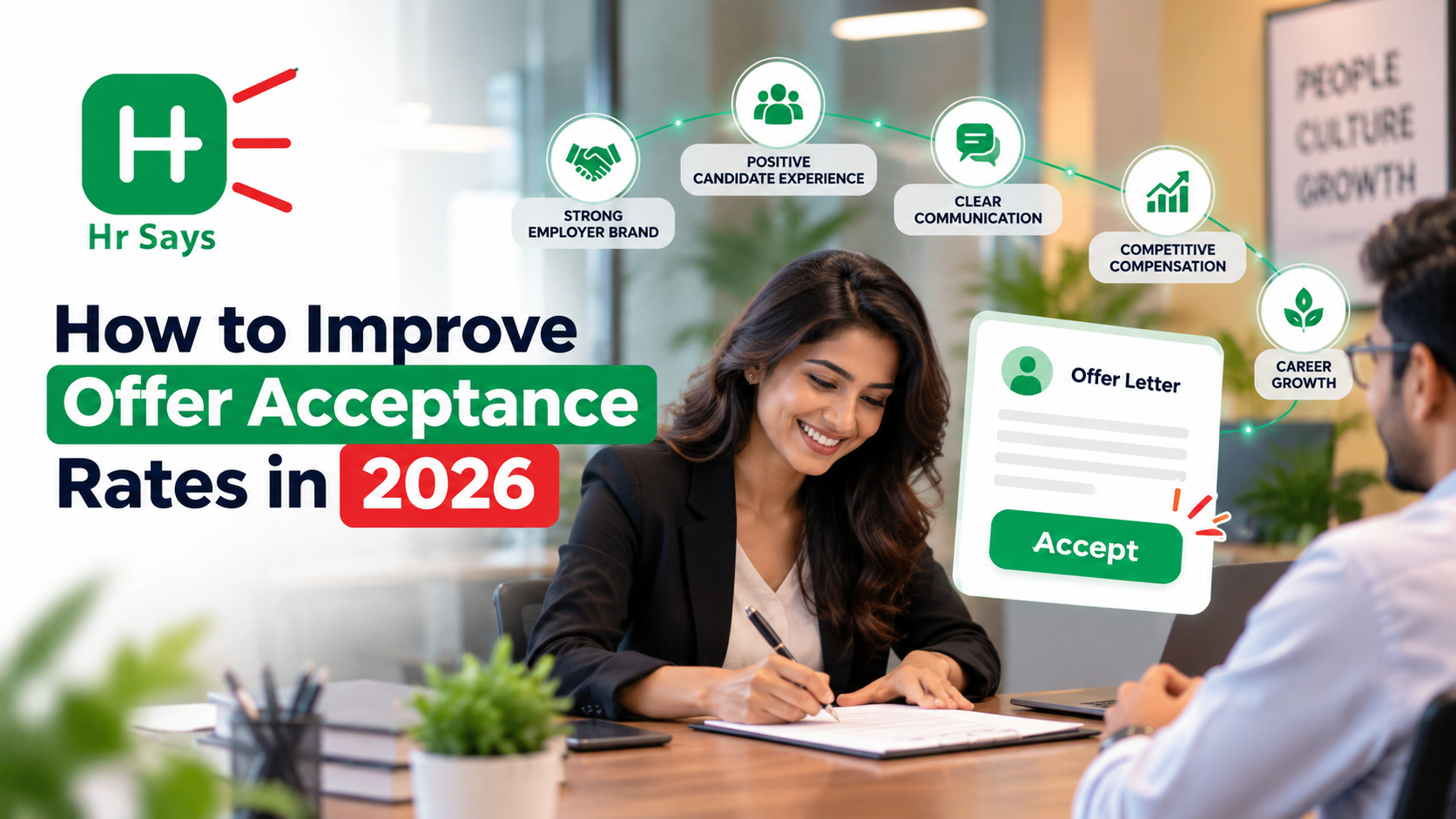
 Improving offer acceptance rates requires competitive compensation, faster hiring, strong employer branding, and proactive candidate engagement throughout the recruitment process for sustained talent acquisition success in India.




Introduction
Every recruiter knows the feeling. Weeks of effort go into sourcing, screening, and interviewing a candidate, only for the offer to be declined at the last step. For HR teams across India, improving offer acceptance rates has become one of the most pressing challenges in talent acquisition today.
The Indian job market has undergone a significant shift in recent years. Candidates, especially in sectors like technology, BFSI, and e-commerce, now hold considerably more power than they did a decade ago. Counteroffers from current employers, multiple competing offers, and rising expectations around compensation, flexibility, and career growth have all contributed to declining offer acceptance rates across industries.
For growing organizations and startups in Tier 1 and Tier 2 cities alike, a low offer acceptance rate does not just delay hiring timelines. It inflates recruitment costs, stretches existing teams, and directly impacts business productivity. Understanding why candidates decline offers and what HR teams can do differently is no longer optional. It is a strategic imperative.
Understanding Offer Acceptance Rates and Why They Matter
The offer acceptance rate is the percentage of job offers that candidates formally accept out of the total number of offers extended by an organization within a given period. A higher offer acceptance rate indicates that the recruitment process is well-aligned with candidate expectations, while a lower rate signals gaps in compensation, communication, culture fit, or candidate experience.
In the Indian context, industry benchmarks for offer acceptance rates vary significantly. Technology companies, particularly those competing for mid-level and senior engineering talent in cities like Bengaluru, Hyderabad, and Pune, often witness lower acceptance rates due to intense market competition. In contrast, sectors such as manufacturing, healthcare, and education tend to see relatively higher acceptance rates, partly because candidate mobility is lower and competing offers are fewer.
HR professionals should track this metric consistently alongside related data points such as offer-to-joining ratio, candidate drop-off stage, and counteroffers received. These numbers together tell a far more complete story about where the recruitment funnel is losing momentum.
Key Reasons Why Candidates Decline Job Offers
Before organizations can meaningfully improve offer acceptance rates, they need to understand what drives candidates to say no. Several common reasons surface repeatedly in post-decline feedback across Indian organizations.
Compensation misalignment remains the single most frequent reason for offer rejections. When the offered package does not match a candidate's current compensation, market expectations, or a competing offer they hold, the decision to decline becomes straightforward. This is particularly visible in the technology and product sectors, where salary benchmarks move rapidly.
A slow or unclear hiring process also damages offer acceptance. When candidates experience long gaps between interview rounds, delayed feedback, or vague timelines, they naturally lose confidence in the organization. In a market where competing companies often move faster, a drawn-out process can push a candidate toward an employer who communicates better.
Role clarity is another underappreciated factor. Candidates who feel the job description was not accurately reflected in the interview conversations, or who are unsure about their actual responsibilities and growth trajectory, often choose to decline rather than take the risk. This is especially true for experienced professionals who are making lateral or upward career moves.
Finally, employer brand perception matters enormously. Candidates today research organizations thoroughly on platforms such as LinkedIn, Glassdoor, AmbitionBox, and through their own professional networks before making a decision. A company with poor reviews around work culture, management practices, or work-life balance faces an uphill battle at the offer stage regardless of how competitive the package is.
Strategies to Improve Offer Acceptance Rates
Align Compensation with Current Market BenchmarksCompetitive compensation is the foundation of any successful offer. HR teams should invest in regular salary benchmarking using credible sources such as compensation surveys from Mercer, Aon, or industry-specific studies. Organizations should also track what competitors are offering for equivalent roles and ensure the package structure, including fixed pay, variable components, and benefits, is competitive and clearly communicated to candidates.
In India, non-monetary benefits are gaining increasing importance. Health insurance with family coverage, flexible work arrangements, performance-linked bonuses, and learning and development budgets are now key considerations for candidates evaluating offers, especially in the post-pandemic workforce landscape.
Accelerate and Simplify the Hiring ProcessSpeed is a competitive advantage in recruitment. When organizations reduce the time between the final interview and the offer letter, they significantly reduce the window during which candidates can receive and consider competing offers. HR leaders should map their hiring timelines carefully and identify which stages introduce unnecessary delays.
Structured hiring frameworks, where interview rounds are predefined and interviewers are aligned on evaluation criteria from the start, allow organizations to move faster without compromising the quality of their hiring decisions. Digital tools for scheduling, assessments, and offer letter generation can further reduce administrative delays.
Build a Stronger Candidate Experience Throughout the ProcessThe candidate experience begins long before the offer is extended. Every touchpoint in the recruitment journey, from the initial job application to interview scheduling, feedback communication, and pre-offer conversations, shapes how a candidate perceives the organization.
HR professionals and hiring managers should communicate consistently, provide timely feedback after each round, and treat candidates with the same respect they would extend to existing employees. This is not just a courtesy. It is a direct investment in offer acceptance.
Organizations that assign a dedicated recruiter or HR point of contact to each candidate throughout the process consistently see better engagement and fewer last-minute declines.
Have Honest Conversations About Competing OffersMany HR teams still hesitate to ask candidates directly whether they are evaluating other opportunities. This reluctance can be costly. A proactive conversation about competing offers allows recruiters to understand where they stand, address gaps early, and tailor the offer to be more compelling where possible.
This does not mean engaging in bidding wars with every candidate. It means having informed, respectful, and transparent discussions about what the candidate values most and whether the organization can meet those expectations. Candidates appreciate this directness, and it builds trust during what is often a stressful decision-making period for them.
Use Pre-Offer and Post-Offer Engagement EffectivelyThe period between the verbal offer and the formal acceptance is fragile. During this window, candidates are most susceptible to counteroffer conversations with their current employer and discussions with other companies they may be in conversation with.
Proactive engagement during this phase is critical. This can take the form of a welcome call from the hiring manager, an introduction to future colleagues, a clear onboarding timeline, or even a small gesture such as a congratulatory message from the leadership team. These efforts signal to the candidate that they are already valued as part of the team before they have formally joined.
Strengthen Employer Brand VisibilityOrganizations that invest in employer branding see measurable improvements in offer acceptance rates over time. Employer branding includes how a company presents its culture, values, growth opportunities, and employee experiences across digital and professional platforms.
For Indian organizations, building a visible and authentic employer brand on LinkedIn, Glassdoor, and AmbitionBox is particularly impactful. Encouraging current employees to share genuine experiences, featuring workplace stories on the company website, and participating in HR and industry forums all contribute to a stronger employer brand that candidates encounter during their research phase.
HRSays, as a platform dedicated to workplace conversations and HR insights, provides organizations and HR leaders with a meaningful space to share their workplace culture stories, thought leadership, and employer brand narratives with a relevant professional audience.
Involve Hiring Managers More Actively in the Offer StageOne of the most effective but underused strategies to improve offer acceptance rates is involving the hiring manager directly in candidate conversations after the final interview. A personal call from the future manager, expressing genuine interest in the candidate and sharing what the team is working on, can shift a candidate's decision significantly.
Hiring managers often have insights into what motivated a candidate during the interview process. Leveraging that understanding to personalize the offer conversation, whether by highlighting specific projects, growth opportunities, or team dynamics, creates a human connection that compensation alone cannot replicate.
Measuring and Monitoring Offer Acceptance Rates Over Time
Improvement requires measurement. HR teams should set up consistent tracking of offer acceptance rates broken down by department, location, role level, and sourcing channel. This segmentation reveals patterns that aggregate data hides.
For example, an organization might discover that offer acceptance rates are strong for entry-level roles but consistently low for senior positions in a specific business unit. That finding points directly to where intervention is needed, whether it is compensation structure, management reputation, role design, or some combination of these factors.
Monthly or quarterly reviews of offer acceptance data, combined with qualitative feedback from candidates who declined offers, give HR teams the insights they need to iterate and improve their approach continuously.
Conclusion
Improving offer acceptance rates is not a one-time initiative. It is a reflection of how well an organization understands its candidates, respects their time, communicates its value, and delivers a recruitment experience worthy of the talent it is trying to attract.
For HR professionals and recruitment leaders in India, the opportunity is clear. By benchmarking compensation rigorously, building faster and more transparent hiring processes, strengthening the candidate experience at every stage, and actively engaging candidates through the offer phase, organizations can significantly improve their ability to close the right hires.
The organizations that will win the talent competition in the years ahead are not necessarily those with the largest budgets. They are the ones that understand what candidates truly value and consistently deliver that experience from the very first interaction.
Frequently Asked Questions
Q1: What is a good offer acceptance rate for Indian companies?
A good offer acceptance rate generally falls between 70 and 85 percent for most industries in India. Technology and product companies in competitive markets often see rates below this benchmark, while sectors with fewer competing employers tend to achieve higher rates. Organizations should track their own trend data over time rather than relying solely on industry averages.
Q2: How does employer branding affect offer acceptance rates?
Employer branding has a direct and measurable impact on offer acceptance rates. Candidates research companies extensively before making a decision. Organizations with positive reviews on platforms like AmbitionBox and Glassdoor, active workplace storytelling on LinkedIn, and a visible culture narrative are far more likely to receive offer acceptances, especially from passive candidates who had multiple options available to them.
Q3: How can HR teams reduce time-to-offer without lowering hiring standards?
HR teams can reduce time-to-offer by pre-aligning interviewers on evaluation criteria before the process begins, using structured interview formats, eliminating redundant interview rounds, and using digital scheduling and assessment tools to remove administrative delays. A faster process does not mean a less rigorous one. It means a more organized one.
Q4: Should HR teams ask candidates about competing offers?
Yes, and doing so proactively is strongly advisable. Understanding whether a candidate holds competing offers helps recruiters make more informed and timely decisions. These conversations, when handled with transparency and respect, also demonstrate that the organization values the candidate's time and is serious about bringing them on board.
Q5: What non-monetary factors most influence offer acceptance decisions in India?
The most commonly cited non-monetary factors include flexibility in work arrangements, quality of leadership and team culture, clarity on career growth and learning opportunities, work-life balance, and the organization's overall reputation as an employer. In Tier 1 cities particularly, candidates weigh these factors alongside compensation when evaluating competing offers.
Resources
- LinkedIn Talent Solutions India: Research and reports on recruitment trends, offer acceptance benchmarks, and candidate expectations in the Indian job market.
- Society for Human Resource Management (SHRM): Globally recognized framework and articles on talent acquisition best practices, offer management, and candidate experience.
- National HRD Network (NHRDN): India's leading HR professional body offering research, events, and publications relevant to recruitment and talent strategy.
- AmbitionBox Employer Insights: India-specific platform providing employer review data and candidate sentiment analysis useful for understanding offer decline reasons.
- Ministry of Labour and Employment, Government of India: Official data and policy updates related to employment trends, workforce participation, and labor market shifts across sectors and states.
Interlinking Keywords
offer acceptance rate, talent acquisition strategy, candidate experience, employer branding India, recruitment funnel, hiring manager best practices, employee value proposition, counteroffers in hiring, HR metrics and analytics, recruitment process improvement
Last Reviewed By
Dr. Manthan Tripathi and Hr Says Advisory Panel on 16 October 2026.
Disclaimer
The content published in this article is intended for general informational and educational purposes only. It is directed at HR professionals, recruiters, business leaders, and talent acquisition practitioners. The strategies and recommendations shared are based on widely recognized industry practices and should be evaluated in the context of each organization's specific hiring environment, industry sector, and organizational needs. HRSays does not guarantee specific outcomes from the application of any strategy mentioned in this article.