 Wednesday, November 11, 2026
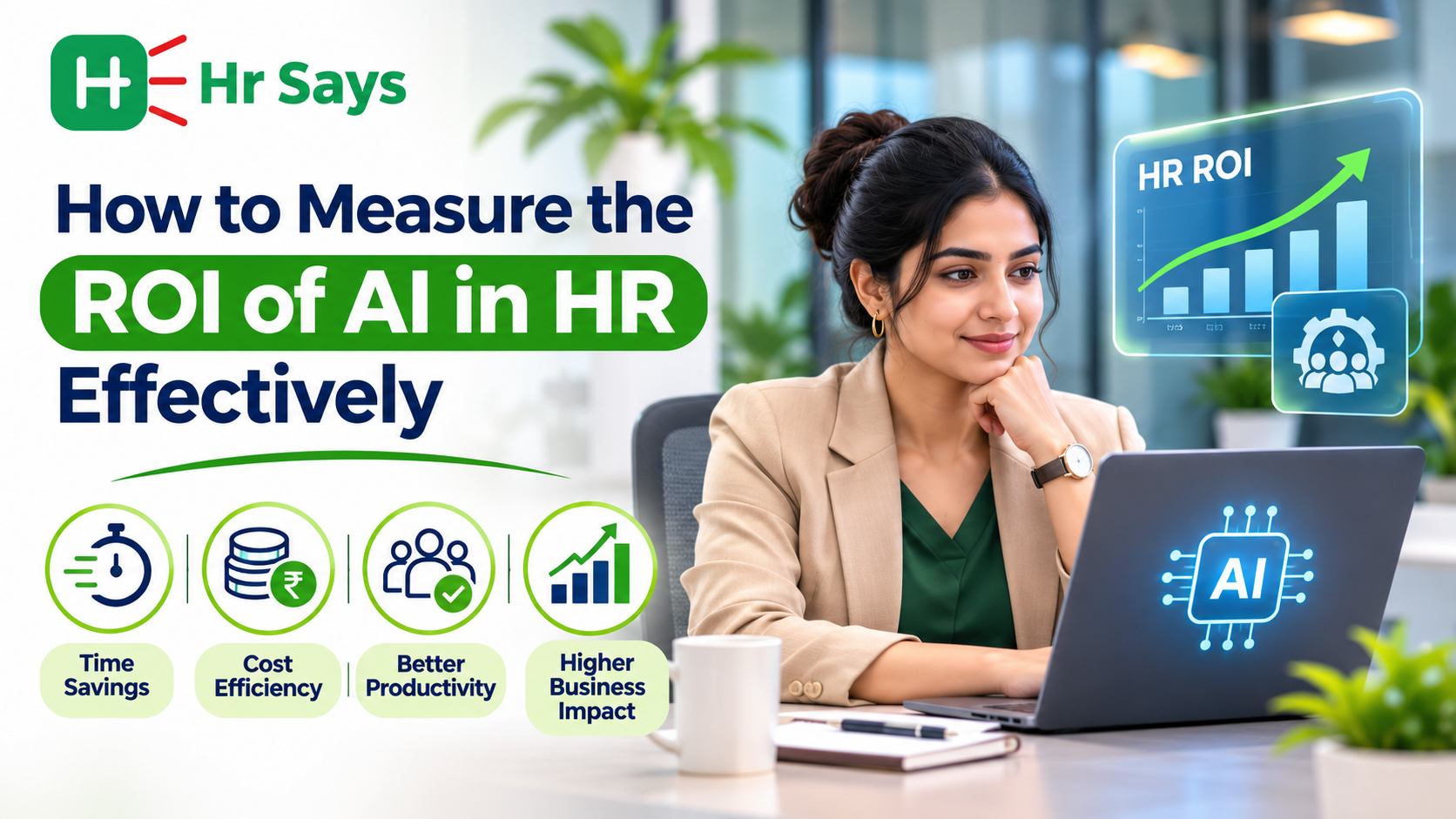
 Measuring AI ROI in HR requires baseline data, consistent metrics tracking, and honest attribution to deliver credible financial and operational insights for Indian organizations adopting HR technology.





Introduction
Artificial intelligence is no longer a distant concept in Indian workplaces. From automating resume screening to predicting employee attrition, AI tools are quietly reshaping how HR teams function across startups, mid-sized companies, and large enterprises alike. Yet for all the excitement surrounding AI adoption, one question continues to challenge HR leaders and business owners at every level: how do you actually know whether your AI investment in HR is working?
Measuring the return on investment (ROI) of AI in human resources is both a practical necessity and a strategic discipline. Without a clear framework to evaluate outcomes, organizations risk making decisions based on vendor promises rather than evidence. The Indian HR technology market is growing rapidly, with platforms offering solutions for hiring, onboarding, payroll, engagement, and compliance. But investing in these tools without measuring their impact is like running a business without reviewing financial statements.
This article provides HR professionals, CHROs, founders, and business leaders with a structured approach to measuring the ROI of AI in HR, with specific relevance to the Indian workplace context.
Understanding AI in HR and Why ROI Measurement Matters
Before measuring ROI, it is important to understand what AI actually does within the HR function. In the Indian context, AI-powered HR tools are deployed across a range of use cases.
- Automated candidate screening and shortlisting in high-volume recruitment
- Chatbots handling employee queries related to leave, payroll, and policy
- Predictive analytics identifying employees at risk of leaving
- AI-driven learning and development platforms recommending training modules
- Natural language processing tools analyzing employee engagement survey responses
- Automated payroll calculations and statutory compliance checks
Each of these functions can generate measurable value. However, ROI measurement matters not just for financial accountability but also for strategic decision-making. Indian companies, particularly those scaling rapidly in sectors like technology, manufacturing, logistics, and retail, need to know which AI tools are genuinely improving outcomes and which are adding cost without proportional benefit.
According to reports from industry bodies such as NASSCOM, India's HR technology adoption has seen a sharp rise since 2022, with companies in metros and Tier 1 cities leading investment in AI-powered people management platforms. Measuring ROI ensures these investments are purposeful and scalable.
Establishing a Baseline Before Deployment
One of the most common mistakes organizations make is deploying AI tools without documenting the status quo first. ROI measurement is fundamentally a before-and-after exercise. Without a reliable baseline, it is impossible to attribute improvements to AI adoption rather than other organizational changes.
HR teams should capture baseline data across the following areas before introducing any AI solution.
Recruitment metrics: Average time-to-hire, cost-per-hire, number of HR hours spent per hiring round, and offer acceptance rates.
Employee operations metrics: Average resolution time for employee queries, number of HR staff handling routine queries per week, and frequency of payroll errors.
Retention and engagement metrics: Employee attrition rate by department and tenure, scores from engagement surveys, and absenteeism rates.
Learning and development metrics: Training completion rates, average time spent on mandatory compliance training, and skill gap data from performance reviews.
Documenting these numbers before going live with an AI tool creates the foundation for a credible ROI calculation later. This step is especially important for Indian companies where HR data infrastructure may not be fully standardized across departments or business units.
Key Metrics to Measure AI ROI in HR
Once a baseline is in place and AI tools have been deployed for a sufficient period (typically three to six months), HR leaders can begin tracking the following categories of metrics.
Cost SavingsCost savings are the most direct measure of ROI. For each AI-powered function, the question to ask is: how much money is being saved compared to the previous approach?
In recruitment, AI-driven screening can reduce the number of hours HR professionals spend reviewing resumes manually. If an organization previously spent 20 hours per hiring cycle on manual screening and AI reduces this to four hours, the saving can be converted into rupee value based on the blended cost of HR staff time.
For payroll processing, AI tools with built-in compliance checks for Provident Fund (PF), Employee State Insurance (ESI), Professional Tax, and TDS calculations reduce the risk of errors and penalties. Each avoided compliance penalty is a direct cost saving that can be attributed to the AI investment.
Time Efficiency GainsTime saved by HR teams is a valuable output even when it does not translate directly into headcount reduction. When HR professionals spend fewer hours on administrative tasks, they can redirect that time toward strategic work such as culture building, performance management, and employee development.
A practical way to measure time efficiency is to track the average time taken to complete specific tasks before and after AI implementation. For example, if an AI-powered chatbot reduces the average time to resolve a leave-related employee query from 48 hours to two hours, this improvement can be quantified and used in the ROI calculation.
Quality of HireAI tools used in recruitment can improve the quality of candidates who reach the interview stage by applying more consistent screening criteria. Quality of hire can be measured through 90-day performance ratings of new joiners, retention rates at the six-month and one-year marks, and hiring manager satisfaction scores.
If AI-screened hires consistently outperform historically hired employees on these measures, it reflects a meaningful ROI that goes beyond cost and time savings.
Employee Engagement and RetentionAttrition is one of the most expensive HR challenges for Indian companies, particularly in sectors like IT services, e-commerce, and manufacturing. When AI tools help HR teams identify at-risk employees earlier and enable targeted interventions, the resulting reduction in attrition generates significant financial savings.
The cost of replacing an employee typically ranges from 50 percent to 200 percent of their annual salary when factoring in recruitment, onboarding, lost productivity, and training costs. If predictive AI tools help reduce attrition by even a few percentage points in a mid-sized organization, the ROI can be substantial.
Compliance and Risk ReductionIn India, HR compliance spans multiple labour laws including the Industrial Disputes Act, the Shops and Establishments Act, the Maternity Benefit Act, and more recently the provisions under the four Labour Codes that are being rolled out across states. AI tools that automate compliance tracking and generate alerts for statutory deadlines reduce the risk of penalties, legal notices, and audit failures. The avoided cost of non-compliance is a legitimate ROI component.
The ROI Calculation Framework
A straightforward formula for measuring AI ROI in HR is as follows.
AI ROI (%) = [(Total Benefits Gained - Total AI Investment Cost) / Total AI Investment Cost] x 100
Total benefits include all quantifiable gains across cost savings, time savings converted to monetary value, avoided compliance penalties, and attrition-related savings. Total AI investment cost includes software licensing fees, implementation costs, training costs for HR staff, and ongoing maintenance or subscription charges.
For example, if an Indian company with 500 employees invests INR 15 lakhs per year in an AI-powered HRMS platform and achieves INR 35 lakhs in quantifiable savings through reduced hiring costs, lower attrition, and avoided compliance penalties, the ROI would be approximately 133 percent.
This formula works best when benefit calculation is conservative and evidence-based rather than aspirational. HR leaders should document how each benefit figure was arrived at to maintain credibility when presenting ROI findings to leadership or the board.
Measuring Intangible Benefits
Not all returns from AI in HR are easy to quantify, but they still matter. These include improvements in the HR team's ability to focus on strategic priorities, higher employee trust in HR responsiveness, faster onboarding experiences, and better alignment between people data and business planning.
A practical approach to capturing these benefits is through structured internal surveys. Asking employees and managers to rate their experience with specific HR processes before and after AI implementation provides qualitative evidence that complements the financial ROI data. HR teams can use a simple Net Promoter Score (NPS) approach for HR services to track shifts in employee satisfaction over time.
Common Mistakes to Avoid When Measuring AI ROI in HR
Several errors can undermine the credibility of an ROI analysis.
- Measuring too early: AI tools often require three to six months before delivering consistent results. Evaluating ROI within the first few weeks will likely underrepresent the actual impact.
- Ignoring adoption rates: If only 30 percent of HR staff or employees are using the AI tool consistently, the results will not reflect the tool's true potential. Adoption data should always accompany ROI reporting.
- Attributing all improvements to AI: Other organizational changes such as new leadership, revised policies, or business growth can also influence HR metrics. ROI reporting should acknowledge these variables rather than attributing everything to the AI platform.
- Overlooking hidden costs: Integration challenges, data migration, staff retraining, and change management efforts all carry real costs that must be included in the investment side of the formula.
Aligning AI ROI with Business Goals
For HR leaders operating within the Indian corporate environment, the most compelling ROI presentations are those that connect HR outcomes to broader business performance. If AI-driven hiring improvements reduce time-to-fill for critical roles by 40 percent, the downstream impact on project delivery timelines and revenue generation can be estimated and included in the ROI narrative.
Platforms like HRSays play an important role in this landscape by creating spaces where HR professionals can share real-world experiences with AI tools, exchange benchmarks, and learn from peers who have navigated similar adoption challenges. Access to community knowledge and practitioner insights can accelerate the ROI journey by helping HR leaders avoid known pitfalls and identify proven approaches faster.
Conclusion
Measuring the return on investment of AI in HR is not a one-time exercise. It is an ongoing discipline that requires baseline documentation, consistent data collection, honest attribution, and regular review. For Indian organizations navigating a complex regulatory environment and a rapidly changing talent landscape, AI tools offer genuine value. But that value is only realized and sustained when HR leaders have the tools and frameworks to measure, communicate, and optimize outcomes with clarity.
The question is not whether AI in HR delivers ROI. The question is whether your organization has built the measurement infrastructure to see it clearly.
Frequently Asked Questions
Q1: What is the ROI of AI in HR?
The ROI of AI in HR is the measurable return an organization gains from deploying artificial intelligence in HR functions, calculated by comparing financial and operational benefits such as reduced hiring costs, lower attrition, and time savings against the total cost of AI implementation and maintenance.
Q2: How do you calculate AI ROI in human resources?
AI ROI in HR is calculated by subtracting the total cost of the AI investment from the total quantifiable benefits and dividing the result by the total investment cost. Multiplying this figure by 100 gives the ROI percentage. Benefits should include direct cost savings, time savings converted to monetary value, and avoided penalties.
Q3: What metrics are most useful for measuring AI effectiveness in HR?
The most useful metrics include time-to-hire, cost-per-hire, employee attrition rate, HR query resolution time, payroll error rate, training completion rates, and engagement survey scores. Tracking these before and after AI deployment allows for a credible comparison.
Q4: Is AI investment in HR worth it for Indian companies?
Yes, particularly for companies dealing with high hiring volumes, complex multi-state compliance requirements, and attrition challenges. Indian companies in sectors like IT, manufacturing, e-commerce, and logistics have reported measurable gains in efficiency and compliance accuracy after adopting AI-powered HR tools.
Q5: What are the biggest challenges in measuring AI ROI in HR?
The main challenges include the absence of baseline data before deployment, difficulty in quantifying qualitative improvements, low adoption rates among HR staff or employees, attributing results accurately to AI versus other organizational changes, and failing to account for all implementation costs.
Resources
- NASSCOM: Reports and research on HR technology adoption and AI trends in the Indian IT and business services sector.
- Ministry of Labour and Employment, Government of India: Official guidance on labour laws, the four Labour Codes, and statutory compliance requirements relevant to Indian HR teams.
- Society for Human Resource Management (SHRM): Frameworks and research on HR metrics, analytics, and AI adoption in people management.
- NITI Aayog: Policy papers and reports on digital transformation and workforce development in India.
- PubMed and Google Scholar: Academic research on AI effectiveness in organizational management and human resource outcomes.
Interlinking Keywords
AI in HR, HR technology India, employee attrition prediction, cost-per-hire metrics, HR analytics framework, AI-powered HRMS, HR ROI calculation, workforce automation India, HR compliance automation, employee engagement tools
Last Reviewed By
Dr. Manthan Tripathi and Hr Says Advisory Panel on 7 November 2026.
Disclaimer
This article is intended for informational and educational purposes only. It does not constitute professional financial, legal, or HR advisory guidance. Organizations should consult qualified HR consultants, legal advisors, and technology specialists before making decisions about AI tool investments or compliance practices. The metrics, formulas, and frameworks described are general references and may need to be adapted to suit individual organizational contexts and applicable laws.