 Monday, October 26, 2026
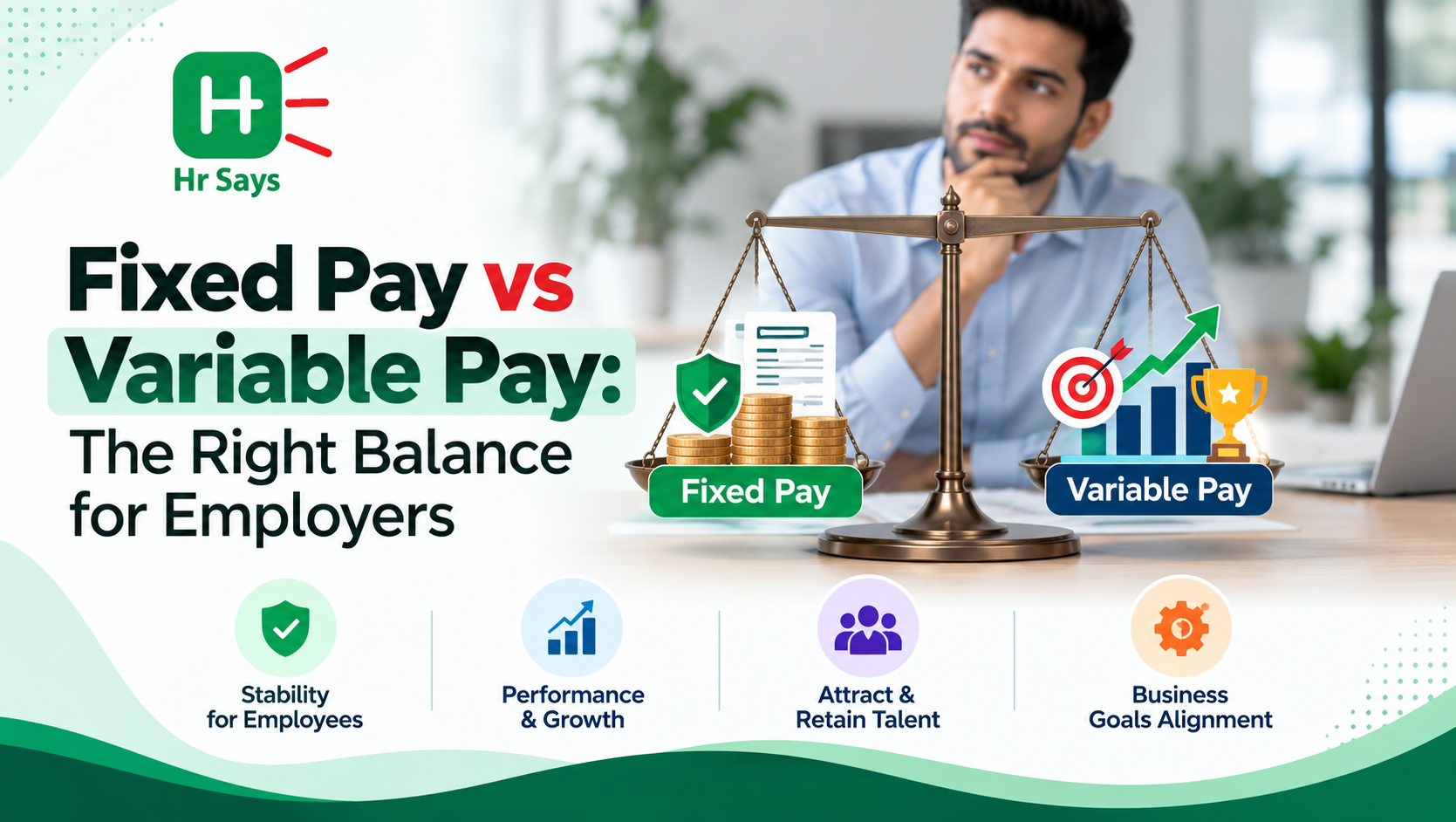
 Balancing fixed and variable pay requires clear compensation philosophy, role-based segmentation, legal compliance, and transparent communication to drive performance and retain talent effectively in India.





Introduction
Compensation is one of the most consequential decisions any employer makes. It shapes how talent perceives an organization, how motivated employees feel from month to month, and whether high performers choose to stay or move on. Among the many structural decisions within compensation design, the balance between fixed pay and variable pay stands out as particularly significant and, for many HR leaders, persistently challenging.
In India, this conversation has become even more layered. With a workforce spanning legacy public sector values, fast-scaling startup cultures, mid-market enterprises, and global multinationals, there is no single compensation model that fits all contexts. Employees in Tier 1 cities like Bengaluru, Mumbai, and Hyderabad often evaluate job offers with a keen understanding of CTC breakups, while those in Tier 2 cities may prefer greater salary predictability. Meanwhile, organizations are under pressure to remain competitive on talent costs while still driving measurable performance outcomes.
Understanding how to design a compensation structure that appropriately weighs fixed and variable components is not just an HR exercise. It is a strategic business decision.
Understanding Fixed Pay and Variable Pay
Before examining the balance, it is worth establishing what these two components actually mean in practice.
Fixed pay refers to the portion of an employee's compensation that remains constant regardless of individual or organizational performance. It typically includes the basic salary, house rent allowance (HRA), conveyance allowance, and other fixed statutory components. This is the amount an employee can count on receiving every month without any conditions attached.
Variable pay, on the other hand, is the portion tied to performance outcomes. It is contingent and earned, not guaranteed. Variable pay can take many forms depending on the industry and role:
- Performance-linked incentives or bonuses paid quarterly or annually
- Sales commissions tied to revenue targets
- Profit-sharing schemes based on company-level outcomes
- Employee stock options or long-term incentive plans (LTIPs)
- Retention bonuses or joining bonuses with clawback clauses
In India, variable pay is a recognized and widely accepted part of total CTC (cost to company) packages, and most job offers in the private sector now include some element of it. However, how much should be variable and how much should be fixed is where employer strategy genuinely matters.
Why the Balance Matters for Employers
Getting this balance wrong carries real risks in both directions.
If the fixed component is too low, employees may feel financially insecure, particularly in economic downturns or during periods when performance targets are unclear or unachievable. This dissatisfaction tends to surface first in engagement surveys and eventually in attrition data. In India, where home loan EMIs, school fees, and family financial obligations are significant for a large portion of the middle-income workforce, a low guaranteed salary can be a genuine deterrent even when the variable upside is attractive.
If the variable component is too low or too poorly designed, it loses its motivational value entirely. Employees who know they will receive the same pay regardless of what they achieve have little financial reason to go beyond the basics. This becomes a serious problem in sales, customer success, and business development roles where performance differentials between individuals can be dramatic.
The balance therefore requires employers to think carefully about what they are trying to achieve: employee security, performance motivation, cost predictability, or competitive talent positioning. Most organizations need all four, and the right structure reflects a deliberate prioritization of these goals.
Factors That Influence the Right Ratio
There is no universal formula for the fixed-to-variable ratio. The appropriate split depends on multiple factors that vary significantly across organizations and roles.
Role Function and AccountabilityRoles with clearly measurable output, such as sales, business development, collections, and field operations, are natural candidates for a higher variable component. The linkage between effort, output, and reward is direct and traceable. In contrast, roles in functions like finance, legal, operations, or HR have more diffuse output that is harder to tie directly to financial metrics, making a higher fixed component more appropriate.
Industry Norms and Competitive BenchmarkingIn sectors like BFSI (banking, financial services, and insurance), FMCG, and IT services in India, variable pay norms are well established. Sales professionals in BFSI routinely operate on structures where 30 to 50 percent of CTC is variable. Technology companies often use stock-based compensation and annual performance bonuses. Employers who deviate too far from industry norms risk either overpaying on fixed costs or losing candidates to better-structured offers.
Organizational Stage and Cash FlowEarly-stage startups and growing companies often lean toward higher variable pay partly because it aligns employee rewards with company success and partly because it conserves cash during uncertain periods. Established enterprises with predictable revenues can afford more competitive fixed packages. HR leaders should align compensation design with the organization's financial maturity.
Employee Seniority and Risk AppetiteSenior leaders and experienced professionals generally have higher financial buffers and a greater understanding of variable pay mechanics. They are often willing to accept a larger variable component if the upside potential is meaningful. Entry-level employees and early-career professionals, however, typically need greater fixed security and may be poorly served by structures that place too much of their income at risk.
Common Compensation Models Used in India
Indian organizations typically operate within a few recognized compensation models, each reflecting a different philosophy about fixed and variable pay.
The most common structure in large Indian corporations places roughly 70 to 80 percent of CTC as fixed and 20 to 30 percent as variable. This is prevalent in IT, consulting, and manufacturing sectors. It provides stability while retaining a meaningful performance lever.
Sales-intensive organizations in sectors like insurance, real estate, and edtech often go further, with variable components reaching 40 to 60 percent of total CTC, sometimes with uncapped commission potential for top performers. This model attracts high-motivation, high-ambition profiles but can lead to high attrition if targets are consistently set too aggressively.
Some organizations, particularly in the public sector and government-linked bodies, operate almost entirely on fixed pay with incremental annual raises based on grade and tenure rather than individual performance. While this offers security, it has well-documented limitations in terms of performance differentiation.
How to Design a Compensation Structure That Works
Employers seeking to build a well-balanced compensation structure should approach it as an ongoing process rather than a one-time policy decision.
Start With a Compensation PhilosophyEvery organization should articulate a clear compensation philosophy that answers basic questions: Does the company want to pay at the median, above the median, or at the top quartile of the market? What behaviors does the compensation structure reward? How does compensation connect to business strategy? Without this foundation, compensation decisions tend to be reactive and inconsistent.
Segment Roles and Define Variable LogicNot all roles should be treated equally. Employers should segment their workforce by function and define variable pay logic separately for each category. Sales and revenue-generating roles, support and enabling functions, leadership and executive roles, and technical and specialized roles each have different performance drivers that require different incentive structures.
Set Targets That Are Challenging but AchievableOne of the most common failures in variable pay design is setting targets that employees perceive as unachievable from the outset. When this happens, the variable component stops being a motivator and becomes a source of frustration and distrust. In India, where many organizations went through severe target disruption during the pandemic years, this issue is particularly relevant. Organizations should invest time in calibrating targets carefully, ensuring they stretch performance without breaking morale.
Ensure Legal and Statutory ComplianceIn India, compensation structures must comply with the Code on Wages, 2019, which brings together the Minimum Wages Act, Payment of Wages Act, Payment of Bonus Act, and Equal Remuneration Act under a unified framework. The code mandates that wages, defined as the sum of basic pay and dearness allowance, must constitute at least 50 percent of total CTC. Employers must ensure their fixed-to-variable splits do not inadvertently breach statutory wage thresholds.
Communicate Clearly and ConsistentlyVariable pay loses its effect when employees do not understand how it is calculated, what they need to do to earn it, or when they can expect it. Transparent communication about variable pay mechanics, payout cycles, and performance measurement criteria is essential. HRSays, as a platform dedicated to workplace knowledge and HR best practices, recognizes that clarity in compensation communication is as important as the structure itself.
Conclusion
Balancing fixed and variable pay is not a one-size-fits-all challenge. It requires employers to think carefully about role design, employee expectations, legal compliance, organizational financial health, and competitive market positioning. In India's diverse employment landscape, the right balance will vary significantly between a startup in Pune, a financial services firm in Mumbai, and a manufacturing company in Gujarat.
What remains constant across all contexts is the need for intentionality. Organizations that approach compensation design with a clear philosophy, well-segmented role logic, achievable performance targets, and transparent communication tend to build stronger employee trust and more sustainable performance cultures.
For HR professionals navigating this complexity, staying informed about compensation trends, benchmarking data, and evolving regulatory frameworks is not optional. It is a core part of building workplaces where people genuinely want to perform and grow.
Frequently Asked Questions
Q1: What is the ideal fixed-to-variable pay ratio in India?
There is no single ideal ratio applicable across all industries and roles. In general, most mid-to-large Indian private sector companies maintain a ratio of 70:30 or 80:20 in favor of fixed pay. However, sales-focused organizations often flip this significantly, with variable pay reaching 40 to 60 percent of total CTC. The right ratio depends on the role, industry norms, and the organization's compensation philosophy.
Q2: Is variable pay legally mandatory in India?
Variable pay is not legally mandatory under Indian labor law. However, if an organization offers variable pay as part of the CTC, any portion that has been earned or accrued may have legal implications under the Payment of Wages Act or the Code on Wages, 2019. Organizations should ensure that variable pay terms are clearly documented in the employment contract to avoid disputes.
Q3: How does variable pay affect employee motivation?
When designed well, variable pay can significantly enhance motivation by creating a direct link between effort and reward. However, poorly designed variable structures, especially those with unclear metrics or consistently unattainable targets, can have the opposite effect and reduce morale. The motivational impact of variable pay depends heavily on how achievable the targets are and how clearly the payout mechanism is communicated.
Q4: Should startups offer higher variable pay to save on fixed costs?
Startups often use higher variable pay to manage cash flow, and this can be a reasonable strategy when the variable component is genuinely tied to upside potential that employees believe in. However, startups should be cautious about using high variable pay purely as a cost-saving measure without real performance upside, as this can be perceived as a red flag by experienced talent and lead to early attrition.
Q5: What role does variable pay play in retaining high performers?
Variable pay is a powerful retention tool when it is differentiated, meaning high performers receive meaningfully higher payouts than average performers. Generic variable pay structures where everyone receives the same percentage regardless of relative performance fail to retain top talent because the financial differentiation is absent. Organizations serious about high performer retention should ensure their variable pay design genuinely rewards performance differentiation.
Resources
- Ministry of Labour and Employment, Government of India: Information on the Code on Wages, 2019 and statutory compliance for compensation structures in India.
- Society for Human Resource Management (SHRM India): Research and benchmarking data on compensation practices, fixed-variable ratios, and pay structure trends across Indian industries.
- National HRD Network (NHRDN): Insights and publications from India's largest HR professional body covering compensation strategy, talent management, and workforce trends.
- Employees' Provident Fund Organisation (EPFO): Guidance on statutory deductions, wage definitions, and compliance requirements affecting the fixed pay component of CTC.
- PayScale India Compensation Reports: Annual compensation benchmarking data covering industry-wise salary trends and fixed-to-variable pay patterns in the Indian market.
Interlinking Keywords
compensation structure India, variable pay policy, CTC breakup meaning, performance-linked incentives, employee salary components, Code on Wages 2019, HR compensation strategy, pay for performance India
Last Reviewed By
Dr. Manthan Tripathi and Hr Says Advisory Panel on 24 October 2026.
Disclaimer
The information provided in this article is intended for general informational and educational purposes only. It does not constitute legal, financial, or professional HR advice. Compensation structures and statutory obligations vary based on organizational type, industry, applicable state laws, and individual employment contracts. Employers and HR professionals should consult qualified legal or HR consultants before making compensation-related decisions. HRSays does not assume any liability for decisions made based on the information presented in this article.