 Saturday, October 31, 2026
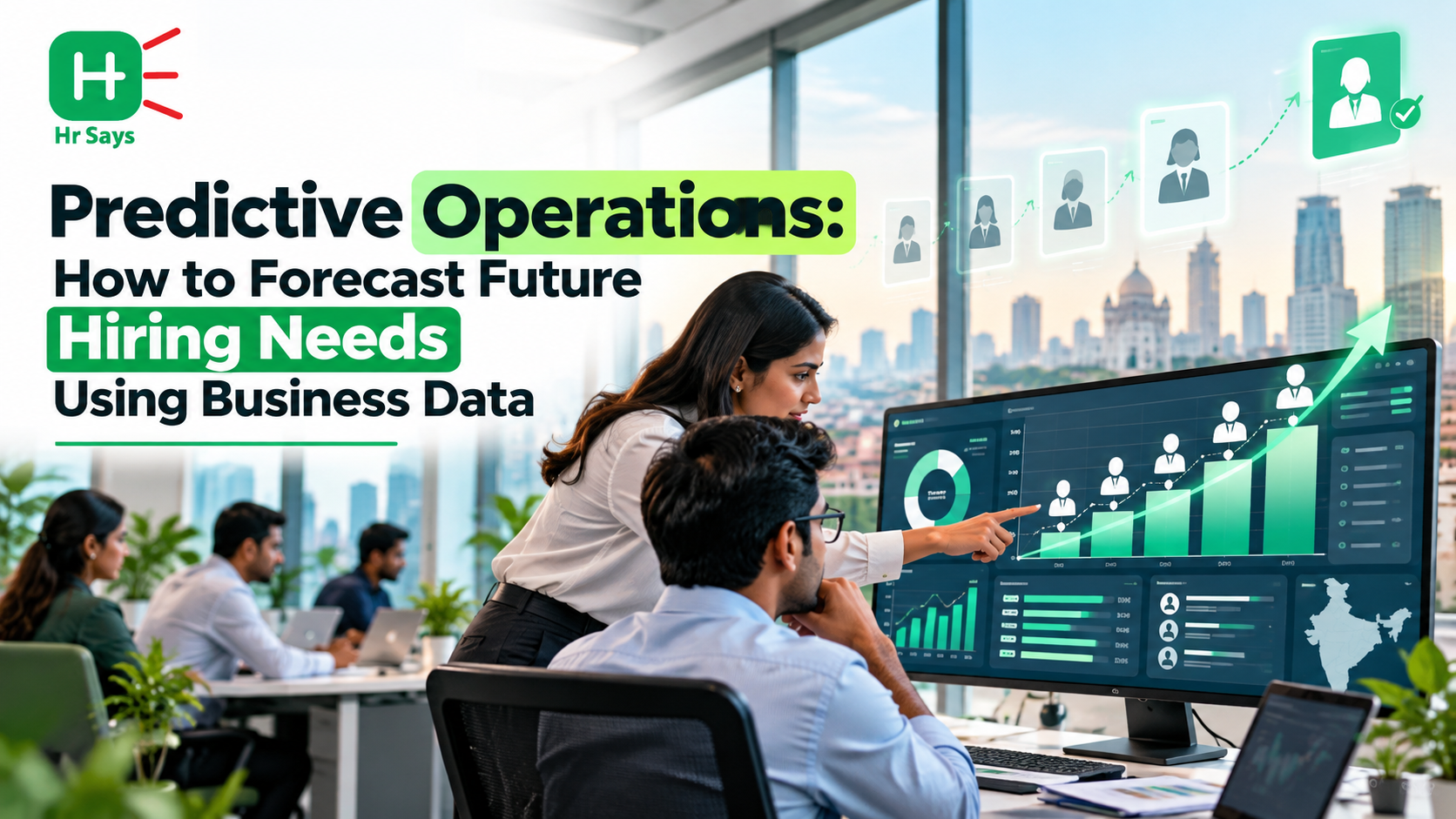
 Workforce forecasting using business data helps Indian HR leaders predict hiring needs, reduce reactive recruitment, align talent strategy with organizational goals, and build future-ready workplaces.





Introduction
Hiring the right people at the right time is one of the most critical responsibilities that any HR leader carries. Yet in many organizations across India, hiring decisions continue to be reactive. A team suddenly finds itself overwhelmed, a department leader raises an urgent request, and the recruitment process begins under pressure. This approach is not sustainable, and it often leads to poor hiring outcomes, inflated recruitment costs, and talent gaps that slow business growth.
Forecasting future hiring needs using business data is the shift that modern HR functions need to make. When organizations use structured workforce data to predict talent requirements in advance, they gain a significant competitive advantage. They can build pipelines before vacancies arise, plan budgets with accuracy, and align their workforce strategy directly with business goals.
For Indian companies navigating rapid economic growth, digital transformation, and an evolving talent landscape, workforce forecasting is no longer a best practice reserved for large corporations. It is a business necessity for organizations of every size.
Understanding Workforce Forecasting and Why It Matters
Workforce forecasting is the process of predicting how many people an organization will need, in what roles, with what skills, and by what timeline, based on current and projected business conditions. It connects people strategy to business strategy in a direct and measurable way.
The need for structured hiring forecasting has never been more urgent in India. According to industry research, India is projected to add over 11 million new workers to its formal workforce annually over the next decade. At the same time, the skills landscape is shifting rapidly due to automation, artificial intelligence, and digital adoption across sectors. Companies that continue to plan their workforce on gut instinct rather than data will increasingly find themselves either overstaffed in certain functions or critically understaffed in others.
Workforce forecasting gives HR professionals and business leaders a clear picture of future talent demand. It reduces the reactive hiring cycle, improves time-to-hire metrics, lowers recruitment costs, and allows organizations to proactively upskill existing employees before skill gaps become business problems.
Key Business Data Sources That Drive Hiring Forecasts
To forecast hiring needs accurately, HR leaders must work with multiple streams of business data. Relying on a single data point, such as revenue targets alone, often produces incomplete and inaccurate projections.
The most reliable forecasting frameworks draw from the following sources:
- Revenue and growth projections: If the business plans to grow revenue by 30 percent in the next financial year, that growth target has direct implications for headcount. Every function from sales to operations to finance will require staffing adjustments proportional to growth expectations.
- Attrition and turnover data: Historical attrition rates by department, role, and tenure reveal how many replacements an organization will need to hire just to maintain current capacity. High-attrition functions in Indian organizations, such as sales and contact centers, require significantly larger hiring buffers.
- Workforce age and tenure data: Understanding the age profile and tenure distribution of existing employees helps HR teams identify where retirement-related exits or voluntary departures are likely to cluster over the next two to three years.
- Business expansion plans: Entry into new geographies, launch of new product lines, or acquisition of new clients all create predictable spikes in hiring requirements that can be quantified in advance.
- Technology and automation roadmaps: As Indian companies adopt more automation tools and AI-powered processes, certain roles will be reduced in volume while demand for digital and technical skills will increase. Hiring forecasts must account for this evolving skill demand.
- Productivity and output metrics: Workforce ratio benchmarks, such as revenue per employee or customers served per team member, help determine how many additional people are needed as business volumes scale.
Building a Data-Driven Workforce Planning Model
Once the relevant data sources have been identified, the next step is to build a working model that translates business inputs into talent requirements. This does not need to be an overly complex process. A structured approach that even mid-sized Indian organizations can adopt is described below.
Step 1: Establish a baseline workforce inventoryBefore forecasting future needs, HR teams must know exactly what they have today. A workforce inventory should include current headcount by department, role, skill category, location, and employment type, covering permanent employees, contract workers, and gig workers.
Step 2: Define planning horizonsWorkforce planning typically works across three time horizons: short-term planning covering zero to twelve months, medium-term planning covering one to three years, and long-term planning covering three to five years. The data inputs and assumptions used will differ across each horizon.
Step 3: Map business drivers to workforce demandEach key business driver identified in the previous section should be mapped to a specific talent impact. For example, if a technology company plans to launch two new product verticals in the next eighteen months, HR can calculate the engineering, product, design, and go-to-market talent required for each vertical based on existing team structures.
Step 4: Account for supply-side constraintsForecasting demand is only half the equation. HR leaders must also assess the internal talent supply. Who within the existing workforce can be upskilled or transferred to meet emerging needs? What roles will be difficult to fill externally due to market scarcity? India faces a recognized shortage of skilled professionals in areas such as data science, cybersecurity, and advanced manufacturing, which means supply-side planning is especially important.
Step 5: Build scenario-based projectionsRather than building a single forecast, effective workforce planning uses scenario modeling. A base scenario, a high-growth scenario, and a conservative scenario allow organizations to prepare contingency hiring plans and adapt quickly when business conditions shift.
The Role of HR Analytics Tools in Accurate Forecasting
Manual spreadsheet-based workforce planning is better than no planning, but it has significant limitations in terms of scale, accuracy, and speed. Indian organizations that are serious about workforce forecasting are increasingly investing in HR analytics platforms that integrate people data with business data automatically.
HR information systems such as SAP SuccessFactors, Darwinbox, Keka, and GreytHR, which are widely used across Indian enterprises, now offer workforce analytics modules that make forecasting considerably more accessible. These tools allow HR professionals to run predictive models, monitor attrition risks in real time, and generate headcount reports that update dynamically as business data changes.
The integration of business intelligence tools such as Power BI or Tableau with HR data sources is also gaining traction among larger Indian companies. These integrations allow leadership teams to visualize workforce demand alongside financial and operational performance metrics in a single dashboard, making hiring forecasts more visible and actionable at the senior leadership level.
Common Pitfalls to Avoid in Workforce Forecasting
Even well-intentioned workforce planning efforts can produce flawed forecasts when certain mistakes are made. HR leaders should be aware of the following common pitfalls.
Relying exclusively on historical data without accounting for future business strategy changes leads to forecasts that mirror the past rather than prepare for the future. A company entering a new market segment cannot simply extrapolate past headcount growth rates to understand future needs.
Siloed planning, where HR forecasts without deep collaboration with finance, operations, and business unit leaders, produces workforce plans that lack buy-in and often miss critical business context. Effective forecasting is a cross-functional process, not an HR-only exercise.
Ignoring skill-level specificity is another frequent mistake. Forecasting that a department needs ten new hires without specifying what skills those hires must bring creates misalignment between recruitment output and business requirements.
Finally, treating the forecast as a fixed annual document rather than a living plan leads to rapid obsolescence. Business conditions change, and workforce forecasts must be reviewed and updated quarterly at minimum.
Aligning Hiring Forecasts With Broader Talent Strategy
Workforce forecasting delivers its greatest value when it is connected to the broader talent management ecosystem within an organization. Hiring forecasts should inform not only external recruitment pipelines but also internal mobility programs, learning and development investments, and succession planning efforts.
For Indian organizations operating in competitive talent markets, particularly in technology, pharmaceuticals, and financial services, forecasting can also inform employer branding priorities. When HR teams know in advance which roles will be hardest to fill, they can build targeted employer branding campaigns well ahead of active hiring needs, significantly reducing time-to-hire and cost-per-hire for critical positions.
HRSays, as a platform dedicated to advancing HR conversations in India, provides HR professionals and business leaders with the insights, frameworks, and thought leadership needed to adopt data-driven workforce planning effectively.
Conclusion
Forecasting future hiring needs using business data is not a function of having perfect information. It is a function of using the right information systematically. For Indian HR leaders, the shift from reactive hiring to proactive workforce forecasting is one of the most impactful changes they can drive within their organizations.
When business revenue data, attrition patterns, expansion plans, and skill demand signals are combined into a structured workforce planning model, organizations gain the clarity to hire ahead of need rather than in response to crisis. The result is a stronger talent pipeline, a more aligned workforce, and a people strategy that genuinely supports the business goals it is meant to enable.
Frequently Asked Questions
Q1: What is workforce forecasting and why is it important for Indian companies?
Workforce forecasting is the process of predicting an organization's future talent requirements using business data such as revenue projections, attrition rates, and growth plans. For Indian companies navigating rapid expansion and a shifting skill landscape, forecasting ensures that hiring stays ahead of business demand rather than reacting to it.
Q2: What data should HR teams use to forecast hiring needs?
HR teams should use revenue and growth projections, historical attrition data, workforce age and tenure profiles, expansion and product launch plans, technology adoption roadmaps, and productivity benchmarks. Combining these data sources produces a significantly more accurate forecast than relying on any single metric.
Q3: How often should a workforce forecast be reviewed and updated?
Workforce forecasts should be reviewed at least once every quarter. Business conditions, market shifts, and strategic priorities can change quickly, and a forecast that is only updated annually will become outdated before it can be fully acted upon.
Q4: Can small and mid-sized Indian companies also use workforce forecasting?
Yes. Workforce forecasting is not limited to large enterprises. Small and mid-sized organizations can begin with straightforward spreadsheet models that map business targets to headcount needs. The complexity of the model can grow as the business scales and as HR capabilities develop.
Q5: What is the difference between workforce planning and headcount planning?
Headcount planning is a component of workforce planning that focuses specifically on the number of people required. Workforce planning is broader and includes skill requirements, internal mobility strategies, succession planning, and the alignment of talent supply with long-term business strategy.
Resources
- Society for Human Resource Management (SHRM): Research reports and frameworks on strategic workforce planning and HR analytics for HR professionals globally.
- People Matters: India-focused HR media platform offering workforce planning insights, research, and case studies relevant to Indian organizations and HR leaders.
- NASSCOM: Data and research on India's technology talent landscape, skill demand projections, and workforce trends across the IT and digital sectors.
- Ministry of Labour and Employment, Government of India: Official data on employment trends, labor market conditions, and workforce statistics across Indian industries and states.
- Deloitte Human Capital Trends Report: Annual global research report on workforce transformation, HR analytics, and the future of work with India-specific data and insights.
Interlinking Keywords
workforce planning India, headcount planning strategy, HR analytics tools, talent forecasting framework, attrition management HR, strategic hiring plan, workforce demand analysis, employee retention data, talent pipeline building, HR data-driven decisions
Last Reviewed By
Dr. Manthan Tripathi and Hr Says Advisory Panel on 30 October 2026.
Disclaimer
The information in this article is for general informational purposes only and does not constitute professional HR, legal, or financial advice. Workforce planning practices and labor market conditions vary across organizations and may change over time. Readers are advised to consult qualified HR professionals or organizational advisors before making significant hiring or workforce planning decisions. HRSays is not liable for any actions taken based on the content of this article.