Saturday, October 10, 2026
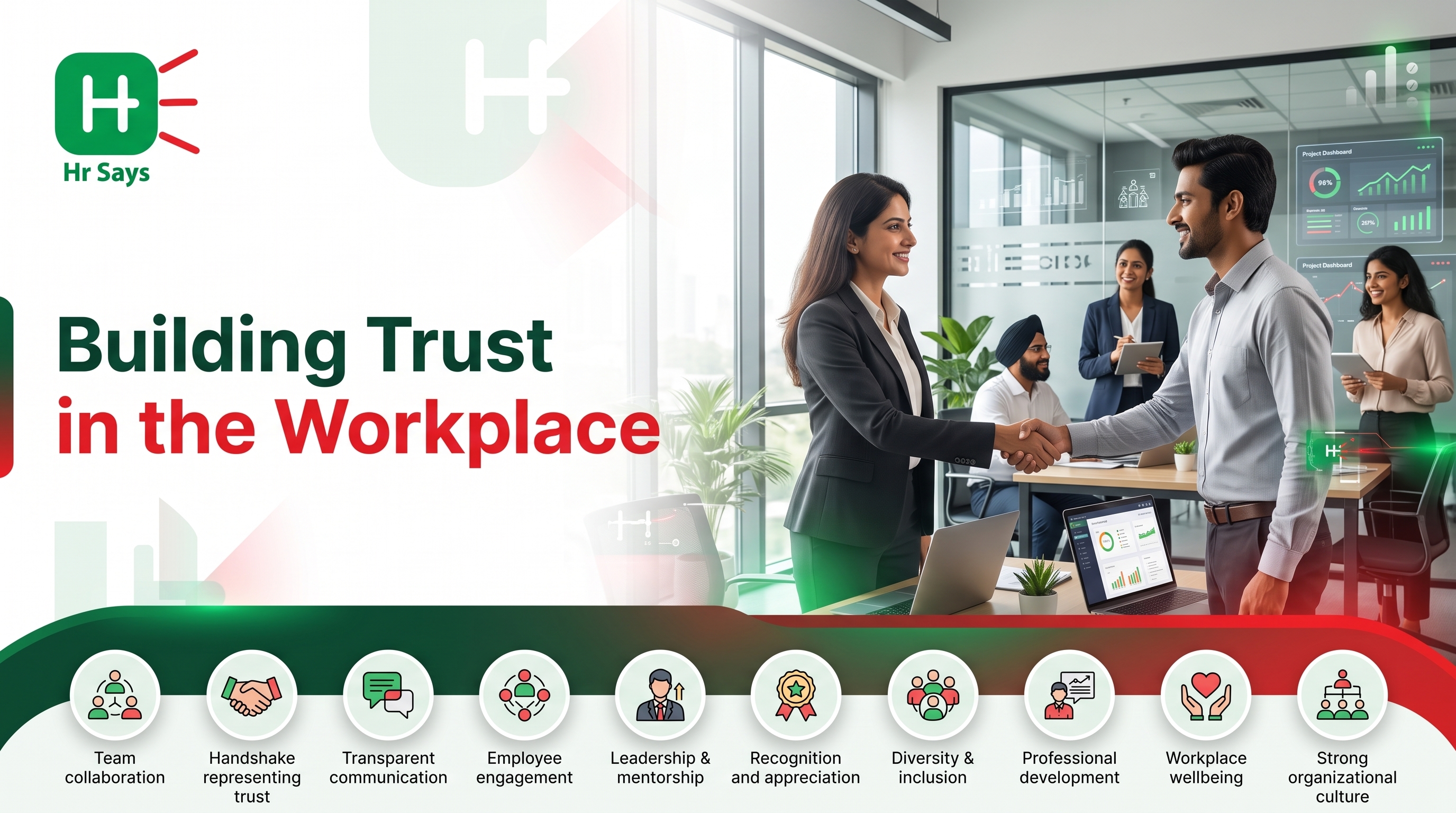
 Trust drives retention, engagement, and performance in Indian workplaces. This guide explores how HR leaders and managers can build, measure, and rebuild trust through consistent, transparent practices.




Introduction
Trust is one of those workplace qualities that is difficult to measure but impossible to miss when it is absent. Employees who trust their organization speak up more freely, collaborate without friction, and stay longer. Those who do not tend to disengage quietly, often long before they formally resign. For HR leaders, founders, and business owners across India, understanding how trust is built and rebuilt has become a genuine business priority rather than a soft skill discussion.
As Indian organizations continue to navigate hybrid work models, multigenerational teams, and rising employee expectations around transparency, trust has moved from being a cultural nicety to a measurable driver of retention, productivity, and employer reputation. This article looks at what trust actually means inside a workplace, the behaviors that build it, the common reasons it breaks down, and practical steps HR teams and leaders can take to strengthen it in a way that suits Indian workplace realities.
Understanding What Trust Means at Work
Trust in the workplace is not a single behavior. It is built from several smaller, repeated experiences that employees have with their managers, teams, and the organization as a whole. Researchers generally describe trust as resting on two core qualities: warmth and competence. Employees trust people who they believe genuinely care about them, and they trust people who demonstrate that they are capable and reliable in their role. A leader who is warm but not competent may be liked but not fully trusted to make sound decisions. A leader who is competent but shows no warmth may be respected but kept at a distance.
In an Indian workplace context, this often plays out through everyday interactions such as how a manager responds when a team member makes a mistake, whether promises around promotions or appraisals are honored, and whether feedback shared upward is genuinely acted upon. Trust, in this sense, is less about grand gestures and more about the accumulation of small, consistent signals over time.
Why Trust Matters More Than Most HR Metrics
Organizations sometimes focus heavily on engagement scores, perks, or compensation benchmarking while underestimating the role trust plays in tying all of these together. Research from workplace culture organizations has repeatedly found that trust is the strongest predictor of a high-performing workplace, often outweighing factors like pay structure or company size. When trust is low, even well-designed HR programs, from wellness initiatives to learning platforms, tend to see poor participation because employees do not believe the effort is genuine.
For Indian companies, particularly those scaling rapidly in sectors like IT, startups, manufacturing, and services, this has direct business implications. High-trust organizations typically report significantly lower attrition, since employees who trust leadership are less likely to leave over minor frustrations. They also tend to see faster onboarding of new hires, since trust reduces the friction of adapting to a new team. Given that replacing a mid-level employee in India can cost anywhere between six months to a year of that employee's salary when recruitment, training, and productivity loss are accounted for, the financial case for investing in trust becomes difficult to ignore.
The Core Behaviors That Build Trust
While trust can feel abstract, it is built through specific, repeatable behaviors that any manager or organization can practice.
Connection through genuine listening forms the foundation. Employees are far more likely to trust leaders who ask real questions and actually listen to the answers, rather than treating one-on-ones as a formality. This is particularly relevant for hybrid teams across Indian cities, where remote employees often feel disconnected from decision-making conversations happening in the office.
Psychological safety is equally important. When employees feel safe admitting mistakes, asking questions, or disagreeing with a decision, they contribute more honestly to the organization. Leaders who assume good intent, rather than immediately looking for someone to blame, tend to create teams where problems surface early instead of being hidden until they become larger issues.
Following through on commitments may be the simplest yet most frequently broken trust behavior. When a leader promises a salary revision, a role change, or a specific timeline and does not deliver, the damage to trust is often disproportionate to the size of the broken promise. If a commitment genuinely cannot be met, communicating that early is far better than allowing it to be forgotten or ignored.
Clarity in communication prevents much of the ambiguity that erodes trust in fast-growing organizations. Confusion about who owns what, unclear reporting lines, or vague expectations around performance reviews are common issues in Indian startups and mid-sized companies scaling quickly. Establishing clear roles and communicating decisions transparently reduces this friction considerably.
Recognition and appreciation round out the picture. Employees who feel their contributions are noticed, not just at annual appraisals but through regular, specific acknowledgment, tend to trust that the organization values them beyond their output alone.
Common Reasons Trust Breaks Down in Organizations
Trust rarely collapses due to one dramatic event. More often, it erodes gradually through repeated small failures that go unaddressed. Some of the most common patterns include leadership making decisions behind closed doors without explaining the reasoning, appraisal processes that feel inconsistent or unfair across teams, managers who take credit for team wins but distance themselves from failures, and inconsistent enforcement of policies where some employees appear to receive preferential treatment.
In the Indian context, hierarchical organizational structures can sometimes make it harder for employees to voice concerns upward, which means trust issues may remain invisible to leadership for longer than they should. This makes proactive listening mechanisms, rather than waiting for formal complaints, especially important.
How HR Teams Can Build Trust Systematically
Building trust cannot rest on individual managers alone. HR functions play a central role in creating the systems and processes that either support or undermine trust across an organization.
Regular, well-designed engagement surveys give employees a structured channel to share feedback, provided the results are acted upon visibly. A survey that collects feedback but produces no visible change tends to damage trust further than not surveying at all, since it signals that leadership is not genuinely listening. Transparent communication during periods of change, such as restructuring, layoffs, or leadership transitions, also matters considerably. Employees generally understand that difficult business decisions happen, but they trust organizations more when those decisions are communicated honestly rather than through rumors or delayed announcements.
Fair and consistent HR policies, particularly around compensation, promotions, and performance reviews, are another critical lever. When employees perceive that policies are applied unevenly across teams or individuals, it undermines trust in the fairness of the entire system, regardless of how well-intentioned individual managers might be. Onboarding experiences also set the tone early. A new employee's first few weeks often shape their baseline level of trust in the organization, making structured onboarding, clear role expectations, and early manager check-ins disproportionately valuable.
Rebuilding Trust After It Has Been Damaged
Trust that has been broken, whether through a layoff handled poorly, a broken promise, or a leadership misstep, can be rebuilt, though the process typically takes longer than building trust from a neutral starting point. The most effective approach begins with acknowledgment. Leaders who openly recognize what went wrong, rather than minimizing or avoiding the issue, create the conditions for repair to begin.
Consistency matters more than grand gestures during this phase. A single large initiative rarely repairs broken trust as effectively as a sustained pattern of smaller, reliable actions over several months. Creating safe channels for employees to express residual concerns, without fear of being seen as difficult or disloyal, also supports genuine repair rather than surface-level reconciliation.
The Business Case for Trust in Indian Organizations
Beyond the cultural argument, there is a measurable business case for prioritizing trust. Organizations recognized for high-trust cultures consistently report lower voluntary attrition, faster innovation cycles, and stronger customer-facing performance, since employees who trust their organization tend to extend that same reliability to clients and stakeholders. For Indian businesses competing for talent in a market where skilled professionals have increasing options, particularly in technology, finance, and consulting sectors, trust has become a genuine differentiator in employer branding, not just an internal culture metric.
Conclusion
Building trust in the workplace is not achieved through a single policy or one well-designed offsite. It is built through the accumulation of consistent, honest, and fair actions repeated over time by leaders and reinforced through HR systems that hold everyone, including leadership, accountable. For Indian organizations navigating rapid growth, hybrid work, and shifting employee expectations, trust is increasingly the foundation that determines whether other workplace investments, from engagement programs to leadership development, actually deliver results. Organizations that treat trust as a deliberate, ongoing practice rather than an assumed byproduct of good intentions tend to build workplaces that people genuinely want to stay in.
Frequently Asked Questions
Q1: What is the fastest way to build trust in the workplace?
Consistent communication and follow-through on commitments tend to build trust faster than any single initiative. When leaders do what they say they will do and explain decisions clearly, employees begin trusting them within weeks rather than years.
Q2: Why is trust important for Indian workplaces specifically?
Indian workplaces often operate with hierarchical structures and diverse teams across locations. Trust becomes the connective factor that allows open feedback, reduces attrition, and supports collaboration across hybrid and multigenerational teams.
Q3: How can HR measure trust levels in an organization?
HR teams typically use engagement surveys, pulse surveys, exit interview data, and structured feedback mechanisms to gauge trust. Metrics such as attrition rate, internal mobility, and participation in feedback channels also indicate trust levels indirectly.
Q4: Can trust be rebuilt after it has been broken at work?
Yes, trust can be rebuilt, though it usually takes longer than building it the first time. Rebuilding requires transparent acknowledgment of what went wrong, consistent corrective action over time, and space for employees to express concerns without fear of retaliation.
Q5: What role does leadership play in building workplace trust?
Leadership sets the tone for trust across the organization. When senior leaders model honesty, admit mistakes, and treat employees fairly, those behaviors tend to cascade down through middle management and shape the overall culture.
Resources
- Society for Human Resource Management (SHRM): Research and guidance on workplace culture and employee relations
- Great Place To Work Institute: Trust Index research and high-trust culture benchmarking studies
- Wharton School Executive Education: Leadership research on building trust through warmth and competence
- American Psychological Association Work in America Survey: Data on employee learning and development expectations
Interlinking Keywords
workplace culture, employee engagement, HR leadership, employee retention, psychological safety, organizational trust, performance reviews, employee feedback, hybrid work culture, leadership development
Disclaimer:
This article was written for general informational and workplace-education purposes. It reflects HR best practices and publicly available research; please verify statistics and adapt recommendations to your organization's specific context before publishing.