 Saturday, October 24, 2026
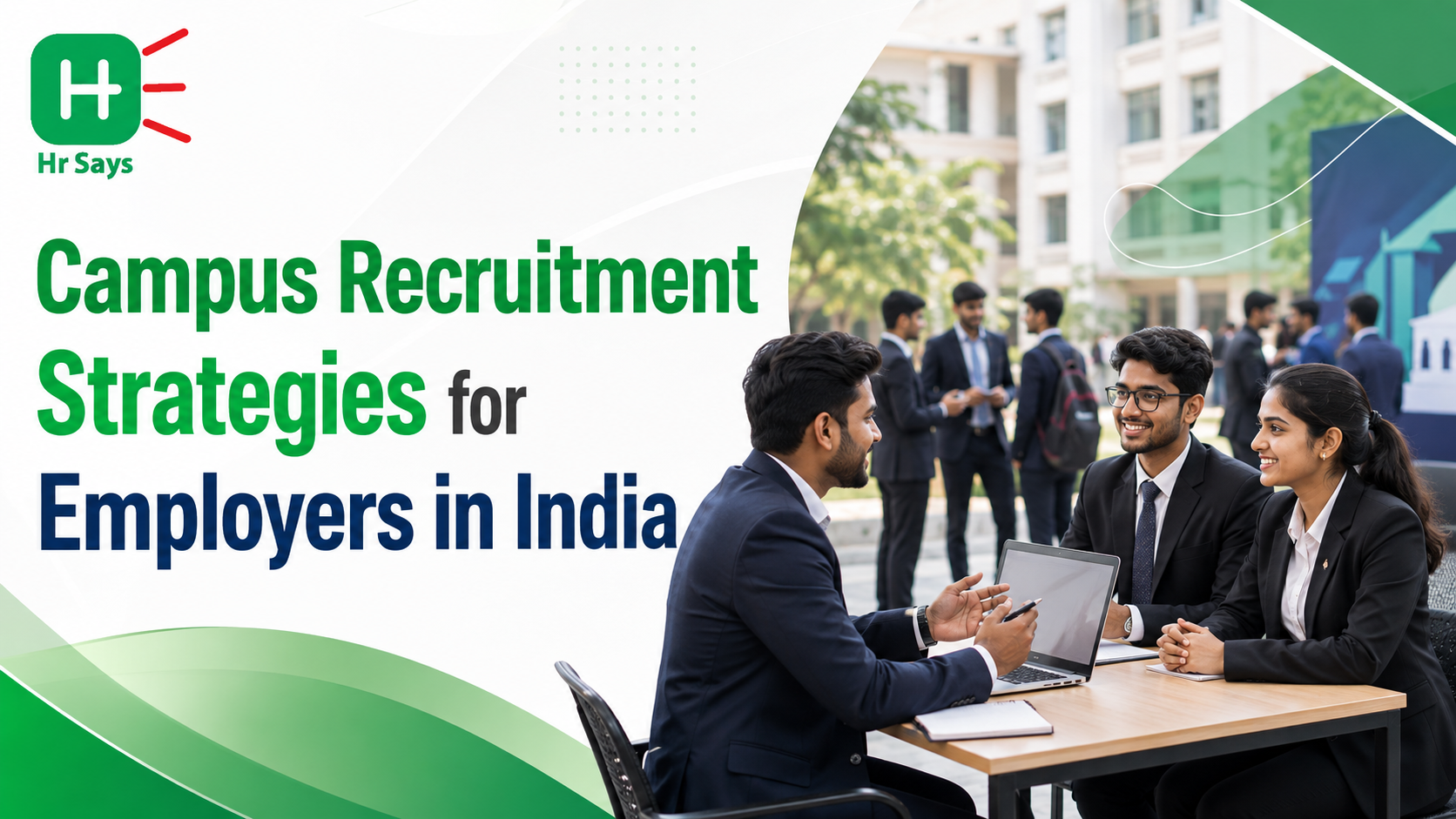
 This article outlines actionable campus recruitment strategies for Indian employers, covering employer branding, structured hiring processes, technology adoption, post-offer engagement, and long-term campus relationship building.





Introduction
Every year, millions of graduates step out of Indian colleges and universities ready to begin their professional lives. For employers, this moment represents one of the most significant talent acquisition opportunities of the calendar year. Campus recruitment, when executed thoughtfully, does not simply fill entry-level positions. It builds the foundational talent layer of an organization, shapes future leadership, and establishes employer reputation among the youngest and most digitally connected segment of the workforce.
Yet many organizations approach campus hiring as a checkbox activity rather than a strategic priority. They show up at a career fair, conduct a few rounds of interviews, extend offers, and consider the job done. The result is often high attrition among campus hires, poor cultural fit, and a lost opportunity to build something meaningful.
In India, where the working-age population is growing rapidly and competition for skilled graduates is intensifying across sectors, having a structured, strategic, and intentional campus recruitment approach is no longer optional. It is a competitive advantage. This guide is designed to help HR professionals, talent acquisition leaders, and business owners think through campus recruitment more strategically and execute it with greater effectiveness.
Understanding Campus Recruitment in the Indian Context
Campus recruitment in India operates across a broad and diverse educational ecosystem. At the top end, institutions like the IITs, IIMs, NITs, BITS Pilani, SRCC, and premier law and design schools attract intense employer interest. The competition for students at these institutions is fierce, and the recruiting season is highly structured with placement committees coordinating schedules, slot timings, and pre-placement talks.
However, India's higher education landscape extends far beyond these premier institutions. The country has over 1,000 universities and more than 40,000 colleges affiliated with them, producing graduates across engineering, management, arts, sciences, commerce, and professional disciplines. Tier 2 and Tier 3 institutions from cities like Coimbatore, Nagpur, Jaipur, Bhopal, and Kochi are increasingly supplying capable, motivated, and skilled graduates who often demonstrate stronger retention rates and organizational loyalty than their counterparts from elite campuses.
Employers who rely exclusively on Tier 1 campus recruitment limit their own talent pool. A smarter approach maps hiring needs to the right institutional profile, not just the most prestigious name.
Building a Strong Employer Brand Before Stepping on Campus
The most important preparation an employer can do for campus recruitment happens long before the placement season begins. Students research companies extensively before they even sit for a placement interview. They check LinkedIn, Glassdoor reviews, social media handles, and speak to seniors who have previously joined the organization. If the employer brand story is weak, inconsistent, or negative, even a strong job offer may not convert.
Employer branding for campus audiences requires a distinct approach. Students are less motivated by legacy or scale and more interested in learning opportunities, work culture, growth trajectories, mentorship, and meaningful work. Employers need to communicate these aspects clearly and authentically.
- Maintain an active and student-friendly presence on LinkedIn and Instagram.
- Share real employee stories, intern experiences, and workplace culture content regularly.
- Engage with campus communities through webinars, guest lectures, and competitions before recruitment season begins.
- Ensure Glassdoor and other review platforms reflect the honest and positive aspects of the work environment.
Organizations that invest in employer brand building during non-placement periods have a measurable advantage when the actual recruitment season begins.
Designing a Structured Campus Recruitment Process
A campus recruitment process without structure leads to inconsistent hiring, candidate drop-offs, and poor experiences for both students and HR teams. A well-designed process includes the following stages:
Pre-Placement Talks and Campus EngagementThe pre-placement talk, commonly called the PPT, is often the first formal interaction between an employer and student community. This session should not be a corporate presentation filled with financial figures and organizational charts. Instead, it should be a genuine conversation about what life looks like inside the company, what the role involves, what the career path looks like, and why a bright graduate should consider this opportunity. The PPT is a sales conversation, and organizations that approach it as such consistently see better engagement and application quality.
Screening and ShortlistingScreening in campus recruitment typically involves aptitude tests, technical assessments, or written evaluations depending on the role. These tools must be role-relevant and calibrated appropriately for fresh graduates. Overly difficult or misaligned tests frustrate candidates and filter out strong performers based on irrelevant criteria. Similarly, group discussions are useful for assessing communication skills, teamwork, and reasoning, but they require trained evaluators to be meaningful.
Interview RoundsStructured interviews with consistent evaluation criteria significantly improve hiring quality. Each interviewer should assess specific competencies rather than arriving with vague criteria. For campus hiring, competency frameworks often include learning agility, problem-solving ability, communication, team orientation, and role-specific technical knowledge. Panel interviews work well for senior campus roles, while one-on-one structured interviews are typically sufficient for graduate trainee or associate-level positions.
Expanding Beyond Premier Campuses
One of the most important shifts Indian organizations need to make in campus recruitment strategy is to broaden their institutional reach deliberately and systematically. The overemphasis on IITs and IIMs for every hiring need creates a competitive bottleneck and often leads to poor fit when the role does not actually demand that level of academic pedigree.
Regional engineering colleges in Tamil Nadu, Maharashtra, Andhra Pradesh, Karnataka, and Gujarat have strong technical programs producing graduates with solid foundational skills. Business schools in Pune, Hyderabad, and Bengaluru consistently produce capable management professionals. Commerce and economics departments in state universities produce graduates well-suited for finance, operations, and analytics roles.
Diversifying campus outreach also supports diversity hiring goals. Recruiting across geographies, institutional types, and academic disciplines naturally builds a more varied and representative workforce.
Leveraging Technology in Campus Recruitment
Technology has fundamentally changed how campus recruitment operates in India, particularly after 2020. Virtual campus drives became standard practice during the pandemic and many organizations have retained hybrid or fully virtual recruitment models because they offer significant advantages in terms of reach, cost, and speed.
Applicant tracking systems designed for campus hiring allow recruiters to manage large volumes of candidates efficiently. Online assessment platforms provide standardized, secure, and scalable testing. Video interview tools reduce scheduling friction and enable panels to evaluate candidates without geography constraints.
Beyond the process tools, data analytics is becoming increasingly important. Employers who track metrics like offer-to-joining conversion rates, campus-to-performance correlation, and first-year attrition by institution are building intelligence that improves future campus recruitment decisions. HRSays has consistently highlighted how data-driven HR practices are reshaping talent acquisition across Indian organizations, and campus hiring is no exception to this transformation.
Managing Post-Offer Engagement and Reducing Offer Drops
One of the most frustrating realities of campus recruitment in India is the offer drop problem. Students frequently accept multiple offers and make final decisions much later, often close to the joining date. Organizations that ignore selected candidates after extending offers lose them at a high rate.
Post-offer engagement is a critical and often neglected phase of campus recruitment. Effective practices include:
- Sending regular updates about the organization, team, and onboarding process.
- Assigning a buddy or point of contact from the existing employee community for informal conversations.
- Inviting selected candidates to virtual sessions, town halls, or industry discussions before they join.
- Sharing pre-joining reading materials, role overviews, or introductory learning content to build excitement.
- Recognizing the human side of the transition: fresh graduates are anxious, and organizations that show genuine care during this period earn loyalty before day one.
Building Long-Term Campus Relationships
Sustainable campus recruitment is not an annual transaction. Organizations that build genuine, year-round relationships with placement cells, faculty, and student bodies consistently outperform those that show up only during hiring season.
This relationship-building can take many forms. Sponsoring college fests, conducting industry workshops, offering faculty development programs, providing live project opportunities to students, and participating in curriculum development are all ways employers can establish meaningful presence on campus beyond recruitment.
Internship programs are arguably the most powerful campus relationship-building tool available. A well-structured internship program introduces selected students to the organization's culture, gives them meaningful work, allows both parties to evaluate fit, and creates a pre-qualified pipeline for full-time hiring. Organizations with strong pre-placement offer conversion rates from their internship programs spend less on lateral hiring and report higher early-year retention.
Measuring Campus Recruitment Effectiveness
Campus recruitment must be treated as an investment with measurable returns. Key metrics that organizations should track include:
- Cost per campus hire compared to lateral hire cost
- Offer acceptance rate by institution
- Offer-to-joining conversion rate
- Performance ratings of campus hires at six months and one year
- Retention rates among campus hires at the one-year and two-year marks
- Promotions or fast-track progression of campus hires versus lateral hires
These metrics tell a far more complete story than the number of offers made or positions filled. Organizations that track and act on this data improve their campus recruitment ROI year over year.
Conclusion
Campus recruitment is not simply a volume exercise in hiring fresh graduates. It is a strategic function that shapes the long-term talent health of an organization. Indian employers who invest in employer brand building, structured processes, broad institutional outreach, technology adoption, and post-offer engagement consistently build stronger, more loyal, and more capable entry-level talent pipelines.
The fundamentals of good campus recruitment come down to treating students as informed, discerning professionals, not as passive applicants. Organizations that respect student intelligence, communicate authentically, offer meaningful opportunities, and follow through on their commitments will always have an advantage in the campus hiring market. In a country as talent-rich and educationally diverse as India, the opportunity is enormous for employers who choose to approach it with intention and seriousness.
Frequently Asked Questions
Q1: What is campus recruitment and why is it important for employers?
Campus recruitment is the process of hiring fresh graduates directly from colleges and universities. It gives employers early access to emerging talent, allows them to shape young professionals according to organizational culture, and builds long-term talent pipelines at a lower cost than lateral hiring.
Q2: Which are the best colleges for campus recruitment in India?
Premier institutions like IITs, IIMs, NITs, and BITS Pilani attract the most employer interest. However, Tier 2 and Tier 3 colleges across states like Tamil Nadu, Maharashtra, and Telangana are increasingly producing strong candidates and offer less competitive hiring environments for employers.
Q3: How can small companies compete effectively in campus recruitment?
Small companies can compete by focusing on authentic employer branding, offering meaningful and growth-oriented roles, and building relationships with regional colleges where they face less competition from large corporates. Transparency about career paths and culture is a strong differentiator.
Q4: What are the most effective assessment methods during campus hiring?
Effective methods include aptitude tests, technical assessments, group discussions, case study presentations, and structured competency-based interviews. Assessments should be calibrated for fresh graduates and directly relevant to the role requirements.
Q5: How can employers improve offer acceptance rates in campus recruitment?
Employers can improve acceptance rates through consistent post-offer engagement, assigning buddy contacts, sharing onboarding information early, inviting selected candidates to company events, and demonstrating genuine interest in the candidate's transition into the professional world.
Resources
- National Association of Software and Service Companies (NASSCOM): Research and insights on talent demand, hiring trends, and skill gaps in India's technology and services sector.
- All India Council for Technical Education (AICTE): Official data on technical education institutions, enrollment figures, and graduate output across India.
- Ministry of Education, Government of India: Reports on higher education statistics, university enrollment, and graduate workforce trends across Indian states.
- LinkedIn Talent Solutions India: Annual talent trends and campus hiring benchmark reports relevant to Indian employers and HR professionals.
- National Skill Development Corporation (NSDC): Data and frameworks on skill development, employability, and workforce readiness among Indian graduates.
Interlinking Keywords:
campus hiring process, employer branding for freshers, talent acquisition strategy India, internship to full-time conversion, HR recruitment best practices, fresher hiring India, placement season strategy, entry-level talent pipeline
Last Reviewed By:
Hr Says Advisory Panel on 2 September, 2026
Disclaimer:
The information provided in this article is intended for general informational and educational purposes only. It does not constitute professional legal, HR compliance, or recruitment advisory guidance. Organizations are encouraged to consult qualified HR and legal professionals before implementing specific recruitment policies or processes. HRSays does not take responsibility for outcomes resulting from the application of strategies discussed in this article without appropriate professional guidance.