 Wednesday, October 28, 2026
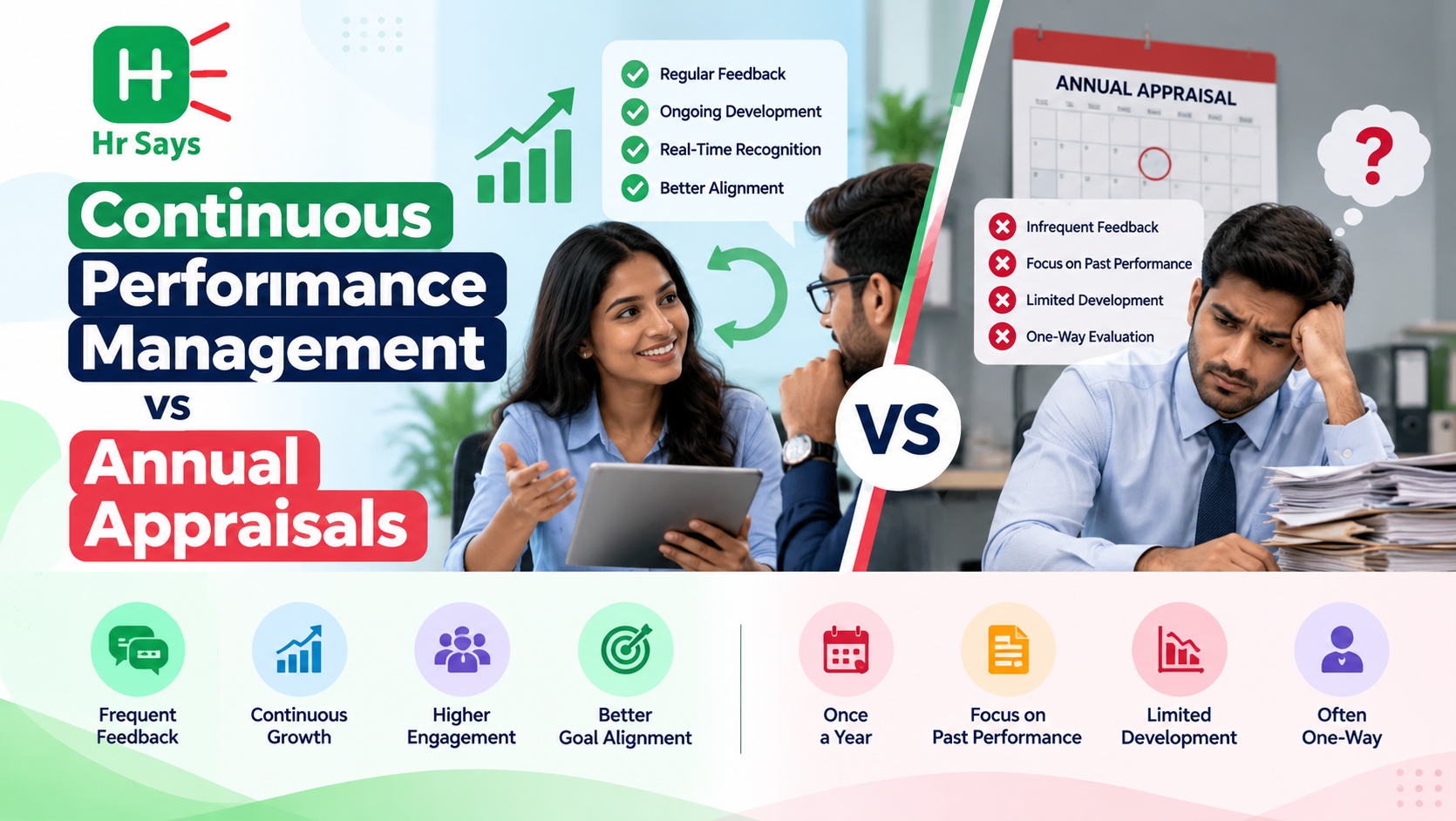
 Continuous performance management and annual appraisals represent two distinct philosophies for evaluating employees. Modern Indian workplaces increasingly benefit from combining both for stronger engagement and growth.





Introduction
Performance management sits at the heart of how organizations grow their people and, in turn, grow themselves. For decades, the annual appraisal was the standard tool that HR teams across India relied on to evaluate employee performance, decide salary increments, and plan promotions. It was a structured, once-a-year conversation that carried enormous weight for both the employee and the organization.
That model is now being questioned at a fundamental level. Across Indian startups, mid-size companies, and large enterprises alike, HR leaders are asking whether a single annual review can accurately capture the work, growth, and challenges of an entire year. The answer, increasingly, is no.
Continuous performance management has emerged as a strong alternative, reshaping how managers and employees interact, how feedback flows, and how performance data is collected and used. The debate between these two approaches is not just a philosophical one. It has real consequences for employee engagement, talent retention, and organizational effectiveness. Understanding both systems in depth is essential for any HR professional or business leader who wants to make a better decision for their workplace.
Understanding the Two Approaches
What Annual Appraisals Look Like in PracticeThe annual appraisal is a performance review system where employees are formally evaluated once a year, typically at the close of a financial or calendar year. In most Indian organizations, this process involves a combination of self-assessment forms, manager ratings, and a face-to-face review meeting. Outcomes from this process determine increments, bonuses, promotions, and sometimes employment continuation.
The model gained widespread adoption because it offered a standardized, manageable framework. HR teams could plan for it, managers could prepare for it, and employees knew when to expect it. In organizations with large workforces spread across multiple locations, having a unified annual cycle made administrative sense.
However, the limitations of this model have become increasingly visible. A manager reviewing twelve months of work in a single sitting often relies more on recent memory than on a complete picture of the year. Employees who performed well in the first half but struggled later may be penalized unfairly. Those who had a rough start but recovered strongly may not receive adequate recognition. Research consistently shows that annual appraisals tend to generate anxiety, reduce motivation, and create an adversarial dynamic between managers and employees rather than a collaborative one.
What Continuous Performance Management InvolvesContinuous performance management replaces the once-a-year review cycle with an ongoing system of goal setting, regular check-ins, real-time feedback, and frequent development conversations. Rather than building toward one high-stakes meeting, performance becomes a living, evolving conversation between managers and employees throughout the year.
In practice, this often means:
- Weekly or bi-weekly one-on-one meetings between managers and direct reports
- Quarterly goal reviews aligned with OKRs (Objectives and Key Results) or similar frameworks
- Real-time feedback shared shortly after project milestones or significant work events
- Pulse surveys and engagement check-ins to monitor team health
- Continuous documentation of achievements, challenges, and growth areas
The goal is to make performance conversations a natural part of how work happens, rather than an annual event that everyone dreads or prepares for in isolation.
Why Indian Organizations Are Rethinking Annual Reviews
India's workforce landscape has changed dramatically over the past decade. The country now has one of the youngest working populations in the world, with millennials and Generation Z employees making up an increasingly large share of the workforce. These employees have different expectations from their workplace relationships. They want to know how they are doing, not once a year, but regularly. They want their managers to be coaches, not just evaluators.
The rise of remote and hybrid work models, accelerated by the pandemic, has also exposed the limitations of the annual appraisal. When employees are not physically present in an office, visibility bias becomes a significant issue in annual reviews. Those who are seen more by their managers tend to receive better ratings, while employees working remotely or from Tier 2 and Tier 3 cities may be undervalued simply because they are less visible.
Indian startups and product-led companies have been among the earliest adopters of continuous performance frameworks. Organizations in sectors like technology, e-commerce, and financial services have introduced tools such as 15Five, Lattice, and Betterworks to support regular feedback cycles. Larger Indian conglomerates and public sector organizations, however, continue to rely heavily on annual appraisal systems, often due to legacy structures, union agreements, or the sheer complexity of managing reviews for thousands of employees simultaneously.
Key Differences Between the Two Models
Frequency and Timeliness of FeedbackThe most obvious difference between the two systems is how often feedback is given. In an annual appraisal model, an employee might go eleven months without any formal feedback on their performance, only to receive a rating in month twelve that influences their salary and career trajectory.
Continuous performance management addresses this directly. When feedback is given close to the moment it is relevant, employees have a real opportunity to act on it. A developer who receives feedback on their communication skills in March can work on improving them through April, May, and beyond, with visible progress documented by the time any formal review happens. The same feedback delivered in December for work done in March loses much of its practical value.
Impact on Employee Engagement and RetentionEmployee engagement is one of the most closely watched metrics in Indian HR circles today, and for good reason. Disengaged employees cost organizations significantly in lost productivity and high attrition. India's attrition rates in sectors like IT and BFSI have reached challenging levels in recent years, making retention a top priority for CHROs and founders alike.
Continuous performance management has a documented positive relationship with engagement. When employees feel heard, supported, and aware of their standing, they tend to be more motivated and less likely to look elsewhere. Annual appraisals, by contrast, often create a once-a-year motivation spike followed by long periods of uncertainty or disengagement.
Manager Capability and Organizational ReadinessContinuous performance management places significant demands on managers. They are expected to hold meaningful conversations regularly, give balanced and constructive feedback, and document performance in a consistent way throughout the year. Not every manager in every Indian organization is equipped or trained to do this well.
Annual appraisals, in contrast, are administratively simpler. The HR team issues forms, managers complete ratings, and the cycle closes. The bar for manager capability is lower in a compliance sense, though that lower bar also means the quality of feedback and development support is consistently poor.
Documentation and Performance Data QualityOne of the underappreciated advantages of continuous performance management is the quality of documentation it produces. Because check-ins and feedback sessions are recorded regularly, organizations build a rich, accurate picture of each employee's performance over time. This makes decisions about promotions, succession planning, and compensation far more defensible and fair.
Annual appraisal documentation, on the other hand, often suffers from recency bias and incomplete data. Managers may not remember specific projects from eight months ago, and employees may not have kept systematic records of their accomplishments either.
What the Research and Global Trends Suggest
Global organizations that have moved away from annual appraisals have reported measurable improvements in employee satisfaction and productivity. Companies such as Adobe, Deloitte, and Accenture publicly restructured their performance management systems, replacing annual ratings with ongoing feedback and development conversations.
In the Indian context, a growing number of HR professionals and organizational development practitioners are advocating for a hybrid approach, one that retains the structure and documentation benefits of formal reviews while embedding the feedback cadence of continuous performance management into the year-round people management process.
This hybrid model may be particularly well-suited to Indian organizations managing diverse, geographically distributed workforces. It allows companies to maintain the annual calibration cycle required for compensation decisions while ensuring that employees receive the regular coaching and recognition they need to stay engaged and grow.
Practical Considerations for HR Leaders
Transitioning from an annual appraisal model to continuous performance management is not a simple administrative change. It requires investment in HR technology, significant manager training, a cultural shift in how feedback is perceived, and leadership commitment at the highest levels.
HR leaders considering this shift should think carefully about the following:
- Whether their current HR technology stack supports continuous documentation and feedback
- Whether managers have the coaching skills required to hold effective, frequent conversations
- Whether the organizational culture currently encourages open, two-way feedback or whether feedback flows primarily top-down
- Whether there is leadership alignment on moving away from traditional rating systems
- Whether the organization is prepared to recalibrate how compensation decisions are made without relying solely on annual ratings
Piloting continuous performance management within one team or business unit before rolling it out organization-wide is a practical first step that many Indian HR leaders are choosing.
The Role of Technology in Enabling Continuous Performance Management
HR technology has become a critical enabler of continuous performance management. Performance management platforms allow organizations to set and track goals, schedule and record check-ins, gather peer feedback, and analyze performance trends over time. For Indian organizations, particularly those operating across multiple cities or managing remote teams, technology is what makes a continuous feedback culture operationally feasible.
Platforms designed for continuous performance management also generate workforce analytics that annual appraisals simply cannot produce. HR teams can identify which managers are having the most productive conversations with their teams, which employees are at risk of disengagement, and which business units are aligned with organizational goals in real time rather than waiting for year-end data.
Which Approach Suits Indian Workplaces Best
There is no single answer that applies to every organization. A fast-growing technology startup with a team of fifty employees has very different needs from a public sector bank managing fifty thousand employees across the country. The right approach depends on organizational size, industry, workforce demographics, technology infrastructure, and management maturity.
What is clear, however, is that the annual appraisal as a standalone system is increasingly inadequate for the expectations and realities of India's modern workforce. Even organizations that cannot immediately shift to a fully continuous model can benefit from introducing more regular check-ins, setting quarterly goals, and making feedback a more frequent and informal part of how managers lead their teams.
For HR professionals and business leaders committed to building better workplaces, the question is not really whether continuous performance management is better in theory. The question is how to move toward a more responsive, people-centered performance culture in a way that works for their specific organization.
Conclusion
The debate between continuous performance management and annual appraisals ultimately reflects a broader shift in how organizations think about their people. Moving from evaluation to ongoing development, from judgment to coaching, and from annual snapshots to real-time insight is not just a process change. It is a cultural transformation.
Indian organizations that invest in building a continuous performance culture are better positioned to retain talent, build stronger manager-employee relationships, and make more informed people decisions. The annual appraisal may not disappear entirely, but its role is evolving. When paired with continuous feedback and regular development conversations, formal reviews become more meaningful, more accurate, and more valuable for everyone involved.
HRSays serves as a platform where these conversations about performance, people practices, and workplace transformation are explored with depth and practical relevance, helping HR leaders and organizations across India find the right path forward for their teams.
Frequently Asked Questions
Q1: What is the main difference between continuous performance management and annual appraisals?
Continuous performance management involves ongoing feedback, regular check-ins, and frequent goal reviews throughout the year. Annual appraisals are formal, once-a-year evaluations. The key difference lies in frequency, timeliness of feedback, and the overall impact on employee development and engagement.
Q2: Are annual appraisals still relevant for Indian organizations?
Annual appraisals remain relevant for compensation decisions and formal documentation, but they are increasingly insufficient as a standalone performance management tool. Most modern HR approaches recommend pairing formal annual reviews with regular check-ins and continuous feedback to make the process more effective.
Q3: How can small and mid-size Indian companies implement continuous performance management without large HR technology budgets?
Small and mid-size organizations can begin with simple practices such as structured weekly one-on-ones, shared goal-tracking documents, and informal feedback after major projects. Many affordable or freemium HR tools also support basic continuous performance functions without requiring enterprise-level budgets.
Q4: Does continuous performance management work for large Indian organizations with thousands of employees?
Yes, but it requires thoughtful implementation. Large organizations often adopt a hybrid model, maintaining annual calibration cycles for compensation while embedding regular check-ins and pulse surveys into their day-to-day people management. Technology platforms are essential for scaling this approach across large, geographically distributed workforces.
Q5: What role does manager training play in making continuous performance management successful?
Manager training is one of the most critical success factors. Continuous performance management requires managers to hold meaningful, coaching-oriented conversations regularly. Without adequate training in giving constructive feedback, setting clear goals, and running productive check-ins, the system will not deliver its intended benefits regardless of the tools or frameworks in place.
Resources
- Society for Human Resource Management (SHRM): Research and frameworks on modern performance management practices and employee development strategies.
- NASSCOM: Reports and insights on HR trends in India's technology sector, including talent management and performance practices.
- People Matters: India-focused HR media platform covering thought leadership on performance management, employee engagement, and workplace transformation.
- Josh Bersin Academy: Global research on HR and people practices, including detailed analysis of continuous performance management models and their outcomes.
- Deloitte Human Capital Trends Report: Annual global report examining workforce trends, including the shift from annual appraisals to agile performance management systems.
Interlinking Keywords
continuous performance management, annual appraisal system, employee performance review, HR performance tools India, OKR goal setting, employee feedback culture, manager training HR, talent retention strategies, performance management software India, employee engagement HR
Last Reviewed By
Dr. Manthan Tripathi and Hr Says Advisory Panel on 26 October 2026.
Disclaimer
The content published on HRSays is intended for informational and educational purposes only. All views, insights, and recommendations presented in this article are general in nature and do not constitute professional HR, legal, or organizational consulting advice. Every organization has unique people, processes, and compliance requirements, and readers are advised to consult qualified HR professionals or legal advisors before making any changes to their performance management systems or workplace policies. HRSays does not take responsibility for any decisions made by individuals or organizations based on the information provided in this article.