Saturday, October 24, 2026
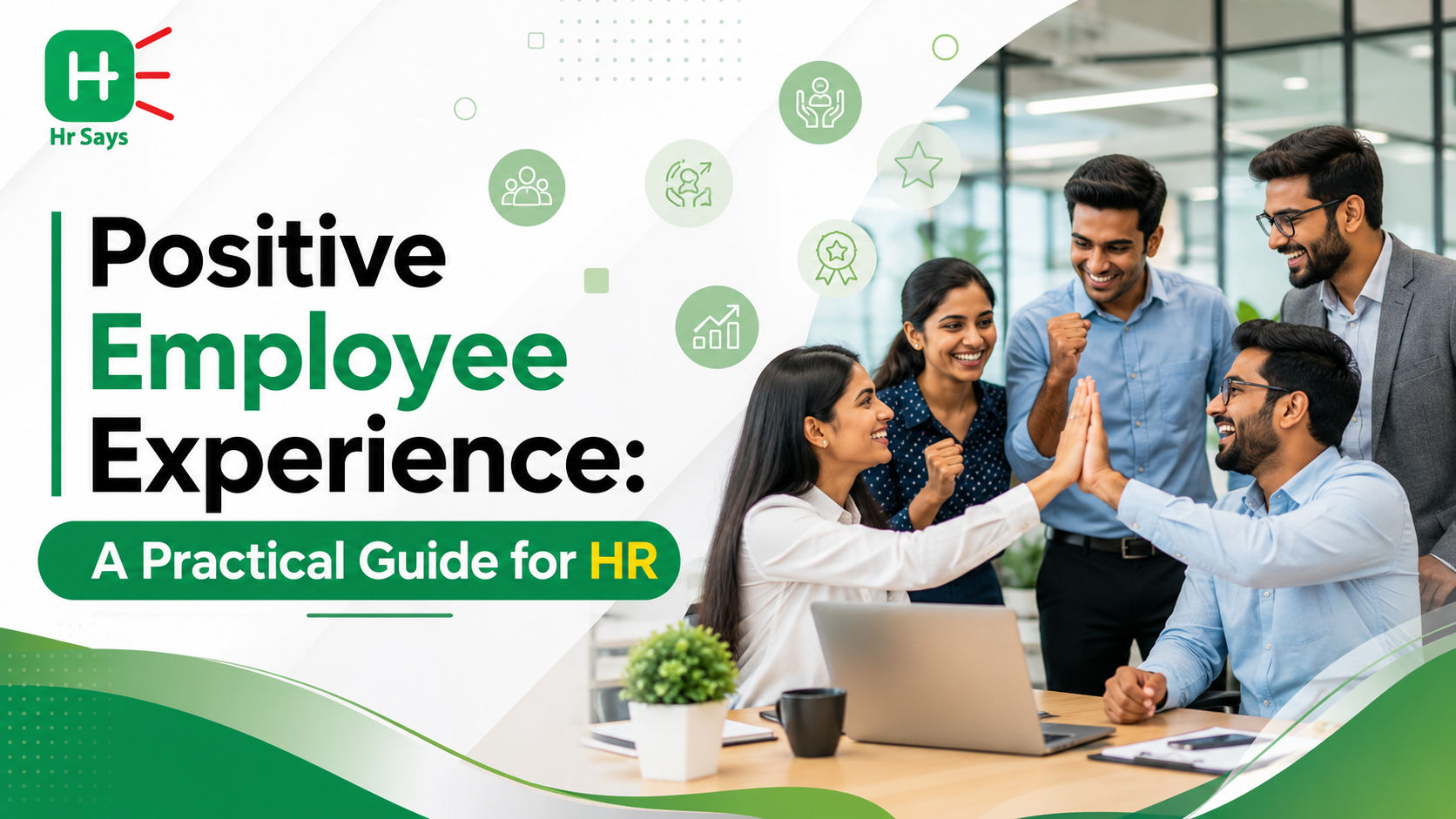
 Building a positive employee experience requires transparent communication, flexibility, growth opportunities, psychological safety, purpose, and capable managers, all shaped to fit the realities of India's evolving workplace culture.





Introduction
Employee experience has become one of the defining priorities for HR leaders across India in 2026. As organizations compete for skilled talent in Bengaluru, Pune, Hyderabad, and increasingly in Tier 2 cities such as Indore, Coimbatore, and Jaipur, the quality of the everyday employee journey has moved from a soft HR metric to a genuine business driver. A positive employee experience shapes whether people stay, how productive they are, and how they represent the organization to the outside world.
For HR professionals, founders, and business leaders, understanding what actually builds a positive employee experience and what quietly erodes it has never mattered more. This guide breaks down the practical building blocks of employee experience, why they matter specifically for Indian workplaces, and how organizations of any size can put them into action without needing large budgets or elaborate programs.
What Employee Experience Really Means
Employee experience covers every interaction an employee has with an organization, starting from the hiring process and continuing through onboarding, daily work, performance conversations, growth opportunities, and eventually the exit. It is not a single initiative or a one-time survey. It is the accumulated sense an employee forms about whether the organization respects their time, values their contribution, and supports their growth.
This is distinct from employee engagement, which refers to how enthusiastic and emotionally invested an employee feels about their work. Experience creates the conditions. Engagement is the response to those conditions. An organization can run engagement activities, but if the underlying employee experience, communication, fairness, growth opportunities, is weak, engagement will not hold for long.
In the Indian context, employee experience takes on additional dimensions. Joint family responsibilities, long commute times in metros, expectations around job security, and generational differences between Gen Z employees and more tenured staff all shape how people experience their workplace. A positive employee experience strategy in India, therefore, needs to account for these realities rather than simply importing frameworks built for other markets.
Why Employee Experience Deserves Board-Level Attention
The business case for employee experience has become difficult to ignore. Organizations with strong employee experience typically see lower attrition, higher productivity, and stronger employer branding, which in turn reduces the cost and time associated with hiring. Given that attrition in sectors such as IT services, BPO, and retail in India has historically run higher than global averages, the retention benefit alone justifies sustained investment.
There is also a direct link between employee experience and customer experience. Employees who feel supported and trusted are more likely to extend the same care to customers and clients. This connection is particularly visible in customer-facing industries such as banking, hospitality, and retail, where frontline employee experience directly shapes brand perception.
Recent industry commentary also points to a shift in what actually drives engagement. Confidence in leadership and clarity during periods of change have become stronger predictors of engagement than traditional factors like a sense of belonging alone, suggesting that transparency and consistent leadership behavior now carry more weight than before.
Building Block One: Transparent and Respectful Communication
Communication is often the first place employee experience breaks down. When employees are unclear about expectations, or when information is inconsistently shared between leadership and teams, trust erodes quickly. Establishing regular one-on-one conversations between managers and their team members helps address this directly, giving employees a predictable space to raise concerns, ask questions, and receive feedback on their work.
Recognition plays an equally important role. Employees who do not feel their contributions are noticed are considerably more likely to consider leaving within the following year. Recognition does not need to involve elaborate rewards programs. Specific, genuine acknowledgment of an individual's effort, given consistently, often has a stronger impact than generic praise offered occasionally.
Organizations that build a habit of open communication, through structured feedback cycles, accessible leadership, and honest updates during periods of change, tend to see stronger trust and lower anxiety among employees, particularly during uncertain business conditions.
Building Block Two: Flexibility, Autonomy, and Trust
Flexibility has moved from a preference to an expectation for a large share of the Indian workforce, particularly among younger professionals and those balancing family responsibilities across joint households. Hybrid work arrangements, once treated as a pandemic-era exception, are now considered a standard feature of a competitive workplace.
Autonomy matters just as much as flexible timing. When managers trust employees to manage their own workload and make decisions within their role, it signals confidence in their capability. Conversely, excessive monitoring or micromanagement is consistently cited as a leading reason employees choose to leave a role, since it undermines the very trust that a positive employee experience depends on.
For organizations still building hybrid or flexible policies, the goal should not simply be permission to work from anywhere. It should be building the underlying trust and accountability structures that make flexibility sustainable for both the employee and the business.
Building Block Three: Growth, Learning, and Career Clarity
Career growth concerns are among the most common reasons employees disengage or leave, and this holds true across experience levels, though the specific concern shifts. Early-career employees in India often prioritize skill building and exposure to new technologies, including practical experience with AI tools that are increasingly part of daily work. Mid-career professionals tend to focus on visibility into their next role or promotion path. More senior employees often look for opportunities to mentor others or take on strategic responsibility.
Organizations that invest in structured learning and development, whether through internal training, mentorship programs, or support for external certifications, tend to see stronger retention among high performers. This is particularly relevant in India's technology and GCC sectors, where skill shelf life has shortened considerably and continuous upskilling has become necessary just to stay competitive.
Career pathing conversations, even informal ones held regularly between managers and employees, help address the uncertainty that often drives talented employees toward competitors offering clearer growth narratives.
Building Block Four: Psychological Safety at Work
A psychologically safe workplace is one where employees feel comfortable raising concerns, voicing disagreement, or admitting mistakes without fear of being penalized or labeled difficult. This is foundational to a positive employee experience because without it, employees tend to withhold ideas, avoid flagging problems early, and disengage quietly rather than address issues directly.
Psychological safety is shaped heavily by immediate managers. A manager who responds to questions with patience, treats mistakes as learning opportunities, and genuinely listens during one-on-ones creates a very different experience than one who reacts defensively or dismissively. Since managers account for a very large share of the variation in team-level engagement, investing in manager capability is one of the most effective ways to strengthen psychological safety across an organization.
For Indian workplaces navigating hierarchical structures inherited from more traditional management styles, building psychological safety often requires deliberate effort. Encouraging junior employees to speak up in meetings, creating anonymous feedback channels, and training managers to respond constructively to dissent are practical starting points.
Building Block Five: Purpose and Everyday Impact
Employees increasingly want to understand how their daily work connects to something larger than individual output. This does not require grand corporate missions. It requires managers and leaders consistently connecting individual contributions to team and organizational outcomes, so employees can see the tangible difference their work makes.
Measuring individual performance through impact, rather than only hours worked or activity volume, also supports a healthier employee experience. Outcome-based performance management, which is gaining traction across Indian organizations moving away from purely attendance-based evaluation, allows employees more ownership over how they achieve results.
Building Block Six: Manager Quality as the Deciding Factor
Across nearly every major research study on employee experience, one factor consistently stands out above the rest: the quality of the relationship between an employee and their direct manager. Managers interpret company policy for their teams, deliver feedback, recognize contributions, and set the daily tone that employees experience.
Many managers, particularly those recently promoted from individual contributor roles, are given people-leadership responsibility without adequate training. Equipping managers with practical tools, structured conversation guides, and ongoing coaching support has a disproportionate impact on employee experience because it strengthens the relationship that employees interact with most directly, every single day.
Organizations serious about employee experience should treat manager development as a core investment area rather than an occasional workshop. Platforms and communities focused on HR knowledge sharing, including practical manager enablement content, can help HR teams access frameworks that are grounded in real workplace challenges rather than generic theory.
Measuring Employee Experience Effectively
Improving employee experience requires ongoing measurement rather than a single annual survey. Common methods include:
- Structured employee experience surveys covering onboarding, communication, and growth opportunities
- Regular one-on-one conversations that surface qualitative concerns metrics alone cannot capture
- Exit interviews that reveal patterns behind voluntary attrition
- Performance and retention metrics tracked over time to identify friction points
Combining quantitative survey data with qualitative conversations gives a more complete picture than either approach alone, and helps HR teams prioritize where to focus limited time and resources.
Bringing It Together for Indian Organizations
Creating a positive employee experience in India requires balancing global best practices with local realities, hybrid work preferences, generational shifts, regional salary variations, and the growing influence of Tier 2 talent hubs. Organizations that get this right treat employee experience not as a single HR initiative, but as a leadership discipline that touches communication, growth, trust, and daily management practice.
HR professionals looking to build stronger workplace practices often benefit from staying connected to ongoing conversations happening across the HR community, since many of the most useful ideas come from peers navigating similar challenges rather than theoretical frameworks alone. Platforms that curate practical, credible HR insights can support this kind of continuous learning for HR leaders and business owners alike.
Conclusion
A positive employee experience is built gradually, through consistent communication, genuine trust, real growth opportunities, psychological safety, a sense of purpose, and capable managers who bring these elements to life daily. None of these require large budgets, but all of them require sustained leadership attention. Organizations that treat employee experience as a continuous priority, rather than a one-time project, are the ones best positioned to attract, retain, and get the best from their people in an increasingly competitive Indian talent market.
Frequently Asked Questions
Q1: What is employee experience in simple terms?
Employee experience refers to everything an employee feels, observes, and encounters while working with an organization, from hiring to exit. It includes daily interactions, relationships with managers, workplace culture, and how valued a person feels at work.
Q2: Why is employee experience important for Indian companies?
Indian companies face high attrition and intense competition for skilled talent, especially in Tier 1 cities. A positive employee experience helps organizations retain people, reduce hiring costs, and build a workplace reputation that attracts quality candidates.
Q3: How can small and mid-sized companies improve employee experience without a large budget?
Employee experience does not require large budgets. Clear communication, regular feedback, genuine recognition, manager training, and consistent follow-through on commitments can meaningfully improve experience even in resource-constrained organizations.
Q4: What is the difference between employee experience and employee engagement?
Employee experience is the complete journey an employee has with an organization. Employee engagement is the emotional and psychological response to that journey. Experience shapes the conditions, and engagement reflects how employees feel about those conditions.
Q5: Who is responsible for employee experience in an organization?
While HR designs the frameworks and policies, managers have the greatest day-to-day influence on employee experience. Leadership sets the tone and culture that managers and HR then translate into daily practice.
Resources
- Gallup Workplace Research: Studies and data on employee experience, engagement, and manager influence on team outcomes
- Deloitte Asia Pacific Human Capital Survey: Research on AI adoption and workforce trends among Indian employees
- EY and Confederation of Indian Industry (CII) Reports: Insights on enterprise technology adoption affecting HR practices in India
- Perceptyx Workforce Transformation Research: Longitudinal survey data on shifting employee engagement drivers
- Great Place To Work India: Research and benchmarking on Indian workplace culture and HR trends
Interlinking Keywords
employee experience, employee engagement, workplace culture, HR best practices, employee retention strategies, manager development, psychological safety at work, employee onboarding, career development plan, employee feedback culture
Disclaimer:
This article is intended for general informational and educational purposes only and does not constitute professional HR, legal, or business consulting advice. Organizations should evaluate their specific workplace context and consult qualified HR or legal professionals before implementing policy changes based on this content.