 Sunday, September 20, 2026
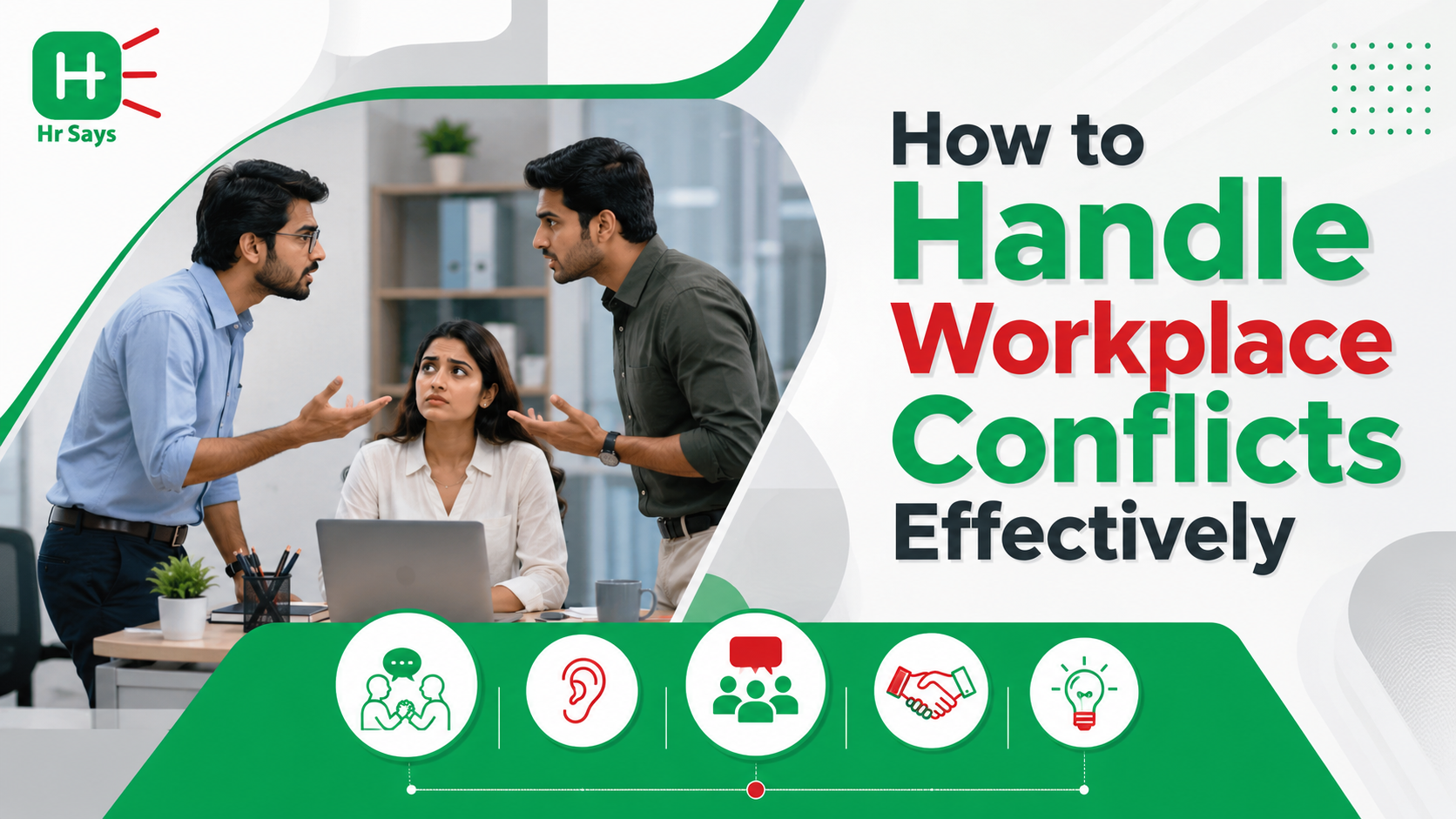
 Workplace conflict is inevitable but manageable. This article explores causes, types, and proven resolution strategies to help Indian HR professionals and managers build healthier, more productive workplaces.





Introduction
Workplace conflict is not a sign of a broken organization. It is, in fact, an inevitable part of any environment where people with different backgrounds, experiences, and professional expectations work together toward shared goals. What separates high-performing teams from struggling ones is not the absence of conflict but the ability to address it with clarity, structure, and emotional maturity.
In India, where workplaces are becoming increasingly diverse in terms of age, regional culture, educational backgrounds, and professional values, conflict is a daily reality for HR professionals, team leaders, and business owners. A survey by the Society for Human Resource Management found that HR professionals in Asia spend a significant portion of their time managing interpersonal disputes. The cost of mismanaged conflict is not limited to damaged relationships; it translates into reduced productivity, higher attrition, and a weakened organizational culture.
Understanding how to handle workplace conflicts effectively is therefore not just an interpersonal skill. It is a strategic HR competency that shapes employee experience, team cohesion, and organizational health. This guide breaks down the causes, types, and resolution strategies for workplace conflict in a way that is practical and directly applicable for HR leaders and people managers in India.
Understanding Workplace Conflict: What It Is and Why It Happens
Conflict in the workplace refers to any perceived incompatibility of goals, interests, values, or working styles between two or more individuals or groups within an organization. It can surface at any level, between two colleagues, within a team, between departments, or between employees and their managers.
In Indian workplaces, several specific factors tend to amplify the likelihood of conflict. The hierarchical nature of many organizations, particularly in traditional industries and family-run businesses, creates power imbalances that are not always easy to navigate. At the same time, the rapid growth of startups and multinational companies has introduced flat structures and agile cultures that can clash with established norms. The generational gap between senior leaders who favor formal communication and younger employees who expect transparent, real-time feedback often creates friction that, if left unaddressed, grows into deeper resentment.
Other common causes of conflict in Indian workplaces include:
- Unclear role definitions that lead to overlapping responsibilities
- Unequal distribution of workload across team members
- Cultural and regional differences in communication styles
- Lack of psychological safety that discourages open dialogue
- Performance pressure that breeds internal competition
Recognizing the root cause of a conflict is the essential first step before any resolution can begin. Conflict that appears to be about a project deadline may actually stem from a deeper issue around accountability or respect. HR professionals who can identify this distinction are far better positioned to intervene effectively.
Types of Workplace Conflict and How to Recognize Them
Not all workplace conflicts look the same, and not all of them require the same approach. Broadly, conflicts in the workplace can be classified into the following categories.
Interpersonal conflict is the most commonly reported type and involves disagreement between two individuals. This could be between colleagues who have different working styles, or between an employee and their reporting manager over expectations and boundaries.
Intra-team conflict occurs within a group or department and often involves role ambiguity, credit disputes, or differing views on how a project should be executed. This type of conflict, if unresolved, can severely damage team morale and reduce collective output.
Intergroup or cross-functional conflict happens between different departments or teams, often around resource allocation, priority setting, or miscommunication during handoffs. This is particularly common in growing organizations where processes have not matured alongside headcount.
Organizational conflict is systemic in nature and often involves disagreement over policies, compensation structures, promotion criteria, or workplace values. This type of conflict often leads to collective grievances and, if not addressed, contributes to high attrition.
Each type of conflict requires a tailored response. The approach that works for a disagreement between two colleagues will not necessarily work when two departments are in structural opposition. HR professionals must develop the diagnostic ability to identify what kind of conflict they are dealing with before choosing a resolution path.
Effective Strategies to Handle Workplace Conflicts
There is no single universally correct method for resolving workplace conflict. The most widely referenced framework for understanding conflict response styles is the Thomas-Kilmann Conflict Mode Instrument, which identifies five core strategies based on how assertive and cooperative each approach is. Understanding these strategies helps HR professionals and managers choose the most contextually appropriate response.
Collaborating is the most recommended strategy for high-stakes conflicts where both the relationship and the outcome matter. It involves both parties working together openly and honestly to find a solution that genuinely satisfies the needs of everyone involved. This approach requires time and emotional investment but produces the most durable resolutions. For HR teams dealing with performance-related conflicts or team culture issues, this is usually the strategy of choice.
Compromising is useful when both parties are willing to give up something in exchange for a workable middle ground. It suits situations where full collaboration is not feasible due to time constraints or where both parties hold equal standing. While compromise does not fully satisfy either side, it moves the situation forward and prevents prolonged standoffs.
Accommodating involves one party yielding to the preferences of the other. It is appropriate when maintaining the relationship is more important than the specific outcome, or when one party recognizes that the other's position is more informed or justified. However, when accommodation becomes a pattern rather than a choice, it can breed quiet resentment and signal to others that assertiveness is not welcome.
Avoiding means sidestepping the conflict temporarily. This can be appropriate when emotions are running high and a cooling period is needed before a productive conversation can take place. However, avoidance as a long-term default is one of the most damaging habits in organizational culture. Research consistently shows that unresolved conflicts erode psychological safety and increase the risk of burnout.
Competing is a high-assertiveness, low-cooperation approach that involves one party pushing their position without much consideration for the other. It is appropriate only in crisis situations where a quick, decisive decision must be made. In everyday workplace situations, a competing style can damage trust and undermine team cohesion.
The practical wisdom for any HR professional or manager lies not in adopting one fixed style but in developing the judgment to know which approach fits which situation. A leader who always compromises is not necessarily a peacemaker; they may simply be avoiding the courage required for genuine collaboration.
The Role of Communication in Conflict Prevention and Resolution
Most workplace conflicts are either caused by poor communication or worsened by it. Miscommunication can take many forms: an ambiguous email that is interpreted as passive-aggressive, a feedback conversation that feels like a personal attack, or a management decision that is announced without context. In each case, the breakdown is not just about what was said but about how it was said and how it was received.
Effective conflict resolution therefore begins with investing in communication culture long before a specific disagreement arises. For Indian organizations, where employees may be reluctant to openly challenge authority figures or express dissatisfaction, creating psychologically safe channels for honest feedback is particularly important.
Structured communication tools such as SBAR (Situation, Background, Assessment, Recommendation) and DESC (Describe, Express, Specify, Consequences) are used extensively in high-stakes professional environments and are equally applicable in corporate settings. These frameworks give employees and managers a disciplined language for raising concerns without defaulting to personal accusations.
Active listening is another foundational skill. There is an important difference between hearing what someone says and genuinely listening to understand their position. Managers who practice active listening, maintaining eye contact, acknowledging what is being said, asking clarifying questions, and resisting the urge to interrupt, create the conditions in which employees feel safe to raise concerns before they escalate into conflict.
In India's increasingly hybrid and remote work environments, where in-person cues are absent, the risk of communication misreading is even higher. HR teams in organizations with distributed workforces must build communication protocols that account for the lack of physical presence and actively compensate for it.
How HR Professionals and Managers Should Intervene
When conflict does escalate to a point where self-resolution between the parties is no longer possible, HR professionals and managers must step in with a clear and structured approach.
The first step is to create a private, neutral space for the conversation. Conflict discussions should never happen in public or in front of other team members, as this adds defensiveness and shame to an already charged dynamic.
The second step is to hear all parties separately before bringing them together. This allows each person to express their perspective without interruption and prevents one person's narrative from dominating the framing.
The third step is to focus the conversation on facts and behaviors rather than on personalities. Statements grounded in observable actions are far more productive than statements about character or intention.
The fourth step is to collaboratively identify a path forward. This does not mean imposing a solution but facilitating one. When employees feel that they had a role in crafting the resolution, they are far more likely to abide by it.
The fifth step is to follow up. One of the most common mistakes in conflict management is treating resolution as a singular event. A check-in after two to four weeks to assess whether the agreement is holding and whether any residual tension remains is essential to ensuring lasting resolution.
Building a Conflict-Ready Workplace Culture
The most effective form of conflict management is prevention, and prevention is a function of organizational culture. When organizations invest in building a culture of psychological safety, clarity, and mutual respect, they reduce the frequency and intensity of conflicts before they have a chance to take root.
This is an area where platforms like HRSays play a meaningful role. By giving HR professionals access to workplace insights, thought leadership, and practical tools, they are better equipped to build the kind of people-first culture that makes conflict less likely and more manageable when it does occur.
Key practices for building a conflict-ready culture include conducting regular team pulse surveys to identify tension before it surfaces, setting clear behavioral expectations and role definitions from day one, offering training on communication skills and emotional intelligence, and building transparent escalation pathways that employees trust and use.
In India, where workplace culture is undergoing rapid transformation driven by demographic shifts, technological change, and evolving employee expectations, organizations that prioritize conflict competence will not only retain talent more effectively but will also build stronger, more adaptive teams.
Frequently Asked Questions
Q1: What are the most common causes of workplace conflict in Indian organizations?
The most common causes include communication gaps, unclear role definitions, differing work styles, hierarchical pressure, and unequal distribution of workload. In Indian organizations, generational differences and cultural diversity across regions also contribute significantly to workplace disagreements.
Q2: What is the best conflict resolution strategy for managers?
The collaborating strategy is widely considered the most effective for managers because it focuses on finding a solution that satisfies the needs of all parties involved. It promotes open communication, mutual respect, and long-term relationship preservation.
Q3: How should HR departments handle unresolved workplace conflicts?
HR departments should establish a clear escalation policy that includes documented mediation procedures, confidential reporting channels, and access to neutral third-party facilitators. Timely intervention is essential to prevent conflicts from affecting team performance and employee well-being.
Q4: Can workplace conflict have positive outcomes?
Yes. When managed well, conflict can lead to improved decision-making, greater innovation, and stronger team relationships. Constructive disagreement encourages diverse viewpoints and helps organizations identify process gaps or cultural issues that need attention.
Q5: What role does emotional intelligence play in conflict resolution at work?
Emotional intelligence plays a central role. It helps individuals recognize and regulate their own reactions, empathize with others, and communicate constructively during tense situations. Managers and HR professionals with high emotional intelligence are better equipped to de-escalate disputes and guide teams toward resolution.
Resources
- Society for Human Resource Management (SHRM): Research and guidelines on conflict management best practices in professional workplaces
- Ministry of Labour and Employment, Government of India: Policy framework and labor dispute resolution mechanisms for Indian organizations
- National HRD Network (NHRDN): India-specific HR insights, learning resources, and professional development guidance for HR practitioners
- Thomas-Kilmann Conflict Mode Instrument (TKI): Widely used psychometric tool for understanding individual conflict-handling styles in organizational settings
- Harvard Business Review: Research-backed articles on leadership, conflict resolution, and organizational culture in modern workplaces
Interlinking Keywords
workplace conflict resolution, employee experience, conflict management strategies, HR best practices India, psychological safety at work, team communication skills, employee engagement, conflict prevention in organizations, HR leadership, people management
Last Reviewed By:
Hr Says Advisory Panel on 1 August, 2026
Disclaimer
The information provided in this article is intended for general informational and educational purposes only. It does not constitute legal, HR consulting, or professional advice. Organizations dealing with complex or legally sensitive workplace conflicts are encouraged to seek guidance from qualified HR professionals, labor law experts, or certified mediators. Organizational contexts vary, and the strategies discussed in this article should be adapted to suit specific workplace needs and applicable laws.