 Monday, September 14, 2026
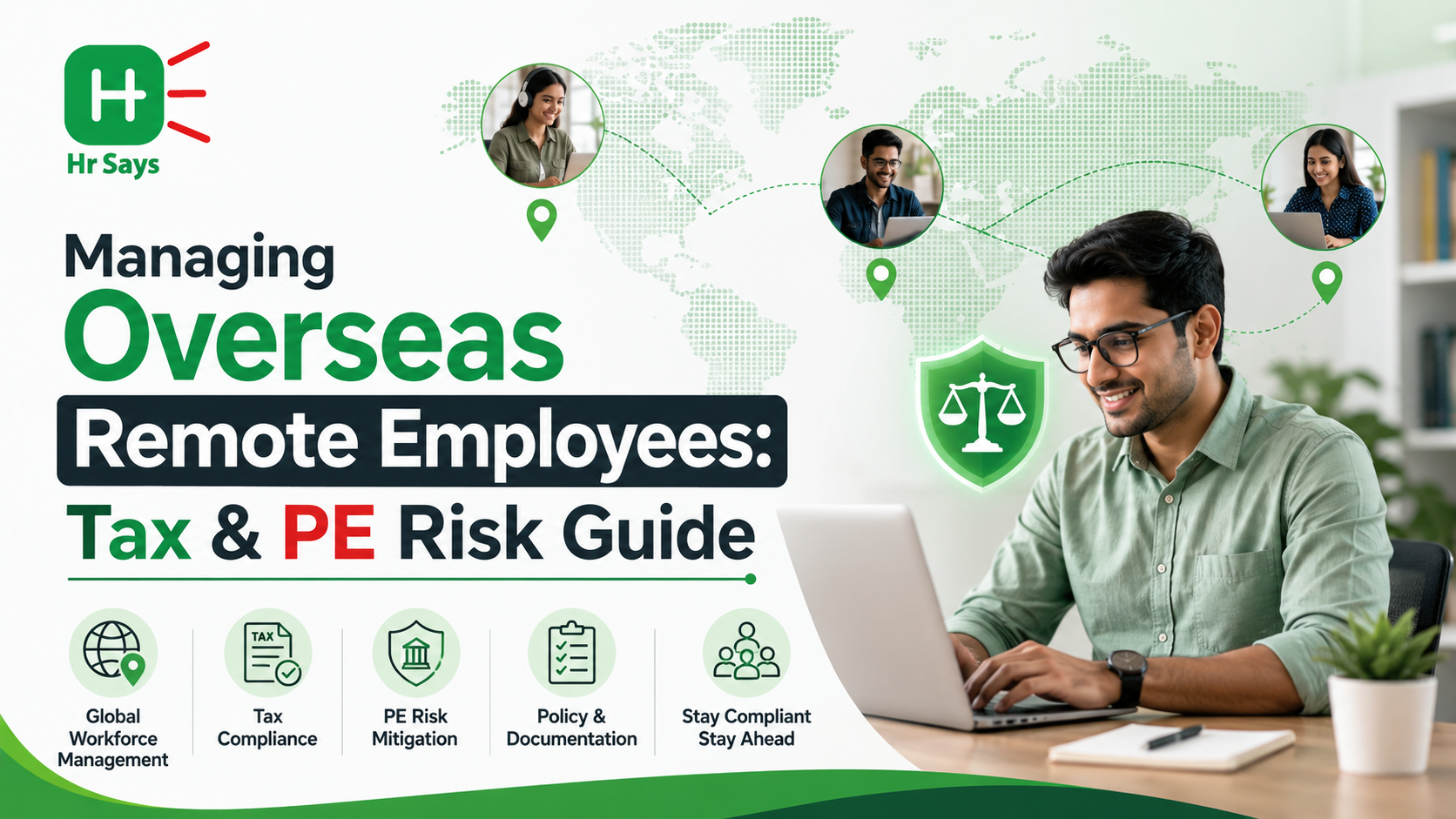
 Managing a distributed workforce across borders offers immense talent acquisition advantages, but it fundamentally transforms corporate liability. When an employee performs work from a foreign jurisdiction, they inadvertently subject their employer to local tax, payroll, and corporate governance laws.





Managing a distributed workforce across borders offers immense talent acquisition advantages, but it fundamentally transforms corporate liability. When an employee performs work from a foreign jurisdiction, they inadvertently subject their employer to local tax, payroll, and corporate governance laws.
The primary exposure point for cross-border operations is Permanent Establishment (PE) risk—a tax concept where a non-resident company becomes subject to local corporate income tax due to a continuous, taxable business presence in a host country.
1. What Triggers Permanent Establishment (PE) Risk?
Under international tax frameworks (such as the OECD Model Tax Convention), PE is triggered through three primary mechanisms:
A. Fixed Place of Business PE (The Home Office Trigger)Historically, PE required a physical office or lease. Today, tax authorities increasingly view an employee’s home office as a "fixed place of business" if the employer requires, expects, or commercially relies on the employee to work from that specific foreign jurisdiction. Working remotely for more than 50% of time over a 12-month period in a foreign market can trigger a fixed-place PE if a local commercial nexus exists.
B. Dependent Agent PE (The Contract-Signing Trigger)If a remote employee in a host country routinely negotiates, concludes, or plays the principal role in closing sales contracts on behalf of the company, they create an Agency PE. This is the fastest route to triggering corporate tax liability.
C. Management PE (The Executive Travel Trigger)When senior C-suite executives, directors, or key decision-makers work remotely from a foreign country, tax authorities may argue that the company's Place of Effective Management (POEM) has shifted to the host country. This can subject the entire company’s worldwide income to corporate taxation in the host jurisdiction.
2. The Operational Compliance Cascade
Creating a PE triggers immediate operational burdens across five regulatory layers:
- Corporate Tax Liability: The foreign country levies corporate income tax on profits attributable to the local remote worker's activities.
- Payroll Tax & Social Security Withholding: Employers must register locally to withhold wage taxes and contribute to local social security, healthcare, and pension schemes.
- Local Employment Law Enforcement: The employee becomes entitled to local statutory protections—including mandatory severance, minimum paid leave, local public holidays, and strict dismissal rules—overriding their home country contract.
- Transfer Pricing Adjustments: Tax authorities require formal transfer pricing documentation to calculate intercompany service fees and profit allocations between the parent company and the host country presence.
- Fines and Back Penalties: Failure to report PE can lead to retroactive tax assessments, severe late-filing penalties, interest charges, and reputational damage.
3. Structural Comparison: Managing Cross-Border Remote Talent
Comparing pathways for international hiring highlights how engagement models impact corporate tax liability, operational risk, and administrative overhead across five core parameters:
- Direct Remote Hire (Unregistered): Relies on the home entity while operating without local registration. Carries extreme PE risk and high liability for corporate tax and payroll non-compliance. While initial administrative setup is low, complexity becomes extreme during an audit. Never recommended for core roles.
- Employer of Record (EOR): Uses a third-party local EOR entity as the legal employer. Carries low-to-moderate PE risk (EOR absorbs local payroll, tax, and employment law liabilities, though core sales or management roles can still create PE). Offers very low administrative complexity and works best for quick expansion or hiring small teams.
- Local Subsidiary or Branch: Establishes a company-owned legal entity in the host country. Ensures controlled, zero-PE exposure by creating a formal local corporate presence. Involves high administrative complexity and setup costs, making it ideal for strategic markets with ten or more long-term employees.
- Independent Contractor: Engages self-employed individuals directly. Features moderate-to-high PE risk due to worker misclassification hazards if the individual is managed like a regular employee. Requires clear contractual boundaries and non-exclusivity clauses, best suited for short-term, project-based tasks.
4. High-Performance Action Plan for HR & Tax Leaders
To mitigate tax compliance risk while supporting flexible remote policies, execute a three-phase governance roadmap:
- Establish a Cross-Border Work Policy and Role Boundaries
Phase 1: Policy Governance
Draft an explicit Work-From-Abroad Policy. Cap temporary remote work days (e.g., maximum 20–30 days per rolling calendar year). Ban all contract negotiations, deal closures, and executive decision-making activities while working remotely in non-registered countries. - Conduct Role Risk-Scoring and Employee Audits
Phase 2: Exposure Mapping
Audit current distributed employees. Categorize roles into Risk Levels: High (Executives, Sales Leads with signing power), Moderate (Senior Managers), and Low (Software Engineers, Designers, Internal Support). - Deploy EOR Infrastructure or Formal Subsidiaries
Phase 3: Legal Remediation
For employees exceeding threshold limits (e.g., working 183+ days in a foreign country or core roles), transition them onto a local Employer of Record (EOR) or set up a formal branch entity. Obtain A1 certificates or totalization agreements for social security exemptions where bilateral treaties exist.
Actionable Strategy: Digital Governance & Compliance Frameworks
- Monitor Border & Travel Telemetry Automatically: Implement automated travel-tracking workflows within HRIS portals. With real-time border tracking mechanisms (such as the EU Entry/Exit System logging stays biometrically), tax authorities have instant visibility into employee cross-border movements.
- Verify Professional Credentials Natively: Ensure HR compliance officers and global mobility managers maintain certified credentials in international tax, employment law, and global compensation. Track professional development credits using digital registries like the APAAR ID system within the Academic Bank of Credits (ABC) network.
- Maintain Health & Emergency Protection Pipelines: Ensure cross-border employees maintain active international health coverage and emergency medical evacuation benefits. Sync worker health records through secure digital channels like the ABHA ID (Ayushman Bharat Health Account) pipeline to ensure care continuity during relocations.
Frequently Asked Questions (FAQs)
Q1. What is the 183-day rule in cross-border employment?Under most double taxation avoidance agreements (DTAAs), an employee becomes a personal tax resident in a host country if they spend 183 days or more within a 12-month period in that jurisdiction. This triggers host-country individual income tax withholding for the employer.
Q2. Does hiring an international employee via an EOR completely eliminate PE risk?No. While an Employer of Record (EOR) absorbs local payroll, social security, and employment law risks, it does not shield against PE if the employee negotiates contracts, drives local revenue, or acts as a C-suite decision-maker for the parent company.
Q3. Can a company hire an international worker as an independent contractor to avoid PE risk?Only if the worker is genuinely independent. If the contractor works exclusively for your company, uses company-provided equipment, has fixed hours, or is managed like a standard employee, tax authorities will classify them as a dependent agent, creating severe misclassification fines and immediate PE liabilities.
Q4. What is a Totalization Agreement, and how does it help?A Totalization Agreement is a bilateral treaty between two countries that prevents double social security taxation. It allows a temporary cross-border employee to remain covered under their home country's social security system, waiving host-country contributions for a specified period (typically 1–5 years).
Q5. What happens if a tax authority determines my company has an undeclared PE?The tax authority can levy retroactive corporate income taxes on profits attributed to that country, assess penalties and interest charges on unpaid payroll taxes, enforce mandatory local benefits, and freeze local operations or bank accounts.
Q6. How does an APAAR ID assist global mobility and compliance teams?An APAAR ID provides a lifetime, verified digital record of academic degrees, legal certifications, and professional qualifications across national databases, streamlining credential background checks for executive relocation and international mobility.
Q7. What activities are considered "auxiliary or preparatory" (Non-PE creating)?Activities like local market research, supply chain sourcing, internal IT support, background data processing, or attending trade conferences generally do not create a PE, provided they remain purely secondary to the company’s core profit-generating business model.
Q8. Why are senior executives working abroad considered the highest PE risk?Senior executives possess strategic decision-making authority. If a CEO or CFO works from a foreign country long-term, tax authorities may declare that the company's "Place of Effective Management" (POEM) has moved, subjecting global corporate earnings to host-country corporate tax.
Q9. What should be included in a Work-From-Anywhere (WFA) remote policy?A compliant WFA policy should mandate prior HR approval, limit remote stays to 20–30 days per year, restrict working from unapproved tax jurisdictions, ban contract signing/negotiations abroad, and require proof of proper work visas or remote work permits.
Q10. What immediate action should a CEO or HR Director take today to limit PE exposure?Audit the location of all remote employees and contractor contracts, flag any team members in sales or leadership roles working outside their home entity jurisdiction, and establish an automated approval workflow for all international remote work requests.