 Sunday, November 29, 2026
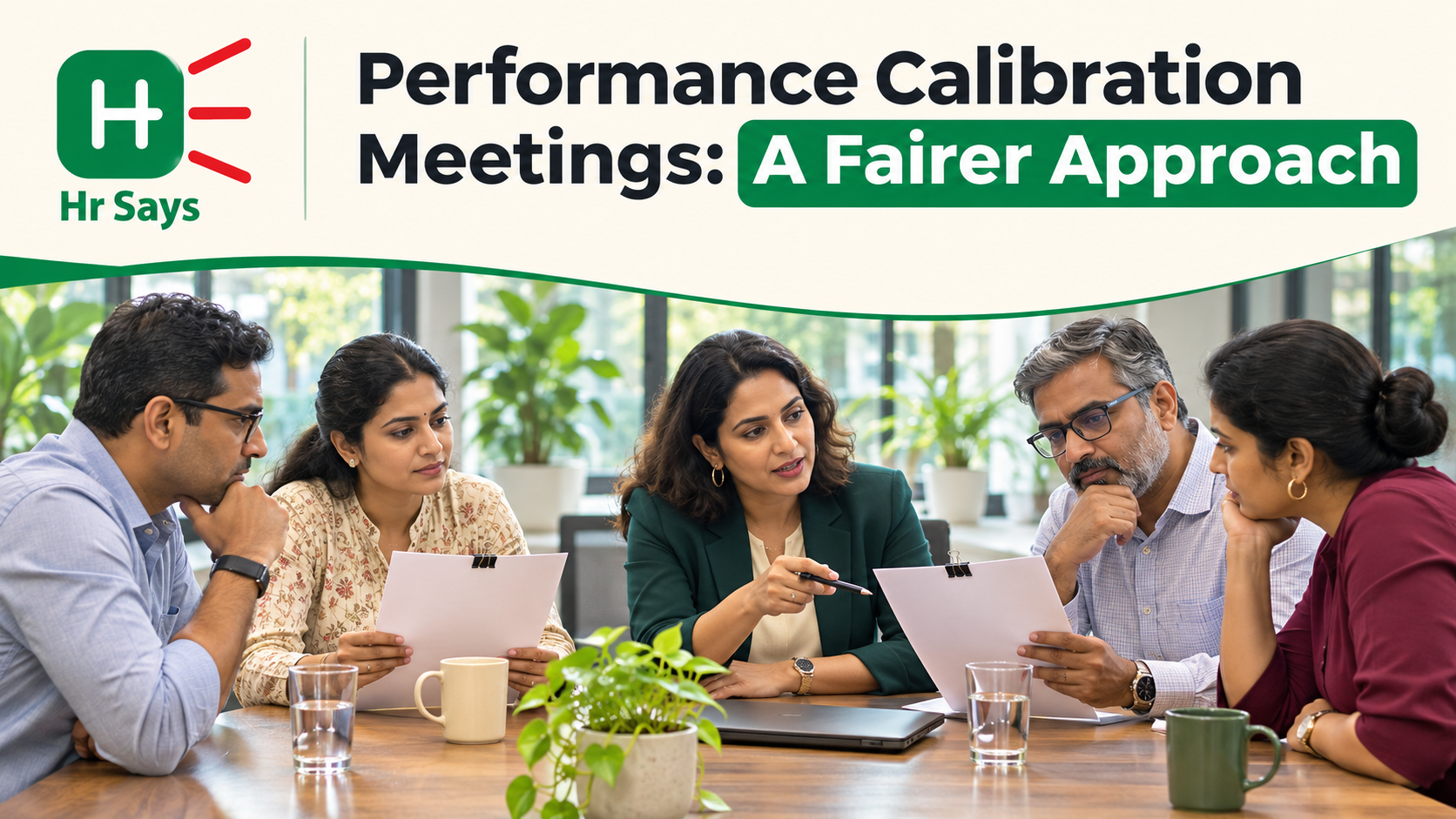
 Performance calibration meetings, when structured fairly and facilitated well, eliminate manager bias, align ratings consistently, and build employee trust across Indian organizations.





Introduction
Performance calibration meetings are among the most consequential conversations that happen inside any organization. They determine who gets promoted, who receives a higher increment, who is recognized as a high performer, and in some cases, who faces a performance improvement plan. Yet in many Indian organizations, these meetings are either conducted without a clear structure or reduced to a brief discussion where the loudest voice in the room wins the argument.
The irony is that calibration meetings were designed specifically to bring fairness into the performance review process. When conducted well, they help organizations move beyond individual manager bias and arrive at a consistent, evidence-based view of employee performance. When conducted poorly, they can amplify the very biases they were meant to eliminate.
For HR professionals, founders, and business leaders who are serious about building fairer workplaces, understanding how to redesign and improve calibration meetings is not optional. It is a core responsibility of people leadership.
Understanding What Performance Calibration Meetings Are Meant to Do
A performance calibration meeting brings together a group of managers, HR business partners, and sometimes senior leaders to review and align employee performance ratings across teams. The goal is to ensure that a "high performer" label means the same thing across different departments and that ratings are not simply a reflection of how generous or strict a particular manager happens to be.
In theory, this is a powerful idea. Without calibration, the same level of output might earn an employee a rating of "exceeds expectations" under one manager and "meets expectations" under another. This inconsistency creates pay inequity, damages employee trust, and distorts talent decisions.
In practice, however, many calibration meetings in Indian companies fall into predictable traps. Managers advocate strongly for their own team members regardless of objective evidence. Senior leaders' opinions carry disproportionate weight. Employees who are less visible or who work in support functions get rated lower simply because their contributions are harder to articulate quickly in a group setting.
Fixing these problems requires both structural changes and cultural shifts.
Common Causes of Unfairness in Calibration Meetings
Understanding why calibration meetings go wrong is the first step toward making them better.
One of the most prevalent issues is recency bias. Managers tend to recall what an employee did in the last two or three months before the review cycle rather than evaluating the full year of work. This means employees who had a strong first half but faced personal challenges later in the year are often rated lower than their actual annual contribution warrants.
Another significant issue is proximity bias. In hybrid and remote work environments, which have become increasingly common in Indian organizations since 2020, employees who work from the office or who interact more frequently with leadership tend to receive higher visibility and therefore more favorable ratings. Employees in Tier 2 or Tier 3 city locations, or those working from home, are particularly vulnerable to this bias.
The halo and horn effect is equally problematic. A single impressive project or a single visible mistake can color how a manager perceives an employee's entire year of performance. This distortion gets carried into the calibration room and, without proper checks, becomes part of the final rating.
Finally, advocating power imbalances create serious fairness issues. In many Indian organizations, hierarchy is deeply respected. When a senior leader expresses a strong opinion about an employee's rating early in the calibration conversation, other managers often defer to that view, even if their own evidence points in a different direction. This turns calibration into a validation exercise rather than a genuine alignment process.
How to Structure a Fairer Calibration Process
Building a fairer calibration process begins long before anyone enters the meeting room. It requires preparation, documentation, and a clear framework that all participants understand and agree to follow.
The foundation of a fair calibration process is a well-defined performance framework. Organizations need to establish in advance what each rating level means, what evidence is required to support each rating, and how performance is evaluated across different roles and functions. Without this foundation, calibration discussions become subjective debates rather than structured evaluations.
Before the meeting, every manager should be required to submit a written summary of each employee's performance that includes:
- Specific accomplishments with measurable outcomes
- Challenges faced and how they were addressed
- Behavioral examples aligned to company values
- Evidence of growth, learning, or capability development
- Any relevant context such as team restructuring or personal circumstances
This documentation requirement forces managers to move beyond gut feelings and prepare evidence-based arguments. It also creates a written record that HR can reference if questions arise later about how a particular decision was made.
Running the Calibration Meeting Itself
The meeting facilitation process matters enormously. HR business partners should take an active role as neutral facilitators rather than passive note-takers. Their job is to ensure the conversation stays grounded in evidence, to flag when a discussion appears to be drifting into bias territory, and to make sure every employee's case gets adequate airtime regardless of which department they belong to.
One practical technique that many progressive organizations use is the structured presentation format. Each manager is given a fixed amount of time to present their team members' cases. The presentation must follow a consistent template and must reference documented evidence. Other managers can ask clarifying questions, but no one should change their position on a rating without citing specific new information that was not previously considered.
Another important safeguard is the practice of requiring managers to flag any rating changes they are willing to make during the calibration discussion. If a manager arrives with an employee rated at "exceeds expectations" and leaves with that employee rated at "meets expectations," there should be a clear documented reason for that change. Without this accountability, calibration meetings can subtly harm employees whose managers are less assertive or less senior.
HR leaders should also ensure that the distribution of final ratings is reviewed for patterns that might indicate systemic bias. If women, employees from certain locations, or employees from particular departments are consistently rated lower year after year, that pattern warrants investigation.
Addressing Unconscious Bias Before and During the Meeting
Unconscious bias training is a necessary but not sufficient condition for fairer calibration. Training alone does not change behavior in the moment. Organizations need to build structural interventions that catch bias as it happens.
One effective approach is to introduce what researchers call a "bias interrupter" into the meeting format. This is a designated role, often played by the HR facilitator, whose explicit responsibility is to pause the conversation when bias-prone language appears. Phrases like "she is not very strategic," "he does not seem very ambitious," or "I am not sure she would be comfortable in a leadership role" are common examples of bias-driven characterizations that should be challenged in real time.
Another useful practice is blind review as a preparatory step. Before the calibration meeting, HR can present initial performance data and evidence to a panel without identifying the employee by name, gender, or department. The panel then provides a preliminary rating based solely on the evidence. These preliminary ratings are then compared to the manager's proposed ratings during the calibration conversation, and significant differences are discussed and explained.
In the Indian workplace context, where social familiarity between senior leaders and certain employees can influence perceptions, this kind of blind review adds a valuable layer of objectivity to the process.
Making Calibration Outcomes Transparent and Actionable
Fairness in calibration does not end when the meeting concludes. What happens after the meeting is equally important. Employees deserve to understand how their performance was assessed and what the key factors were that influenced their rating. This does not mean sharing every detail of the calibration discussion, but it does mean that managers should be able to have clear, specific, and honest performance conversations with each team member after calibration is complete.
HR teams should provide managers with talking points and coaching on how to communicate calibration outcomes effectively. A manager who cannot explain why an employee received a particular rating in specific, evidence-based terms is not prepared for that conversation. And an employee who receives a vague or inconsistent explanation is right to question the fairness of the process.
Organizations should also use calibration data to inform talent development decisions. High performers should have documented development plans that reflect the investment the organization is making in their growth. Employees who are rated lower should receive clear guidance on what specific changes in performance or behavior would result in a different outcome in the next cycle.
The Role of Technology in Supporting Fairer Calibration
HR technology platforms have made it significantly easier to structure and document the calibration process. Many modern performance management systems now include calibration modules that allow managers to view comparative performance data, track rating distributions, and identify anomalies in real time.
For Indian organizations that are scaling quickly, investing in an integrated HR platform that connects goal setting, continuous feedback, and calibration in a single workflow is a meaningful step toward building a more consistent and defensible performance management process. Platforms that also capture qualitative feedback from multiple sources, including peers, cross-functional collaborators, and direct reports, give calibration participants a richer and more balanced picture of each employee's contribution.
The key is to use technology as a tool to support structured human judgment rather than as a substitute for it. Data and dashboards can flag patterns and prompt questions. The actual decisions still require thoughtful human conversation guided by clear principles.
Frequently Asked Questions
Q1: What is a performance calibration meeting?
A performance calibration meeting is a structured discussion among managers and HR leaders to align and standardize employee performance ratings across teams, ensuring consistency and fairness in the appraisal process.
Q2: How do you reduce bias in calibration meetings?
Bias can be reduced by using structured evaluation criteria, training managers on unconscious bias, relying on documented evidence, involving HR as a neutral facilitator, and introducing bias interruption techniques during the meeting.
Q3: Who should attend a calibration meeting?
Calibration meetings typically include direct managers, skip-level managers, HR business partners, and senior leadership, depending on the size and structure of the organization.
Q4: How often should calibration meetings be held?
Most organizations hold calibration meetings once or twice a year, typically aligned with their annual or mid-year performance review cycles. Some organizations also conduct a lighter calibration check at the quarter mark.
Q5: What is the difference between a performance review and a calibration meeting?
A performance review is a one-on-one conversation between a manager and an employee. A calibration meeting is a cross-functional discussion among managers and HR to ensure ratings are consistent and fair across the organization.
Resources
- Society for Human Resource Management (SHRM): Research and practitioner guidance on performance management best practices and calibration processes.
- NASSCOM HR Research: Insights on performance management trends specific to the Indian technology and services industry.
- Ministry of Labour and Employment, Government of India: Policy frameworks and labor compliance guidelines relevant to employee appraisal and workplace fairness.
- Harvard Business Review: Peer-reviewed and practitioner articles on reducing bias in performance evaluations and building fairer HR processes.
- LinkedIn Talent Insights: Annual reports on talent management, performance trends, and HR benchmarks across Indian industries.
Interlinking Keywords
Performance management process, employee appraisal system, HR calibration framework, unconscious bias in the workplace, talent development strategy, fair performance reviews, HR business partner role, continuous feedback culture, performance improvement plan, employee recognition programs
Last Reviewed By
Dr. Manthan Tripathi and Hr Says Advisory Panel on 27 November 2026.
Disclaimer
The information presented in this article is intended for general informational and educational purposes only. It does not constitute legal, HR compliance, or professional consulting advice. Organizations should consult qualified HR professionals, legal advisors, or certified consultants before implementing any changes to their performance management or calibration processes. HRSays does not accept liability for decisions made based on the content of this article.