 Monday, November 23, 2026
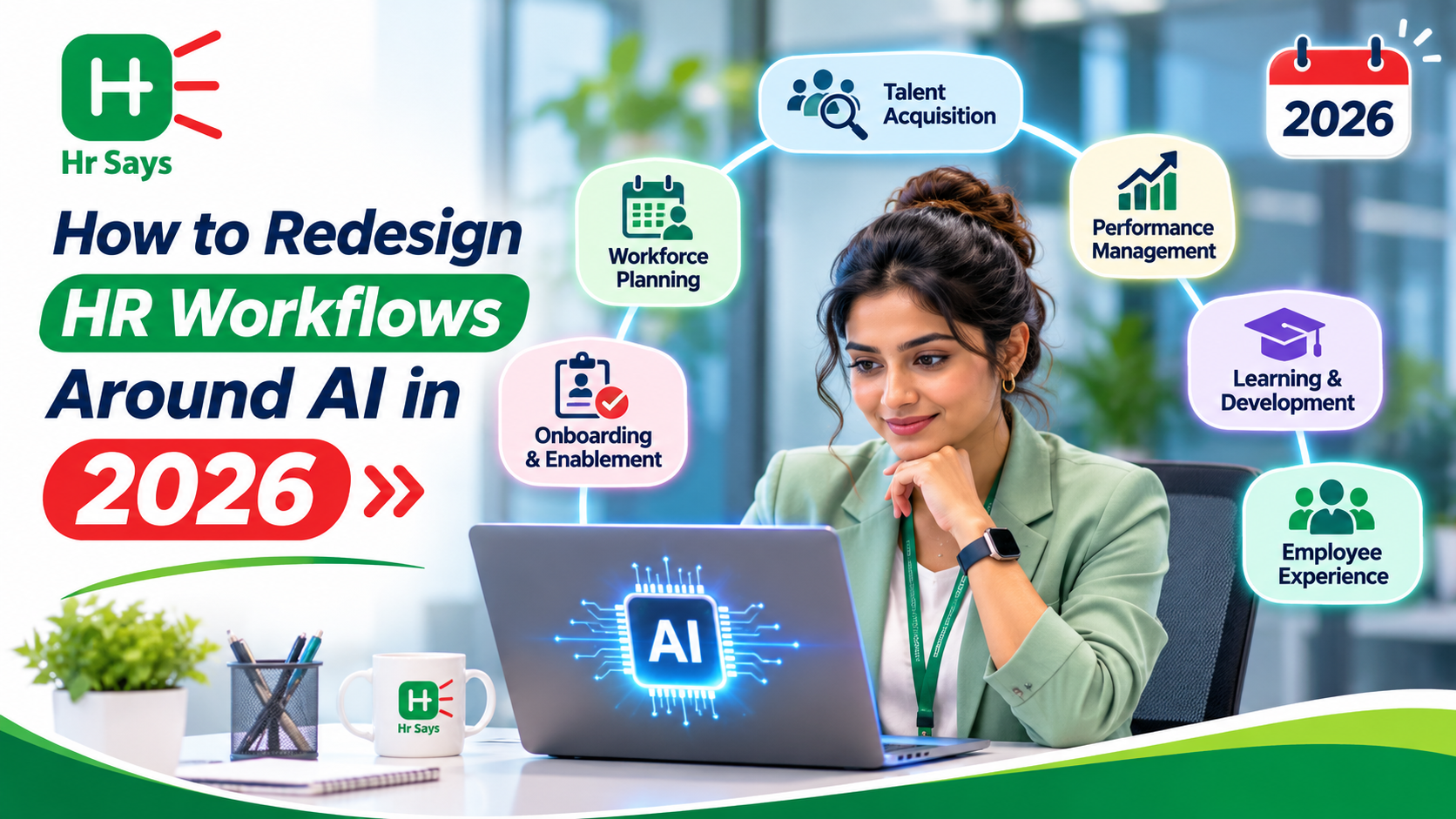
 AI is reshaping Indian HR workflows across recruitment, onboarding, performance management, and compliance. HR leaders must redesign processes thoughtfully, blending intelligent automation with strong human judgment for lasting organizational impact.





Introduction
Artificial intelligence is no longer a distant concept on the horizon for Indian workplaces. It is actively reshaping how HR teams hire, onboard, engage, and retain talent. From Bengaluru's technology corridors to manufacturing hubs in Pune and emerging startup ecosystems in Hyderabad, HR professionals across the country are facing the same fundamental question: how do organizations redesign their existing HR workflows around AI without losing the human core of people management?
This is not simply a question of deploying new software. It is a strategic rethinking of how HR functions operate, how decisions are made, and how the relationship between technology and people can produce better outcomes for everyone involved. For HR leaders, founders, and business owners in India, this guide offers a structured, practical approach to redesigning HR workflows around AI with clarity, purpose, and long-term value.
Understanding AI in the Context of HR Transformation
Before redesigning any workflow, HR leaders must develop a clear understanding of what AI actually does inside an HR function. AI in HR is not a single tool. It is a category of technologies that includes machine learning, natural language processing, predictive analytics, robotic process automation, and generative AI. Each of these has specific applications across different HR domains.
In the Indian context, the adoption of AI in HR has accelerated significantly over the past few years. According to a 2024 report by NASSCOM, over 60 percent of large Indian enterprises have begun piloting or deploying AI tools in at least one HR function. The interest is not limited to large organizations. Startups and mid-sized companies across Tier 1 and Tier 2 cities are increasingly exploring AI-powered HRMS platforms, applicant tracking systems, and employee engagement tools.
The core value proposition of AI in HR rests on three pillars:
- Reducing administrative burden so HR professionals can focus on strategic and relational work
- Improving decision-making through data-driven insights rather than intuition alone
- Creating more consistent and equitable processes across the employee lifecycle
Understanding this foundation is essential before any workflow redesign begins.
Mapping Existing HR Workflows Before Making Changes
One of the most common mistakes organizations make when introducing AI is attempting to automate workflows that are already broken. AI does not fix poorly designed processes. It amplifies them, including their inefficiencies and biases. The first practical step in any HR workflow redesign is an honest, thorough audit of existing processes.
HR teams should map every major workflow from end to end. This includes recruitment and sourcing, candidate screening and shortlisting, interview scheduling, offer management, onboarding, learning and development, performance management, payroll processing, compliance reporting, and exit management. For each workflow, the HR team should ask the following questions.
Where is the most time being consumed? Where are the most errors occurring? Where are decisions being made inconsistently? Where is employee experience suffering because of delays or lack of communication?
This mapping exercise creates a prioritized list of workflows where AI can deliver the greatest return on investment. In most Indian organizations, recruitment, onboarding, and compliance reporting consistently emerge as the highest-priority areas for AI-driven redesign.
Redesigning the Recruitment Workflow with AI
Recruitment is typically the first HR workflow that organizations redesign around AI, and for good reason. The volume of data involved in hiring, from job descriptions and resumes to interview notes and assessment scores, makes it one of the most suitable areas for intelligent automation.
AI-Powered Sourcing and Job Description OptimizationModern AI tools can analyze job descriptions for gendered language, overly restrictive requirements, and poor keyword alignment with candidate search behavior. For Indian HR teams operating in competitive talent markets, optimizing job descriptions using AI-driven suggestions has shown measurable improvements in both the quality and diversity of applicant pools.
AI-powered sourcing tools can scan professional networks, alumni databases, and internal talent pools to identify candidates who match specific role requirements before a single manual search is conducted. This shifts the recruiter's role from administrative sorting to strategic evaluation.
Intelligent Resume Screening and Candidate RankingAI-based applicant tracking systems can process thousands of resumes in minutes, applying consistent scoring criteria based on skills, experience, and role fit. However, HR leaders must approach this capability with a critical eye. AI screening models trained on historical hiring data can perpetuate existing biases if not regularly audited and recalibrated.
Indian organizations operating in diverse, multilingual environments must ensure that their AI screening tools do not disadvantage candidates from Tier 2 or Tier 3 cities, candidates with non-English educational backgrounds, or candidates from communities historically underrepresented in certain industries.
Interview Scheduling and CoordinationOne of the most time-consuming administrative tasks in recruitment is coordinating interview schedules across multiple stakeholders. AI-powered scheduling tools integrated with calendar systems can reduce this burden dramatically, cutting average scheduling time from days to hours. This improvement in process speed also improves candidate experience, which is a growing concern for Indian employers competing for skilled talent.
Redesigning the Onboarding Workflow with AI
Onboarding is a critical moment in the employee experience, yet it remains one of the most inconsistently executed workflows in Indian organizations. Research consistently shows that employees who experience poor onboarding are significantly more likely to leave within their first year. AI offers meaningful opportunities to redesign onboarding into a more personalized, responsive, and efficient process.
Automated Document Collection and Compliance VerificationIn India, onboarding involves a substantial volume of documentation, including PAN card verification, Aadhaar-based identity checks, educational certificate validation, and statutory form submissions under various labor laws. AI-powered document management systems can automate the collection, verification, and filing of these documents, reducing processing time and minimizing compliance risk.
Personalized Onboarding JourneysGenerative AI tools can create personalized onboarding plans based on role, department, prior experience, and learning preferences. Rather than delivering the same generic onboarding content to every new employee, AI enables HR teams to tailor the experience, ensuring that each individual receives information that is relevant, timely, and actionable.
AI Chatbots for New Employee SupportAI-powered chatbots deployed during the onboarding period can answer frequently asked questions about policies, benefits, payroll cycles, and workplace processes without requiring HR staff to respond manually to each query. For large Indian organizations onboarding hundreds of employees simultaneously across multiple locations, this capability represents a significant improvement in both efficiency and new employee satisfaction.
Redesigning Performance Management with AI
Performance management is one of the most complex and sensitive HR workflows to redesign, because it directly affects employee careers, compensation, and engagement. AI can support more continuous, data-driven, and transparent performance processes, but only if the redesign is approached carefully.
Continuous Feedback SystemsAI-enabled performance management platforms can facilitate continuous feedback between managers and employees throughout the year rather than relying solely on annual appraisals. For Indian organizations that have historically relied on year-end review cycles, this shift represents a meaningful cultural change as much as a process change.
HR leaders redesigning this workflow should invest time in preparing managers to use continuous feedback tools effectively. Technology alone will not drive behavior change.
Predictive Analytics for Attrition and EngagementAI models trained on engagement survey data, performance metrics, attendance records, and compensation data can identify employees at risk of leaving before they submit their resignation. For Indian companies operating in high-attrition sectors such as technology, banking, and business process outsourcing, this predictive capability has significant strategic value.
By identifying early warning signals, HR teams can intervene proactively through targeted conversations, career development opportunities, or compensation reviews rather than reacting after the fact.
Redesigning Compliance and Payroll Workflows with AI
India's labor law landscape is complex, with central legislation such as the Code on Wages, the Code on Social Security, and the Code on Industrial Relations operating alongside state-level variations. Compliance errors carry real financial and legal risk. AI can significantly reduce this risk by automating compliance monitoring and payroll processing.
AI-powered payroll systems can automatically apply the correct statutory deductions for Provident Fund, Employee State Insurance, Professional Tax, and TDS based on employee category, location, and compensation structure. These systems can also generate compliance reports and flag anomalies in real time, giving HR and finance teams advance warning of potential issues.
Building an AI-Ready HR Culture
Redesigning workflows around AI is not purely a technical exercise. It requires a parallel investment in building an AI-ready HR culture within the organization. HR professionals need to develop new capabilities, including data literacy, the ability to interpret AI-generated insights critically, and the judgment to know when human intervention is needed despite what an algorithm recommends.
Indian HR teams should prioritize upskilling programs that build these competencies. Organizations such as the National Institute for Human Resource Development (NIIHTD) and various SHRM India chapters offer relevant learning pathways. HRSays, as a knowledge platform for HR professionals, plays an active role in sharing practical insights, case studies, and expert perspectives that help HR teams navigate this transition thoughtfully.
Senior HR leaders must also model a balanced, thoughtful relationship with AI tools, neither dismissing them nor over-relying on them. The organizations that redesign HR workflows most successfully are those that position AI as a support system for human judgment rather than a replacement for it.
Frequently Asked Questions
Q1: What HR workflows should Indian companies automate with AI first?
Recruitment, onboarding documentation, and payroll compliance are typically the best starting points. These workflows involve high volumes of repetitive tasks, clear rules, and measurable outputs, making them well-suited for AI-driven automation before more complex, judgment-intensive processes are addressed.
Q2: How can HR leaders ensure AI tools do not introduce bias into hiring decisions?
HR leaders should regularly audit AI screening models for demographic bias, ensure training data reflects diverse candidate profiles, and require human review of all shortlisting decisions. Transparency about how AI scores are calculated is essential for maintaining fairness and trust in the recruitment process.
Q3: Is AI adoption in HR affordable for small and mid-sized Indian companies?
Yes. A wide range of AI-powered HRMS platforms are available at tiered pricing suitable for small and mid-sized organizations. Cloud-based tools with modular pricing allow smaller companies to start with specific features such as payroll automation or recruitment screening without committing to large upfront investments.
Q4: How should HR teams handle employee concerns about AI monitoring in the workplace?
Transparency is the most important principle. HR teams should clearly communicate what data AI tools collect, how it is used, who has access to it, and how it influences decisions that affect employees. Employees should have clear channels to raise concerns and seek clarification about AI-driven processes that affect their work.
Q5: What role does data privacy play in AI-driven HR workflows in India?
Data privacy is a critical consideration. Indian organizations using AI in HR must comply with the Digital Personal Data Protection Act, 2023. This requires obtaining informed consent from employees for data collection, ensuring data is used only for stated purposes, and maintaining security standards that protect sensitive personal information from unauthorized access or misuse.
Resources
- NASSCOM : Reports and research on AI adoption and digital transformation in Indian workplaces and enterprises
- Ministry of Labour and Employment, Government of India : Official source for Indian labor law updates, the new Labour Codes, and statutory compliance guidance
- Society for Human Resource Management (SHRM India) : Professional development resources, research reports, and best practice frameworks for HR leaders in India
- National Institute for Human Resource Development (NIIHTD) : Government-affiliated institute offering HR training, certification, and thought leadership for Indian HR professionals
Interlinking Keywords
AI in HR, HR automation India, future of HR, employee onboarding workflow, performance management system, HR technology platform, attrition prediction, labor law compliance India, HR digital transformation, workforce analytics
Last Reviewed By
Dr. Manthan Tripathi and Hr Says Advisory Panel on 21 November 2026.
Disclaimer
The information provided in this article is intended for general educational and informational purposes only. It does not constitute legal, compliance, or professional HR advisory guidance. Organizations should consult qualified HR, legal, and technology professionals before implementing AI-driven changes to their HR workflows. Labor law requirements vary by state and organization size in India and should be verified with appropriate legal counsel.