 Thursday, November 19, 2026
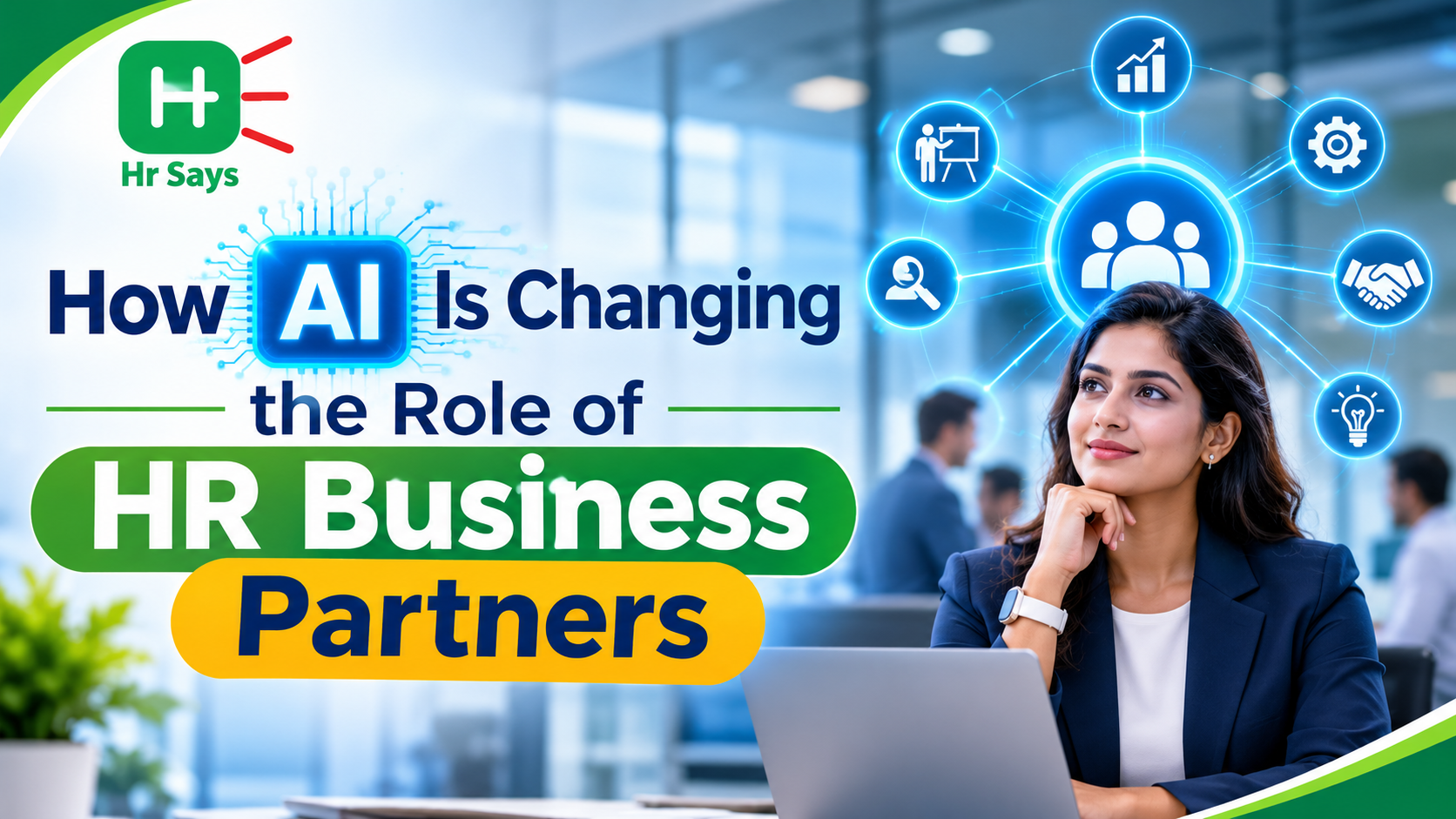
 Artificial intelligence is transforming the HR Business Partner role in India by automating routine tasks, enabling predictive analytics, and elevating HRBPs from operational handlers to strategic workforce advisors.





Introduction
The HR Business Partner role has always been about bridging the gap between people strategy and business outcomes. For years, HR Business Partners (HRBPs) operated at the intersection of workforce management and organizational direction, often navigating complex talent challenges with limited data and significant administrative burden. That reality is shifting rapidly.
Artificial intelligence is no longer a distant concept in the HR conversation. It is an active, present force that is rewriting what HRBPs are expected to know, do, and deliver. In India, where organizations ranging from early-stage startups in Bengaluru to large-scale enterprises in Mumbai and Delhi are investing in AI-powered HR tools, the transformation of the HRBP role is both urgent and consequential.
According to SHRM's 2026 State of AI in HR report, 62 percent of organizations globally now use AI somewhere in the business, while 46 percent expect to use it within the HR function this year. For HR Business Partners, this shift demands a new kind of readiness, one that combines human judgment with the analytical power of intelligent technology.
Understanding the HR Business Partner Role in the Modern Workplace
Before examining how AI is reshaping the HRBP function, it is worth understanding what the role fundamentally stands for. An HR Business Partner is not simply an administrative HR generalist. The HRBP operates as a strategic advisor to business unit leaders, translating people challenges into actionable workforce plans.
According to AIHR, business partnering is about truly understanding the business well enough to become a genuine thought partner to the leadership team, functioning as the right hand to that leadership structure. This means the HRBP has always needed strong business acumen, communication skills, and the ability to influence decisions at the leadership level.
However, the traditional HRBP model has often been weighed down by operational tasks. Policy queries, compliance issues, onboarding processes, and routine reporting frequently consumed a disproportionate share of an HRBP's working hours, leaving limited time for the strategic work the role was designed for. AI is changing that equation.
How AI Is Transforming Core HRBP Responsibilities
From Administrative Support to Strategic CounselOne of the most immediate impacts of AI on the HRBP role is the automation of repetitive and time-consuming administrative tasks. AI-powered chatbots and virtual HR assistants can now handle employee queries related to leave policies, benefits, payroll clarifications, and compliance documentation, tasks that once demanded significant HRBP attention.
At one global organization, automation of most HR support activity below the business partner level was used specifically to reduce operational costs, freeing HRBPs to concentrate on higher-order responsibilities. In the Indian context, where HR teams often work with large employee bases and lean team structures, this kind of automation can produce a meaningful shift in how HRBPs allocate their time.
The result is an HRBP who spends less time answering repetitive queries and more time partnering with business heads on workforce planning, capability development, and organizational design.
Predictive Analytics and Workforce IntelligencePerhaps the most significant transformation that AI brings to the HRBP function is the introduction of predictive analytics. Rather than relying solely on intuition and experience, HRBPs can now access data-driven insights on employee engagement, attrition risk, performance patterns, and talent gaps.
AI tools can identify which employees are most likely to leave based on behavioral signals, survey sentiment, performance trends, and absenteeism patterns. This allows HRBPs to intervene proactively rather than reactively. In a country like India, where attrition in sectors such as IT, banking, and retail remains a persistent challenge, predictive retention tools represent a genuine competitive advantage.
Deloitte South Asia's research points out that India is well positioned to lead the next phase of AI-enabled workforce transformation, given its digital ecosystem and talent base, though the ability to convert workforce data into faster and more informed business decisions will be a critical differentiator.
For HRBPs, this means learning to work fluently with people analytics dashboards and translating data insights into concrete recommendations for business leaders.
Talent Acquisition and Workforce PlanningAI has fundamentally altered how talent is sourced, screened, and assessed. Resume screening tools, AI-powered video interview analysis, and skills-matching platforms have significantly reduced the time-to-hire for many Indian organizations. HRBPs who understand how these tools work can collaborate more effectively with recruitment teams and business heads to design smarter hiring strategies.
India's IT-BPM sector alone employs 5.4 million professionals, with generative AI expected to impact 70 to 80 percent of IT roles in the next three to five years. This creates a pressing need for HRBPs to participate actively in workforce planning conversations, specifically around identifying which roles will evolve, which skills will become obsolete, and how organizations can reskill employees before gaps become critical.
NASSCOM estimates that India will need to reskill 60 to 65 percent of its workforce by 2030, with AI adoption expected to create 38 million new jobs across sectors in that period. The HRBP who can help an organization navigate this skills transition will become indispensable to business leadership.
Performance Management and Employee ExperiencePerformance management is another area where AI is driving measurable change. Traditional annual appraisal cycles are being replaced by continuous feedback platforms that use AI to surface real-time performance insights, identify skill gaps, and recommend personalized development plans.
For HRBPs, this shift means moving from calendar-driven performance conversations to ongoing coaching relationships. AI tools can alert an HRBP when an employee's engagement scores drop, when a high-performer shows early signs of disengagement, or when a team is experiencing collaboration difficulties. This kind of real-time visibility enables HRBPs to act with precision and empathy rather than waiting for a situation to deteriorate.
The Evolving Skill Set of an AI-Ready HR Business Partner
The transformation of the HRBP role through AI demands a parallel evolution in the skills and competencies that HR professionals bring to the table. The HR Business Partner of 2026 and beyond will need to master a combination of capabilities that were not previously central to the role.
Key competencies that AI-ready HRBPs are expected to develop include:
- Data literacy and HR analytics: The ability to read, interpret, and communicate insights from people data, even without deep technical expertise.
- AI tool fluency: Comfort in working with AI-powered platforms for talent management, engagement measurement, and workforce planning.
- Business acumen: A sharper understanding of financial outcomes, organizational strategy, and market dynamics to anchor HR insights in business context.
- Change management: As AI drives organizational redesign, HRBPs will serve as change agents, helping employees and leaders adapt to new ways of working.
- Ethical HR judgment: The ability to identify and address bias in AI-generated recommendations, ensuring fairness in hiring, promotions, and performance evaluation.
As AI rewires the anatomy of the HRBP role, the job title may remain the same but the expectations attached to it are being fundamentally restructured, with less time on routine work and more time on quality control, strategic interpretation, and meaningful questioning.
The Indian Context: Opportunities and Challenges
India's HR landscape has its own distinct characteristics that shape how AI adoption plays out within the HRBP function. Organizations across Tier 1 cities such as Bengaluru, Hyderabad, Pune, and Chennai are ahead in AI adoption, particularly in the IT, fintech, and e-commerce sectors. However, Tier 2 city organizations and traditional industries such as manufacturing, agriculture technology, and regional retail are still in the early stages of AI integration.
The SHRPA 2026 Global Executive Insights report notes that 41 percent of organizations in the APAC region are still in the experimentation stage of AI transformation, with only 22 percent leading AI transformation at the enterprise level, while India specifically has the highest number of organizations still in the pilot stages.
This means that for many Indian HRBPs, the immediate challenge is not simply learning to use new tools but also making a business case for AI investment, managing change resistance among leaders, and ensuring that AI tools are aligned with the organization's culture and compliance requirements, including India's data privacy framework under the Digital Personal Data Protection Act.
A BCG report notes that there is a significant shift underway in how organizations are positioning HR as a strategic partner shaping business outcomes rather than a purely operational function, and that HR needs to move faster in implementing digital technology both within the HR function and in driving people elements of digital transformation across the business.
For Indian HRBPs, this is both an opportunity and a mandate. Those who position themselves as AI-informed strategic advisors will find their relevance within organizations growing substantially.
From AI Adopter to AI Strategist: The Road Ahead for HRBPs
As articulated by Paramjit Singh Nayyar, CHRO at Hero FinCorp, by 2026, HR must move from being a technology adopter to a strategic AI partner, one that builds AI credibility through demonstrable business impact, not simply capability.
This framing captures something important for HRBPs at every level. The goal is not to become an AI engineer or a data scientist. The goal is to become a credible, confident user of AI-powered insights who can translate those insights into better people decisions, stronger workforce strategies, and measurable organizational outcomes.
The world is witnessing a significant shift in how HR will operate, moving from a Business Partner and Operations model toward a Centre of Excellence model for the people side of business that acts as a strategic think tank for the organization.
For HRBPs who are willing to invest in learning, adapt their mindset, and embrace a data-informed approach to people work, this transformation represents one of the most significant career opportunities the profession has seen in decades.
Conclusion
Artificial intelligence is not replacing the HR Business Partner. It is redefining what excellence in that role looks like. The HRBPs who will lead organizations forward are those who can pair human empathy and business insight with the analytical power of AI tools. In India, where workforce complexity is immense and organizational change is accelerating, this new HRBP model is not aspirational. It is becoming a practical necessity.
HRSays recognizes that HR professionals in India need more than awareness of these shifts. They need actionable insights, real-world conversations, and a community that takes the future of work seriously. As AI continues to reshape the workplace, the HR Business Partner who evolves alongside it will not just remain relevant, but will become more essential than ever before.
Frequently Asked Questions
Q1: What does an HR Business Partner do?
An HR Business Partner is a senior HR professional who works directly with business unit leaders to align people strategy with organizational goals. The role involves workforce planning, talent management, employee relations, organizational design, and change management.
Q2: How is AI changing the HR Business Partner role in India?
AI is enabling Indian HRBPs to shift from administrative tasks to strategic responsibilities by automating routine processes, providing predictive workforce analytics, improving talent acquisition efficiency, and offering real-time employee engagement insights. This allows HRBPs to function more as strategic advisors and less as operational handlers.
Q3: Will AI replace HR Business Partners?
AI is unlikely to replace HR Business Partners because the role requires judgment, empathy, relationship building, and contextual decision-making that AI cannot replicate. Instead, AI will augment the HRBP role by handling data processing and routine tasks, freeing HRBPs for higher-value strategic work.
Q4: What skills do HR Business Partners need in the age of AI?
HR Business Partners will need skills in HR analytics and data literacy, AI tool fluency, business acumen, change management, and ethical decision-making. The ability to interpret AI-generated insights and translate them into business-relevant recommendations is becoming a core competency for the role.
Q5: What is the future of the HR Business Partner role in India?
The future HRBP in India will function closer to a strategic business advisor and organizational change architect. As Indian organizations accelerate AI adoption across sectors, HRBPs who can lead workforce transformation, guide reskilling initiatives, and drive data-informed talent strategies will command greater influence and compensation.
Resources
- SHRM India: Research, insights, and frameworks on AI transformation in HR across Indian organizations.
- People Matters (peoplematters.in): Coverage of SHRPA HR Tech and Transformation research and HR industry trends in India.
- NASSCOM FutureSkills (nasscom.in): Data and programs on workforce reskilling and AI readiness in India's technology sector.
- Deloitte South Asia Human Capital Reports: Research on HR analytics maturity, data readiness, and strategic HR transformation in Indian enterprises.
- NITI Aayog National Strategy for Artificial Intelligence (niti.gov.in): India's national policy direction on AI adoption across sectors, including workforce development.
Interlinking Keywords
HR Business Partner role in India, AI in HR, predictive HR analytics, HR technology India, future of HR Business Partner, employee attrition prediction, workforce planning India, HR digital transformation, HR strategy and AI, people analytics India, HRBP skills 2026, generative AI in HR, HR operating model India, AI-powered talent management, HR change management
Last Reviewed By
Dr. Manthan Tripathi and Hr Says Advisory Panel on 17 November 2026.
Disclaimer
The information presented in this article is intended for general informational and professional development purposes only. It reflects trends, research findings, and insights available at the time of publication. Organizational outcomes may vary based on industry, company size, existing HR infrastructure, and the nature of AI tools deployed. Readers are encouraged to consult with qualified HR technology and organizational development professionals before making strategic decisions related to AI implementation in their HR functions. HRSays does not endorse any specific AI platform, vendor, or technology solution mentioned or referenced in this article.