 Saturday, November 28, 2026
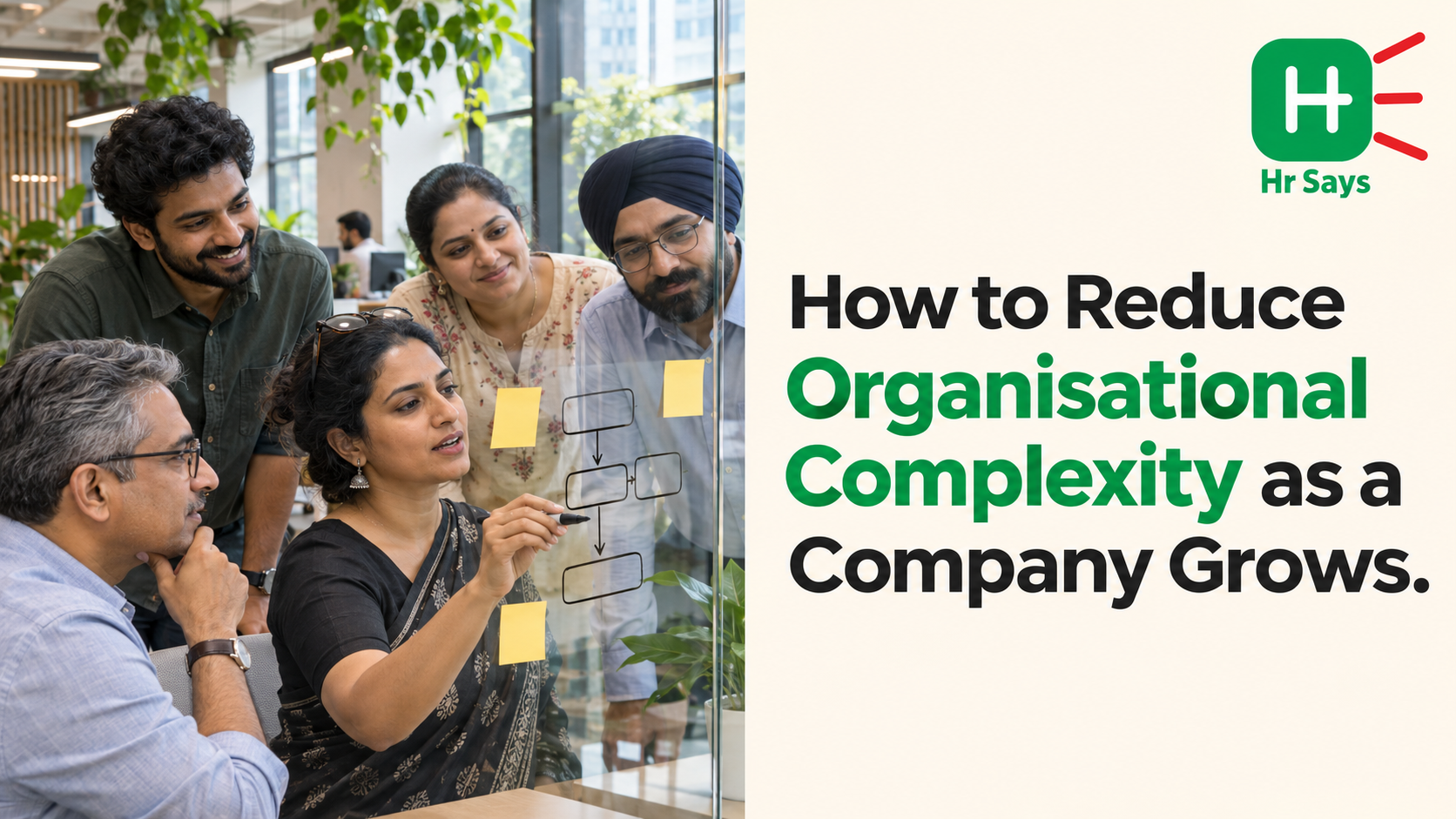
 Growing companies must address organisational complexity through structural audits, role clarity, simplified processes, and empowered decision-making to build agile, high-performing workplaces that scale sustainably.





Introduction
Growth is the goal that every business works toward, but it rarely arrives without complications. As companies expand their teams, enter new markets, launch new products, and serve more customers, they often find that the organisation itself becomes harder to manage. Decisions slow down. Communication breaks down. Accountability becomes unclear. Layers of management multiply without producing proportional value.
This is what organisational complexity looks like in practice, and it is one of the most common and least discussed challenges that growing businesses face in India. Whether a company is scaling from 50 employees to 500, or from a single-city operation to a pan-India presence, the structural and cultural weight of complexity can quietly erode performance, morale, and competitive agility.
For HR professionals, founders, and business leaders, understanding how to manage and reduce this complexity is not just an operational matter. It is a strategic priority that directly shapes how effectively people can do their best work.
Understanding Organisational Complexity
Organisational complexity refers to the degree to which an organisation's structure, processes, roles, reporting lines, and decision-making systems have become layered, fragmented, or difficult to navigate. It is not the same as being large. Many large organisations operate with clarity and speed. Equally, many mid-sized companies are paralysed by structures that have never been intentionally designed.
Complexity tends to build gradually. A new department is created to solve an immediate problem. A new approval step is added after a compliance issue. A new reporting layer is introduced when a manager's span of control grows too wide. Each of these changes may make sense in isolation, but when they accumulate without review, they create an organisation where energy is spent on internal navigation rather than value creation.
In the Indian business context, this challenge is particularly visible in sectors undergoing rapid transformation, such as technology, manufacturing, e-commerce, healthcare, and professional services. Startups that have crossed Series B or Series C funding rounds, family-owned businesses transitioning to professional management structures, and large conglomerates acquiring smaller firms all encounter their own versions of this problem.
Why Complexity Increases as Companies Grow
Understanding the root causes of organisational complexity is essential before attempting to address it. Growth introduces complexity in several predictable ways.
The first is structural proliferation. As teams expand, new roles, functions, and departments are created, often without a corresponding review of existing ones. This leads to duplication of responsibilities and unclear ownership.
The second is process accumulation. Organisations tend to add processes but rarely remove them. What begins as a sensible quality check or approval gate can become an entrenched bureaucratic step that slows down work without adding meaningful control or oversight.
The third is communication fragmentation. Larger teams require more coordination, but without deliberate communication design, information travels slowly, selectively, or inconsistently. Silos form between departments. Cross-functional collaboration becomes an effort rather than a natural outcome.
The fourth is role ambiguity. As organisations grow and restructure, job roles often shift without being formally redefined. People end up doing work that falls outside their original mandate, or they avoid responsibilities that feel outside their formal ownership.
The fifth is leadership bottlenecks. When decision-making remains centralised even as the organisation grows, senior leaders become the chokepoints through which every significant action must pass. This creates delays, reduces responsiveness, and signals to employees that they are not trusted to act.
Recognising the Signs of Growing Complexity
Before HR leaders and business owners can address complexity, they need to recognise it clearly. Some of the most telling signs include:
- Decisions that require more than two layers of approval for routine matters
- Frequent miscommunication between teams working on the same project
- High levels of meeting fatigue with low actionable output
- Employees unsure of who owns a particular decision or outcome
- New hires taking unusually long to understand how the organisation works
- A growing sense among managers that rules and processes slow more than they help
In many Indian workplaces, complexity is also masked by a culture of compliance and hierarchy, where employees follow processes without questioning whether they are necessary, and where leaders mistake activity for productivity. The result is an organisation that feels busy but moves slowly.
Strategies to Reduce Organisational Complexity
Reducing complexity is not about cutting people or dismantling structure. It is about making the organisation more intentional, more legible, and more capable of doing meaningful work efficiently.
Conduct a Structural AuditThe starting point is an honest review of how the organisation is currently designed. This includes mapping reporting lines, identifying where accountability is shared or unclear, and counting the number of layers between front-line employees and senior decision-makers.
For many Indian companies, this audit reveals surprising findings. Teams that were once tightly integrated may have drifted into separate silos. Departments that were meant to collaborate may have developed competing priorities. Roles that were created for a specific business phase may no longer fit the current context.
An effective structural audit is not a performance review. It is a diagnostic exercise that asks a simple question: does this structure help or hinder the work?
Flatten Decision-Making Where PossibleOne of the most effective ways to reduce complexity is to push decision-making authority closer to the people doing the work. This does not mean eliminating oversight. It means distinguishing between decisions that genuinely require senior involvement and those that can be safely delegated.
Indian organisations, particularly those with traditional hierarchical cultures, often centralise decisions out of habit rather than necessity. Building a framework that clearly defines which decisions belong at which level gives managers and teams the confidence to act without waiting for approval, and frees senior leaders to focus on decisions that only they can make.
Simplify and Prune ProcessesEvery organisation accumulates processes over time. Periodic process reviews are essential to ensure that existing workflows still serve their original purpose. A useful test for any process is to ask what problem it was designed to solve, whether that problem still exists in the same form, and whether the current process is the most efficient solution.
For HR teams specifically, this might mean reviewing performance management cycles, approval workflows for hiring, onboarding procedures, or compliance documentation processes. In many cases, processes can be streamlined, combined, or eliminated without any loss of control or quality.
Clarify Roles and AccountabilityRole clarity is one of the most powerful tools for reducing complexity at the individual level. When every person in an organisation knows precisely what they are responsible for, what decisions they can make, and how their work connects to broader goals, the organisation moves faster and with less friction.
This requires more than updating job descriptions. It requires deliberate conversations between managers and their teams, honest reviews of where accountability has drifted, and the courage to have difficult conversations about roles that no longer serve the organisation's current needs.
HR professionals on platforms like HRSays often highlight that role clarity is not just an HR function. It is a leadership responsibility that must be modelled from the top.
Invest in Communication DesignAs organisations grow, communication must be designed rather than left to chance. This means establishing clear rhythms for how information flows between teams, how decisions are communicated, and how strategic priorities are translated into day-to-day work.
In the Indian workplace context, where both hierarchical and informal communication patterns coexist, designing effective communication is both more important and more nuanced. Teams may be distributed across cities, working across time zones, or collaborating with partners in different cultural contexts. The right communication structure reduces the ambiguity and noise that feed complexity.
Build Agile Organisational StructuresMany forward-thinking Indian companies are experimenting with flatter, more agile organisational models. Rather than rigid departmental hierarchies, these structures rely on cross-functional teams built around specific outcomes or projects, with clear mandates, timelines, and measures of success.
This approach is not suitable for every organisation or industry, but the underlying principle applies broadly: organisational structure should serve the work, not the other way around. When structure becomes an end in itself, complexity follows.
The Role of HR in Managing Organisational Complexity
HR leaders are uniquely positioned to identify and address organisational complexity because they sit at the intersection of people, structure, and culture. Workforce planning, organisational design, role definition, succession planning, and leadership development all fall within the HR mandate and all directly shape how complex or simple an organisation feels to the people working within it.
For HR professionals in India, this means bringing a strategic lens to what are often seen as administrative functions. It means advocating for structural reviews before headcount decisions are made, building capability frameworks that support role clarity, and equipping managers with the tools and confidence to lead without excessive escalation.
Platforms like HRSays provide HR leaders with practical insights, frameworks, and community support to navigate these challenges with greater confidence and credibility. The platform's focus on real workplace conversations makes it particularly valuable for HR professionals seeking not just theory but applicable guidance.
Prevention and Proactive Measures for Sustainable Growth
The most effective way to manage organisational complexity is to prevent it from becoming entrenched in the first place. This requires building a culture of structural intentionality, where leaders regularly examine whether the organisation's design is still fit for purpose.
Some practical measures include:
- Scheduling annual or biannual organisational design reviews as a formal leadership activity
- Creating a principle that every new process or layer must be justified by a clear business need
- Building feedback mechanisms that surface complexity before it becomes a crisis
- Developing leaders who are capable of simplifying rather than just managing complexity
- Ensuring that growth plans include an organisational design component from the outset
Indian companies that build this discipline early are better positioned to scale without losing the speed and clarity that made them competitive in the first place.
Conclusion
Organisational complexity is an inevitable companion to growth, but it does not have to be a permanent one. With intentional structural design, clear accountability, simplified processes, and empowered decision-making, companies can grow without becoming rigid or slow.
For HR leaders and business owners in India, the opportunity lies in treating organisational design as a living discipline rather than a one-time exercise. The organisations that thrive at scale are not necessarily the largest or the best-resourced. They are the ones that remain clear about who does what, why it matters, and how decisions get made. That clarity is the foundation on which sustainable growth is built.
Frequently Asked Questions
Q1: What is organisational complexity and why does it increase with growth?
Organisational complexity refers to the accumulation of layers, processes, roles, and reporting structures that make an organisation harder to navigate. It increases with growth because each new team, function, or challenge tends to introduce new structures without necessarily removing outdated ones, leading to fragmentation over time.
Q2: How can Indian companies specifically address organisational complexity?
Indian companies can address complexity by conducting structural audits, reducing unnecessary approval layers, clarifying roles and accountability, simplifying processes, and investing in deliberate communication design. Given the prevalence of hierarchical cultures, building leadership confidence in delegation is particularly important.
Q3: What is the role of HR in reducing organisational complexity?
HR plays a central role by leading workforce planning and organisational design initiatives, defining role clarity frameworks, supporting leadership development, and building feedback systems that surface structural inefficiencies before they become embedded in the culture.
Q4: How does role ambiguity contribute to organisational complexity?
Role ambiguity creates confusion about who owns which decisions and responsibilities. This leads to duplication of effort, delays, missed accountability, and an increase in escalations, all of which add unnecessary layers to how work gets done and complicate the overall structure.
Q5: Can a company reduce complexity without restructuring or laying off employees?
Yes. Reducing complexity does not require large-scale restructuring or workforce reduction. It often involves process simplification, clearer role definitions, flattened decision-making hierarchies, and improved communication design, all of which can be achieved through thoughtful HR and leadership practices without significant disruption.
Resources
- NITI Aayog: Research and policy documents on Indian business transformation and workforce development
- Society for Human Resource Management (SHRM): Global frameworks for organisational design and HR strategy
- Ministry of Labour and Employment, Government of India: Policy references for workforce planning and compliance in Indian organisations
- McKinsey Global Institute: Research reports on organisational agility, complexity reduction, and the future of work
- HRSays (hrsays.in): Practical insights, HR frameworks, and workplace conversations for Indian HR professionals and business leaders
Interlinking Keywords
Workforce planning India, organisational design strategies, HR leadership development, employee role clarity, decision-making frameworks, agile organisational structure, HR compliance India, talent management best practices, employee engagement strategies, business scaling challenges
Last Reviewed By
Dr. Manthan Tripathi and Hr Says Advisory Panel on 26 November 2026.
Disclaimer
The information provided in this article is intended for general informational and educational purposes only. It reflects general HR, organisational design, and business management principles and should not be treated as specific legal, financial, or professional consulting advice. Every organisation has unique structures, cultures, and regulatory requirements. Readers are encouraged to consult qualified HR professionals, management consultants, or legal advisors before making structural or workforce decisions. HRSays does not accept liability for decisions made based on the content of this article.