 Sunday, November 22, 2026
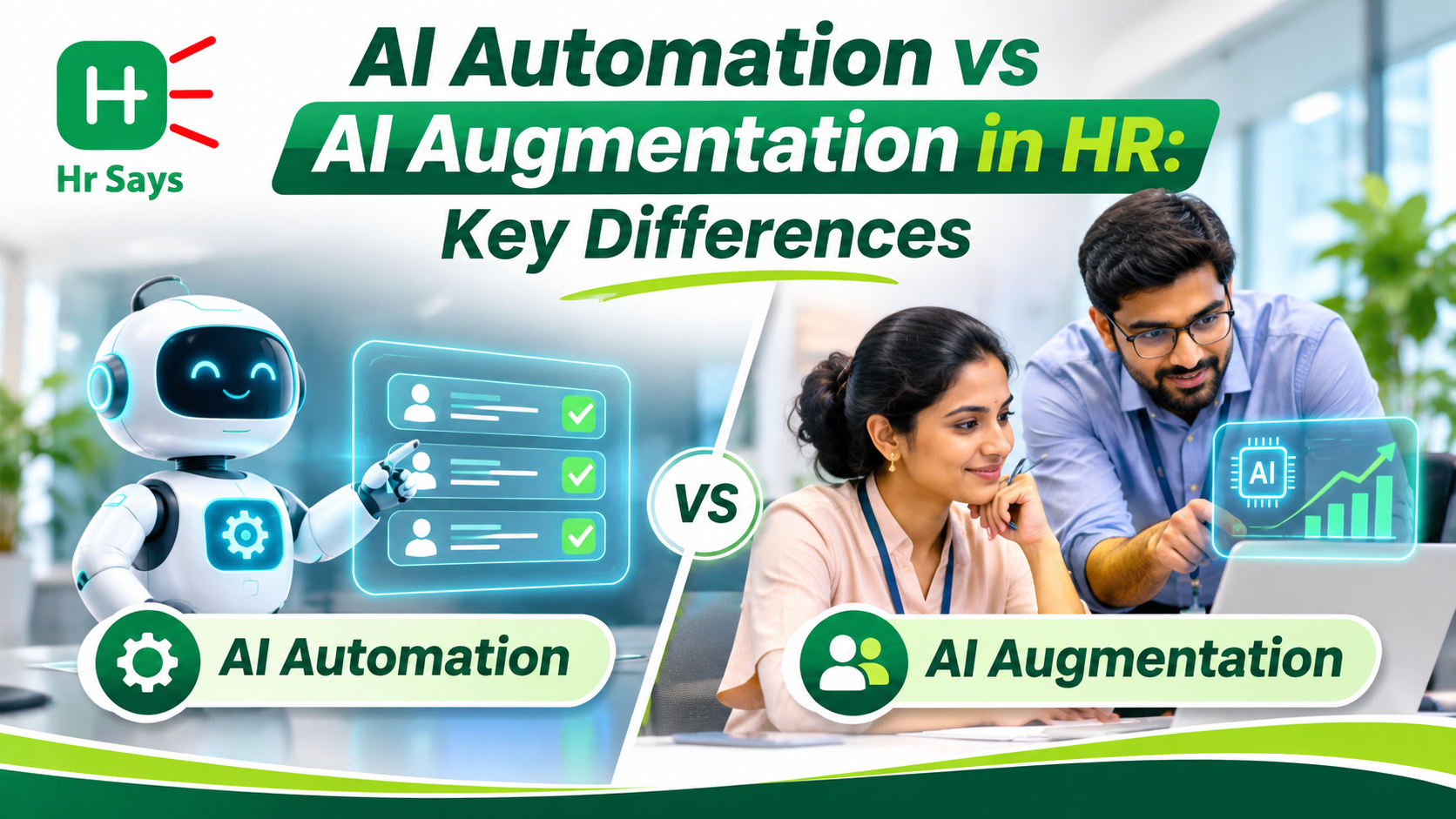
 AI automation and AI augmentation serve distinct roles in HR. Automation handles repetitive tasks while augmentation empowers HR professionals to make smarter, more human-centered decisions at work.





Introduction
Artificial intelligence has moved from being a subject of boardroom speculation to a present-day operational reality in human resources departments across India. Whether it is screening hundreds of job applications in a matter of seconds or generating real-time dashboards that track employee engagement, AI is visibly changing how HR functions. However, beneath this broad adoption lies an important distinction that many HR leaders and business owners either overlook or misunderstand: the difference between AI automation and AI augmentation.
These two concepts are not interchangeable, and conflating them leads to poor technology decisions, misaligned expectations, and sometimes real harm to workplace culture. For HR professionals in India who are navigating a rapidly evolving talent landscape, understanding this distinction is not just an academic exercise. It is a strategic necessity.
This article explains what AI automation and AI augmentation each mean in the context of HR, how they differ in purpose and application, what Indian organizations are doing with both, and how to think about deploying them thoughtfully to build better workplaces.
Understanding the Two Concepts
What Is AI Automation in HR?AI automation in HR refers to the use of artificial intelligence to perform tasks that were previously done by humans, typically tasks that are repetitive, rule-based, and high in volume. The defining characteristic of automation is that it removes the human from the loop for those specific tasks. The AI executes, decides, and acts without requiring human review or input at each step.
Common examples of AI automation in HR include:
- Automated resume screening that filters candidates based on predefined criteria
- Chatbots that handle frequently asked questions from job applicants or employees
- Automated payroll processing and compliance calculations
- Scheduled onboarding email sequences that trigger without manual effort
- Attendance tracking systems that log and flag anomalies automatically
In each of these cases, the goal is efficiency. The organization wants to reduce the time, cost, and manual effort involved in routine HR operations. Automation is particularly valuable in large organizations where the sheer volume of transactions makes manual processing impractical.
In the Indian context, companies with thousands of employees spread across multiple states, all subject to different labor laws and compliance requirements, find automation especially useful. Payroll systems that automatically calculate provident fund contributions, gratuity, TDS deductions, and state-specific statutory obligations represent one of the most commercially successful examples of HR automation in India.
What Is AI Augmentation in HR?AI augmentation takes a fundamentally different approach. Rather than replacing the human role, augmentation uses AI to make HR professionals more capable, more informed, and more effective in their decision-making. The human remains in control. The AI acts as an intelligent support system that surfaces insights, flags patterns, makes predictions, and presents options, but the final judgment still rests with the person.
Examples of AI augmentation in HR include:
- People analytics platforms that show HR leaders which employees are at risk of attrition and why
- AI-assisted interview scoring tools that provide behavioral analysis to support, not replace, the interviewer's judgment
- Sentiment analysis tools that read patterns in employee feedback and help HR leaders understand cultural health
- Succession planning algorithms that map skill gaps and recommend development paths
- Compensation benchmarking tools that give HR heads real-time market data during salary negotiations
The spirit of augmentation is empowerment. It recognizes that HR is fundamentally a human function dealing with human beings, careers, emotions, and relationships, and that no algorithm can fully substitute for the judgment, empathy, and contextual understanding that experienced HR professionals bring.
Why the Distinction Matters
The reason this distinction matters is not theoretical. It has direct implications for how organizations design their HR technology stack, how they train their people, and how they communicate AI adoption to employees.
When an organization deploys AI automation without transparency, employees often feel surveilled, devalued, or disposable. A job applicant who is filtered out by an automated screening tool without a human ever reviewing their profile may carry that negative experience publicly, affecting employer brand. An employee whose performance review is determined by an algorithm without human oversight may feel that their years of service have been reduced to a data point.
AI augmentation, on the other hand, tends to generate greater acceptance because it visibly keeps human judgment at the center. When a people analytics dashboard flags an employee as a flight risk, it is a signal for a manager to have a meaningful conversation, not an automated termination of a contract.
For Indian HR professionals, this distinction also carries legal weight. India does not yet have a comprehensive AI governance law, but the Digital Personal Data Protection Act, 2023 has introduced accountability standards around how personal data is collected, processed, and used. HR automation systems that make consequential decisions about employees using personal data will face increasing regulatory scrutiny in the coming years.
How Indian Organizations Are Using Both
Indian organizations, particularly in the technology, banking, financial services, and insurance (BFSI), and manufacturing sectors, have been early adopters of both AI automation and augmentation in HR.
Large IT companies and business process management firms with tens of thousands of employees have been using automated applicant tracking systems for over a decade. Many have now layered augmentation tools on top, using AI to analyze historical hiring data and predict which candidate profiles are most likely to perform well and stay long-term in specific roles.
In the startup ecosystem, particularly in Bengaluru, Hyderabad, Pune, and the Delhi NCR region, HR augmentation tools have gained significant traction among founders and HR heads who need to make fast, data-informed people decisions without large HR teams. A startup with fifty employees and two HR professionals can now use an AI-powered engagement platform to monitor organizational sentiment at a level that previously required an entire HR analytics function.
Mid-sized Indian companies, particularly those in Tier 2 cities where HR talent can be harder to recruit and retain, are also beginning to adopt these tools as cloud-based HR technology becomes more affordable and accessible.
The Human Element: What AI Cannot Replace
One of the most important things that HR professionals across India must understand is what AI, in either its automation or augmentation form, is fundamentally unable to do.
AI cannot replace the trust that is built between an HR leader and an employee during a genuinely difficult conversation. It cannot understand the unspoken dynamics of a regional office where local culture, language, and hierarchical norms shape how feedback is given and received. It cannot navigate the complexity of a family emergency that affects an employee's performance, or the nuanced judgment required when an organization decides to restructure a team.
These are deeply human capabilities. AI augmentation tools can support HR professionals in approaching these situations with better data, but the moment of decision remains human.
This is why the future of HR in India is not a choice between AI automation and AI augmentation, but a thoughtful integration of both alongside a clear-eyed understanding of where the human role is irreplaceable.
Building a Balanced AI Strategy for HR
For HR leaders thinking about how to position AI within their organizations, a few guiding principles are worth considering.
The first principle is to automate at the edges and augment at the core. Administrative, transactional, and compliance-related tasks are strong candidates for automation. Hiring decisions, performance conversations, succession planning, and culture-building are areas where augmentation adds value without compromising the human element.
The second principle is to be transparent with employees about where and how AI is being used. Indian workforces, like workforces everywhere, are more receptive to AI adoption when they understand its purpose and limits. HR leaders who communicate clearly about which processes are automated and which remain human-guided build greater trust and encounter less resistance.
The third principle is to invest in upskilling HR teams alongside AI adoption. AI augmentation tools are only as useful as the HR professional's ability to interpret and act on the insights they generate. Building digital literacy and data interpretation skills within HR teams is a strategic investment that Indian organizations cannot afford to delay.
Frequently Asked Questions
Q1: What is the difference between AI automation and AI augmentation in HR?
AI automation in HR replaces repetitive manual tasks with machine-driven processes, while AI augmentation enhances human judgment and decision-making by providing data-driven insights and recommendations without replacing the HR professional.
Q2: Is AI automation or AI augmentation better for Indian HR teams?
Neither is inherently better. Indian organizations benefit most from a balanced approach where automation handles high-volume administrative tasks and augmentation supports complex, people-focused HR decisions.
Q3: Will AI replace HR professionals in India?
AI is unlikely to replace HR professionals entirely. While automation will eliminate certain transactional roles, augmentation tools will increase demand for HR professionals with strategic thinking, emotional intelligence, and digital literacy.
Q4: How can small and mid-sized Indian companies start with AI in HR?
Small and mid-sized Indian companies can begin by adopting affordable AI-powered ATS platforms and payroll tools for automation, while exploring AI-driven people analytics dashboards for augmentation as they scale.
Q5: What are the risks of using AI in HR without proper strategy?
Without a clear strategy, AI in HR can produce biased hiring decisions, erode employee trust, mismanage sensitive data, and create compliance risks, especially in India where labor law complexity varies significantly across states.
Resources
- Ministry of Electronics and Information Technology (MeitY): Official source for India's Digital Personal Data Protection Act, 2023 and related AI governance updates
- Society for Human Resource Management (SHRM): Global research and thought leadership on HR technology, AI in the workplace, and future of work trends
- National Association of Software and Service Companies (NASSCOM): Reports on AI adoption in Indian enterprises and workforce transformation in the technology sector
- World Economic Forum (WEF): Future of Jobs reports covering AI's impact on HR roles, workforce reskilling, and organizational transformation globally
Interlinking Keywords
AI in HR India, HR technology trends, people analytics, employee engagement tools, HR automation software, AI-powered recruitment, future of HR, HR digital transformation, talent management strategy, HR compliance India
Last Reviewed By
Dr. Manthan Tripathi and Hr Says Advisory Panel on 20 November 2026.
Disclaimer
The information provided in this article is intended for general educational and informational purposes only. It does not constitute legal, compliance, or professional HR advisory guidance. Organizations should consult qualified HR, legal, and technology professionals before implementing AI-based systems in their human resources processes. References to Indian regulations are based on publicly available information at the time of writing and may be subject to change.