 Sunday, September 20, 2026
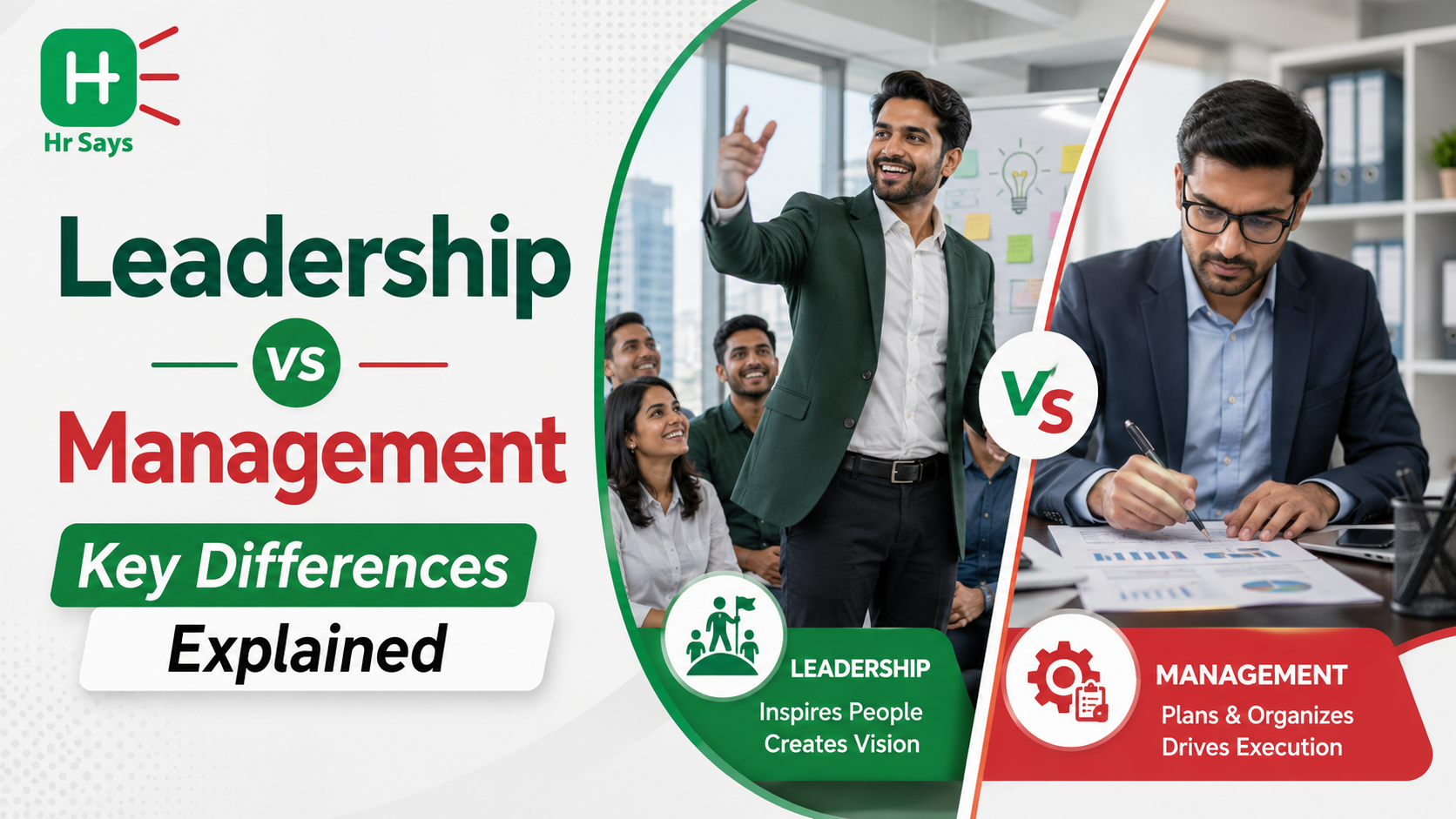
 Leadership and management are distinct yet complementary. Leadership inspires vision and change while management ensures execution and stability. Both are essential for building effective, people-centred Indian workplaces.





Introduction
In workplaces across India, from fast-scaling startups in Bengaluru to established manufacturing firms in Pune, a persistent confusion shapes how organisations build their teams and develop talent. The confusion is this: treating leadership and management as the same thing.
The two are frequently used interchangeably in job descriptions, performance reviews, and boardroom conversations. However, they are fundamentally different in purpose, approach, and impact. Understanding this distinction is not merely an academic exercise. It is a practical necessity for HR leaders, CHROs, founders, and anyone responsible for building productive, people-centred workplaces.
Both leadership and management matter. Both are necessary. But confusing one for the other, or expecting a single individual to intuitively master both without awareness of the difference, is one of the most common and costly mistakes in organisational development today.
This article breaks down what separates leadership from management, where the two overlap, and why Indian organisations that invest in developing both capabilities tend to build stronger, more resilient teams.
Understanding the Core Concepts
What Is Management?Management is the disciplined process of coordinating people, resources, timelines, and activities to achieve defined organisational goals. A manager's primary responsibility is operational: to ensure that work gets done correctly, on time, and within the boundaries set by the organisation.
Management involves planning quarterly targets, organising team structures, allocating budgets, monitoring performance metrics, resolving operational bottlenecks, and maintaining procedural compliance. In an Indian corporate context, this often includes managing complex reporting hierarchies, navigating appraisal cycles, handling payroll and compliance requirements under labour laws, and coordinating across departments that may span multiple cities or geographies.
The essence of management is stability and execution. A good manager ensures that the engine of an organisation runs smoothly, day after day.
What Is Leadership?Leadership is the ability to influence, inspire, and guide people toward a shared vision. It is less about controlling outcomes and more about shaping the direction and energy of a group. Leaders do not simply direct people to complete tasks. They create an environment in which people feel motivated to go beyond their defined roles in pursuit of a meaningful goal.
Leadership operates primarily through influence, not authority. A leader may hold a formal title, or may have none at all. What distinguishes a leader is the capacity to earn the voluntary commitment of others, to make people believe in a direction and choose to move toward it with genuine energy.
In the Indian workplace context, effective leadership often means navigating diverse cultural expectations, bridging generational gaps within teams, and articulating a vision that resonates across varied socioeconomic and regional backgrounds.
Seven Key Differences Between Leadership and Management
1. Vision Versus ExecutionManagers focus on execution. Their strength lies in breaking down a goal into actionable steps, assigning responsibilities, and tracking progress toward defined outcomes. Leaders, by contrast, focus on vision. They ask where the organisation should go, what the future should look like, and why it matters.
In a practical sense: a manager in a logistics company will ensure that deliveries meet service-level agreements this quarter. A leader in the same company will be asking what the organisation needs to look like three years from now to remain competitive in a rapidly evolving e-commerce landscape.
Vision without execution becomes wishful thinking. Execution without vision becomes purposeless routine. Organisations need both.
2. Authority Versus InfluenceManagers derive their power from the position they hold in the organisational hierarchy. Employees follow managers because the structure of the organisation requires it. Leaders derive their power from trust, credibility, and the ability to inspire. People follow leaders because they believe in the leader's vision and judgment.
This distinction has significant implications for HR practice in India, where hierarchical structures remain strong in many traditional industries. Investing in leadership development means investing in the capacity to move people beyond compliance into genuine commitment.
3. Process Orientation Versus People OrientationManagement is primarily process-oriented. It focuses on systems, workflows, KPIs, and operational efficiency. Leadership is primarily people-oriented. It focuses on engagement, motivation, growth, and the human experience of work.
A manager may redesign a workflow to improve productivity by fifteen percent. A leader will invest time in understanding why team members feel disengaged and address the deeper cultural and motivational factors that no workflow redesign can fix.
4. Stability Versus ChangeManagement thrives in stable environments. It creates predictability, reduces risk, and maintains consistency. Leadership is most critical during periods of change, uncertainty, or disruption. When an organisation needs to pivot, transform, or navigate a crisis, it is leadership that provides the courage, direction, and inspiration required to move forward.
Indian organisations navigating digital transformation, shifting workforce expectations after the pandemic years, or the pressures of global competition need leaders who can guide teams through ambiguity with clarity and confidence.
5. Short-Term Focus Versus Long-Term ThinkingManagers are typically accountable for short-to-medium-term results: quarterly targets, monthly compliance, annual appraisals. Leaders think in longer timeframes. They build capability, culture, and strategic direction that shapes the organisation over years, not quarters.
This is not to suggest that managers do not think ahead. However, the primary orientation differs. HR leaders in India increasingly recognise that organisations focused only on short-term metrics often underinvest in the long-term capabilities that will determine their sustainability.
6. Supervision Versus EmpowermentA manager supervises. This means monitoring whether work is being done correctly, addressing deviations, providing feedback on output, and ensuring accountability. A leader empowers. This means giving people the confidence, autonomy, and resources to grow beyond what they currently believe they are capable of.
- Supervision ensures standards are met today.
- Empowerment builds the capacity to raise standards tomorrow.
Both are essential, but organisations that over-index on supervision at the expense of empowerment tend to struggle with employee engagement and retention, which remains one of the most pressing challenges in Indian workplaces today.
7. Risk Management Versus Risk-TakingManagers are trained to minimise and control risk. Their role demands prudence, predictability, and adherence to established processes. Leaders, by contrast, are willing to take calculated risks. They recognise that innovation requires experimentation, that growth involves uncertainty, and that the greatest risk an organisation can take is refusing to evolve.
The most effective organisations in India today, particularly in sectors such as technology, healthcare, and consumer goods, are those that have cultivated managers who protect operational excellence while developing leaders who push the organisation toward necessary reinvention.
Where Leadership and Management Overlap
The differences between leadership and management are real, but so is the overlap. Both roles require strong communication, the ability to motivate others, sound decision-making, and a commitment to achieving goals.
The most effective professionals in any organisation develop fluency in both. An HR head who can manage compliance requirements with rigour while also leading culture transformation conversations demonstrates the full range. A founder who manages investor expectations and operational realities while leading the team through rapid growth exemplifies the same duality.
A significant insight from global research, including studies cited by Gallup, is that team engagement is heavily influenced by the quality of the immediate manager. This means that managers who develop genuine leadership qualities, who inspire, not just direct, who coach, not just evaluate, have a disproportionate positive effect on their teams. For Indian HR professionals, this finding is directly actionable: leadership development programmes must not be reserved only for the C-suite. The opportunity and the need exist at every level of management.
The Indian Workplace Context
India's workplaces are undergoing rapid transformation. The rise of hybrid work models, the entry of a large millennial and Gen Z workforce with different expectations around autonomy and purpose, and the increasing complexity of talent management in a competitive market are reshaping what both leadership and management need to look like.
Traditional management approaches, which often relied on hierarchical authority and directive supervision, are proving less effective in engaging newer workforce segments. At the same time, inspirational leadership without operational management rigor has contributed to high-profile organisational failures in India's startup ecosystem.
The most competitive Indian organisations today are those investing deliberately in both dimensions. They are creating management systems that are structured, compliant, and efficient, while simultaneously building leadership pipelines that develop visionary, empathetic, and courageous professionals at every level of the organisation.
HR professionals and CHROs play a central role in this effort. Platforms such as HRSays serve as critical spaces where these conversations about people practices, leadership development, and organisational culture are shared, discussed, and shaped across the Indian HR community.
Developing Both Leadership and Management Capabilities
Organisations that seek to build both capabilities effectively typically focus on the following:
- Structured management training that builds skills in goal-setting, performance management, delegation, and operational decision-making.
- Leadership development programmes that cultivate self-awareness, emotional intelligence, visioning skills, and the ability to inspire and influence.
- Coaching and mentoring structures that allow experienced leaders to model leadership behaviours for managers who are developing their own leadership identity.
- A culture that values and rewards both operational excellence and bold, people-centred leadership.
It is equally important for individuals to understand their own current orientation, whether they are naturally stronger as managers or as leaders, and to invest in developing the qualities of the other dimension. The goal is not to create people who are all things at once, but to develop professionals who can draw on both sets of capabilities as the situation demands.
Conclusion
The difference between leadership and management is not a matter of hierarchy or seniority. It is a matter of orientation, purpose, and approach. Management builds the systems and structures through which work happens. Leadership builds the will, the vision, and the culture that determines whether that work is meaningful and sustainable.
Indian organisations that recognise this distinction and invest in developing both capabilities are better positioned to attract and retain talent, navigate change, and build workplaces where people genuinely want to contribute. For HR professionals, this understanding is foundational. Every hiring decision, every development programme, every culture initiative reflects either a conflation of the two or a thoughtful appreciation of the distinct and complementary value each brings.
The best workplaces are not those with the most efficient managers or the most charismatic leaders. They are the workplaces where management and leadership work in concert, shaping an environment that is both well-run and deeply human.
Frequently Asked Questions
Q1: What is the most important difference between leadership and management?
The most important difference is one of orientation. Management focuses on coordinating processes, resources, and activities to achieve defined goals efficiently. Leadership focuses on inspiring people, setting direction, and creating the motivation to pursue a shared vision. Management is about how work gets done. Leadership is about why it matters and where the organisation is headed.
Q2: Can a manager also be a leader?
Yes, and ideally every manager should develop leadership qualities over time. A manager who only supervises and directs without inspiring or empowering their team will typically see lower engagement and performance. Developing leadership qualities, such as emotional intelligence, the ability to communicate vision, and the willingness to trust and empower people, makes a manager significantly more effective.
Q3: Why do Indian organisations often confuse leadership with management?
In many Indian organisations, particularly those with traditional hierarchical structures, seniority and positional authority are closely associated with both management and leadership. As a result, the two are treated as synonymous. However, as Indian workplaces become more dynamic and talent-driven, the distinction between the two is becoming more critical to understand and act upon.
Q4: Is leadership more important than management?
Neither is more important than the other. Both are necessary for organisational success. Organisations with strong management but poor leadership tend to be efficient but stagnant. Organisations with strong leadership but poor management tend to be inspiring but operationally chaotic. The most successful organisations develop and value both.
Q5: How can HR professionals develop both leadership and management capabilities in their organisations?
HR professionals can create structured development pathways that address both dimensions. This includes management training for operational skills, leadership development programmes focused on vision, emotional intelligence, and influence, coaching and mentoring initiatives, and a culture that recognises and rewards both excellent execution and courageous people-centred leadership.
Resources
- Harvard Business Review: Foundational articles on leadership versus management, including the work of John Kotter on distinguishing the two roles in organisational contexts.
- Gallup Workplace Research: Data and insights on employee engagement, managerial impact, and the relationship between leadership quality and team performance.
- SHRM (Society for Human Resource Management): Research and frameworks for HR professionals on leadership development, talent management, and building management capability.
- National HRD Network (NHRDN), India: India-specific resources and thought leadership on HR practices, leadership development, and workplace transformation.
- Ministry of Skill Development and Entrepreneurship, Government of India (msde.gov.in): Policy frameworks and initiatives related to workforce capability building and professional development in India.
INTERLINKING KEYWORDS
leadership development, management skills, employee engagement, workplace culture, HR leadership India, talent management, performance management, organisational growth, people management, HR professional development
DISCLAIMER
The content published on HRSays is intended for informational and educational purposes only. It reflects general perspectives on HR practices, leadership, and workplace management and does not constitute professional legal, financial, or organisational consulting advice. Readers are encouraged to apply the insights shared here in the context of their own organisational needs and to consult qualified professionals for specific advice relevant to their circumstances. HRSays does not take responsibility for decisions made based on the information provided in this article.