 Saturday, October 24, 2026
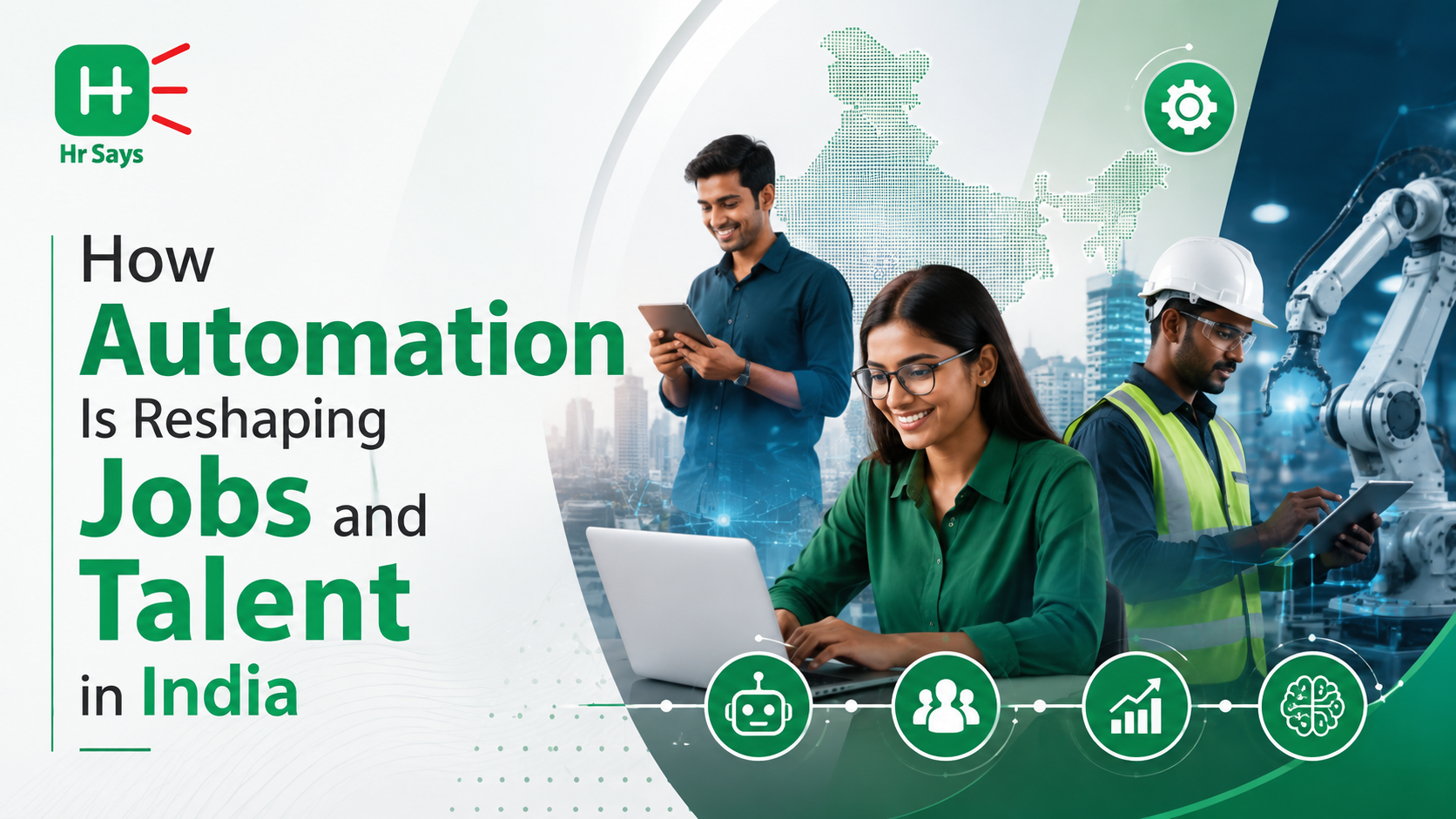
 Automation is reshaping jobs and talent across India. HR leaders must address skill gaps, invest in reskilling, and build learning cultures to navigate workforce transformation effectively.





Introduction
The conversation around automation and jobs is no longer a distant forecast. It is happening right now, inside Indian factories, corporate offices, call centers, IT firms, and retail chains. Machines, software algorithms, and artificial intelligence tools are steadily taking over tasks that were once considered exclusively human. For HR professionals and business leaders, the pressing question is not whether automation will affect their workforce. The real question is how prepared their organizations are to respond.
India stands at a particularly critical crossroads. With one of the youngest and largest working populations in the world, the country must simultaneously harness the productivity benefits of automation while ensuring that millions of workers are not left behind. This is not just a policy challenge. It is a talent strategy challenge that sits directly at the desk of every CHRO, HR manager, and people leader across the country.
This article examines the real impact of automation on employment and talent, what sectors are most affected in India, how HR functions must evolve, and what practical steps organizations can take to future-proof their workforce.
Understanding Automation and Its Growing Role in the Workplace
Automation refers to the use of technology to perform tasks with minimal or no human intervention. In earlier decades, automation was largely confined to physical manufacturing processes. Today, the scope has expanded dramatically. Robotic Process Automation, or RPA, handles repetitive digital tasks such as data entry, invoice processing, and compliance reporting. Artificial intelligence powers hiring tools, customer service chatbots, financial analysis platforms, and even performance management systems.
Machine learning algorithms are being used to screen resumes, predict employee attrition, and generate business insights from large datasets. In logistics and supply chain management, autonomous systems are optimizing route planning and warehouse operations. In healthcare, diagnostic tools powered by AI assist doctors in identifying diseases with greater accuracy. The breadth of automation is no longer limited to blue-collar work. It now reaches deep into white-collar and knowledge-based professions as well.
For India's workforce, this shift is significant. A large portion of employment in the country is still concentrated in roles that involve routine, rules-based tasks, whether in banking back-offices, manufacturing units, business process outsourcing operations, or retail. These are precisely the kinds of jobs that automation targets first.
The Dual Reality: Job Displacement and Job Creation
One of the most important things HR leaders must understand about automation is that its impact is not one-dimensional. Automation displaces certain jobs while simultaneously creating new ones. The challenge lies in the fact that these two processes do not always happen at the same speed or for the same group of workers.
On the displacement side, roles that involve predictable, repetitive, or data-driven tasks face the greatest vulnerability. In India, this includes a significant portion of the BPO sector, entry-level accounting roles, data processing jobs, and assembly-line manufacturing positions. According to research findings from global institutions, workers in such roles are at a substantially higher risk of automation, and without intervention, many could find themselves structurally unemployed.
On the creation side, automation generates demand for entirely new categories of roles. AI trainers, data scientists, automation engineers, cybersecurity specialists, UX designers, and robotics technicians are among the fastest-growing job profiles globally and increasingly in India as well. Beyond technology-specific roles, there is also growing demand for workers who can perform tasks that machines struggle with, namely emotional intelligence, complex problem-solving, creative thinking, ethical judgment, and nuanced communication.
The critical insight for HR professionals is this: automation does not simply eliminate jobs. It restructures the nature of work. The organizations that navigate this transition successfully are those that actively invest in helping their people evolve alongside the technology rather than waiting for disruption to force their hand.
Sectors in India Most Affected by Automation
While automation is reshaping work across virtually every industry, certain sectors in India are experiencing more immediate and visible changes.
Manufacturing has been at the forefront of automation for years. Large automotive plants, electronics manufacturing units, and pharmaceutical production facilities have progressively adopted robotics and automated quality control systems. The result is higher output with reduced dependency on unskilled labor.
Banking, Financial Services, and Insurance (BFSI) is another sector witnessing rapid change. Loan processing, KYC verification, fraud detection, and customer service are increasingly handled by intelligent software systems. Several major Indian banks and insurance companies have deployed AI-powered chatbots and decision-making tools that have reduced turnaround times and operational costs.
Information Technology and IT-enabled Services face a nuanced challenge. While the Indian IT sector has long been a global powerhouse, the rise of AI-powered code generation tools, automated testing platforms, and cloud-based deployment systems is putting pressure on certain categories of software professionals, particularly those in manual testing, routine coding, and repetitive technical support roles.
Retail and E-commerce are also witnessing significant automation through warehouse management systems, demand forecasting tools, and automated billing platforms.
Healthcare, while still highly human-dependent, is beginning to use AI for diagnostics, drug discovery, and administrative workflows, changing the skill requirements for healthcare support staff.
The Widening Skill Gap: A Talent Management Challenge
Perhaps the most pressing HR challenge created by automation is the widening skill gap. As roles transform and new job categories emerge, a large portion of the existing workforce lacks the skills required to fill them. This mismatch is particularly acute in India, where the formal skilling ecosystem has historically struggled to keep pace with the speed of economic and technological change.
Research consistently highlights that workers without postsecondary education or technical credentials are most vulnerable to the negative effects of automation. However, the challenge is not limited to entry-level workers. Mid-career professionals in fields like accounting, legal support, data analysis, and content processing also face disruption as AI tools take over functions they were trained to perform.
For HR teams, this creates a clear mandate:
- Conduct regular skills audits to identify which roles within the organization are vulnerable to automation.
- Build workforce planning frameworks that account for the skills the organization will need in three to five years, not just today.
- Design targeted reskilling and upskilling programs aligned to both business needs and employee career goals.
- Partner with external training providers, technology vendors, and academic institutions to access specialized learning resources.
- Create internal mobility pathways so that employees whose roles are being automated can transition into emerging functions without leaving the organization.
How HR Functions Themselves Are Being Transformed
It would be incomplete to discuss automation's impact on jobs without acknowledging how it is reshaping the HR function itself. HR technology platforms now offer capabilities that were unimaginable a decade ago. AI-powered applicant tracking systems can screen thousands of resumes in minutes, identify high-potential candidates based on behavioral patterns, and even predict cultural fit. People analytics tools help HR teams make data-informed decisions about hiring, performance management, engagement, and retention.
Payroll automation, compliance tracking tools, and digital onboarding systems have significantly reduced the administrative burden on HR teams. This is a positive development because it frees HR professionals to focus on higher-value work such as organizational design, leadership development, culture building, and strategic workforce planning.
However, it also means that the HR professional of today must develop new competencies. Understanding people analytics, being comfortable with HR technology platforms, and having the ability to translate data into human-centered decisions are fast becoming non-negotiable skills for anyone in the HR field. Platforms like HRSays are playing an important role in helping HR professionals stay informed about these trends, develop their knowledge, and engage with a wider community of practice.
Reskilling and Upskilling: The Organizational Imperative
Organizations that are serious about navigating the automation era responsibly must place reskilling and upskilling at the center of their talent strategy. This is not simply an ethical consideration, although the human dimension matters enormously. It is also a business imperative. The cost of replacing an employee who has been displaced is significantly higher than the cost of investing in developing that employee for a new role.
In India, several large organizations have already begun building internal academies and learning programs. Companies in the IT sector have made visible commitments to reskilling hundreds of thousands of employees in areas like cloud computing, AI, cybersecurity, and agile methodologies. The National Skill Development Corporation, or NSDC, and initiatives under the Pradhan Mantri Kaushal Vikas Yojana, or PMKVY, also offer frameworks that HR teams can leverage.
Effective reskilling programs share certain characteristics. They are personalized to the learner's existing skills and career trajectory. They are practical and project-based, not purely theoretical. They are supported by managers who actively encourage participation. And they are connected to visible career outcomes so that employees understand the value of investing their time and effort.
Building a Future-Ready Workforce: The Role of Leadership and Culture
Reskilling programs alone are not sufficient. Organizations must also build a culture that embraces continuous learning, adapts to change, and treats uncertainty as an opportunity rather than a threat. This requires strong leadership, clear communication, and a genuine commitment to employee development.
Leaders who are transparent about the changes automation is bringing, who explain what the organization is doing to support its people, and who create psychological safety for employees to raise concerns and ask questions, are far more likely to manage automation transitions successfully. Fear and uncertainty are among the biggest barriers to workforce adaptation. Culture and leadership can either compound that fear or counter it.
HR leaders are uniquely positioned to champion this kind of organizational readiness. By working with business leaders to develop clear workforce transformation strategies, communicating honestly with employees, and building the systems that support continuous learning, HR can be the function that turns a potentially disruptive period into one of organizational renewal and growth.
Frequently Asked Questions
Q1: Which jobs in India are most at risk from automation?
Jobs that involve routine, repetitive, and rules-based tasks face the highest risk. This includes roles in data entry, basic accounting, customer service, certain BPO functions, assembly-line manufacturing, and low-complexity back-office operations. However, the risk is not uniform and depends significantly on the specific tasks involved within a role.
Q2: Will automation create more jobs than it destroys in India?
Research suggests that automation tends to create new job categories even as it displaces others. However, the transition is not seamless. The new jobs often require different skills than the displaced ones, which means that job creation does not automatically benefit workers who have lost their positions without reskilling and support.
Q3: How should HR teams prepare their organizations for automation?
HR teams should start with skills audits to identify vulnerable roles, develop reskilling programs tied to future skill demands, build internal mobility pathways, invest in HR technology to improve their own efficiency, and foster a learning culture that makes continuous development part of everyday work life.
Q4: What skills will be most valuable in an automated workplace?
Skills that complement rather than compete with machines will be most valuable. These include critical thinking, creativity, emotional intelligence, complex problem-solving, ethical judgment, communication, and the ability to collaborate across disciplines. Technical skills in AI, data analytics, and cybersecurity are also in very high demand.
Q5: What role does the Indian government play in managing automation's workforce impact?
The Indian government has several initiatives focused on skill development, including PMKVY, the National Apprenticeship Promotion Scheme, and various NSDC-led programs. Additionally, the National Education Policy of 2020 emphasizes future-ready skills in education. However, the scale of the challenge means that government efforts must be complemented by active investment from employers and industry bodies.
Resources
- Organisation for Economic Co-operation and Development (OECD): Reports on automation, employment outlook, and workforce transformation across global economies including emerging markets.
- National Skill Development Corporation (NSDC), India: Frameworks, programs, and data related to skill development and workforce readiness in India.
- World Economic Forum (WEF): Future of Jobs Reports offering global and regional insights into how automation is reshaping employment and skill demands.
- Ministry of Skill Development and Entrepreneurship, Government of India: Policy documents, scheme details, and research on India's skilling ecosystem and workforce development priorities.
- People Matters: India-focused HR and workplace insights publication covering HR technology, talent strategy, and future of work trends.
Interlinking Keywords
future of work India, HR technology trends, reskilling and upskilling, workforce transformation, talent management strategy, employee learning and development, people analytics, automation and employment
Last Reviewed By:
Hr Says Advisory Panel on 17 August, 2026
Disclaimer
The information presented in this article is intended for general informational and educational purposes only. It is aimed at HR professionals, business leaders, and workplace practitioners seeking to understand broader trends in workforce transformation. The views expressed reflect research-based insights and should not be construed as legal, financial, or policy advice. Organizations are encouraged to consult relevant experts and conduct their own assessments before making workforce-related decisions.