Sunday, September 20, 2026
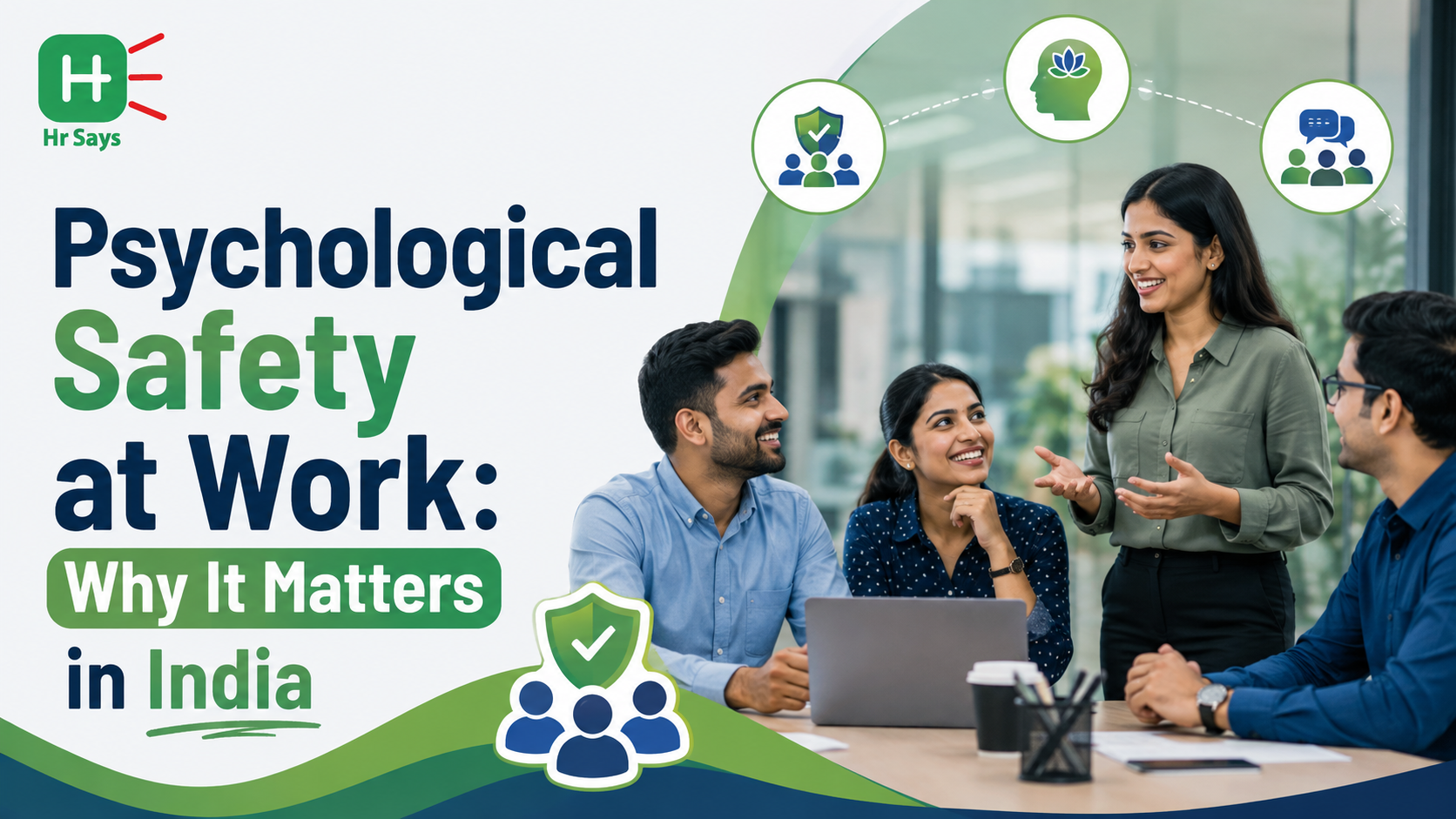
 Psychological safety at work enables honest dialogue, reduces burnout, and drives innovation. Indian organisations navigating hierarchy and hybrid work must build it deliberately through consistent, trust-focused leadership behaviour.





Introduction
Workplace safety in India has traditionally meant fire drills, ergonomic seating, and compliance with labour laws. It has rarely meant the freedom to admit a mistake without fear of being reprimanded in front of colleagues, or the confidence to challenge a senior leader's decision during a team meeting. This is where psychological safety comes in, and it is quickly becoming one of the most discussed workplace concepts among HR leaders, CHROs, and business owners across India.
Psychological safety at work refers to a shared belief within a team that it is safe to take interpersonal risks. It means employees can ask questions, report errors, propose unconventional ideas, or disagree with a manager without worrying about embarrassment, punishment, or damage to their professional standing. For organisations navigating rapid growth, hybrid work models, and a workforce that increasingly values transparency, understanding and building psychological safety is no longer optional. It has become a genuine business priority.
This article explores what psychological safety means in practice, why it matters especially in the Indian workplace context, the research backing its business impact, and practical steps HR professionals and leaders can take to build it within their organisations.
Understanding Psychological Safety at Work
The concept of psychological safety was developed by Harvard Business School professor Dr Amy C. Edmondson, whose research into hospital teams found something counterintuitive. The most effective teams reported more errors, not fewer. It turned out these teams did not actually make more mistakes; they simply felt safe enough to report them. Other teams, operating under fear of blame, were far more likely to hide errors, which ultimately made their work environments less safe overall.
In a modern workplace setting, psychological safety does not mean an absence of accountability or a culture where everyone is unfailingly polite. It means creating conditions where honest dialogue, constructive disagreement, and genuine feedback can happen without triggering fear. Employees in psychologically safe teams feel comfortable saying "I do not know" or "I think we are making a mistake here" without worrying that doing so will damage their reputation or career prospects.
For Indian organisations, this distinction matters significantly. Many workplaces in India, particularly in traditional family-owned businesses, manufacturing units, and even some large corporates, continue to operate with strong hierarchical norms inherited from schooling systems and cultural upbringing where questioning authority was discouraged. Building psychological safety in such environments requires a deliberate shift in leadership behaviour, not just a policy update.
Why Psychological Safety Matters for Indian Workplaces
India's workforce is undergoing a significant transformation. Younger employees entering the workforce, particularly those from Tier 1 and Tier 2 cities, increasingly expect workplaces that value their voice and involve them in decision-making. At the same time, organisations are dealing with rising attrition, talent competition, and the ongoing complexities of hybrid and remote work arrangements.
Global research offers useful signals for Indian HR leaders. Gallup engagement data referenced by workplace researchers found that only three out of ten employees strongly agreed that their opinions counted at work, a figure that highlights how widespread the psychological safety gap is, even in mature markets. In virtual meetings specifically, a notable proportion of women reported feeling overlooked or ignored, a pattern that is likely even more pronounced among employees from underrepresented backgrounds.
A peer-reviewed study published in Health Affairs Scholar examined psychological safety among healthcare professionals and found that <cite index="3-2">psychological safety significantly reduced the negative relationship between work environment factors and clinician burnout, with mediation effects on emotional exhaustion ranging from 18 to 37 percent</cite> across different workplace relationship factors. While this research was conducted in a clinical setting, the underlying principle applies broadly. When employees feel psychologically unsafe, the wear and tear of a difficult work environment compounds into exhaustion and disengagement far more quickly.
Closer to the Indian context, organisations dealing with high-pressure targets, sales-driven cultures, and long working hours would do well to notice this pattern. Burnout is a growing concern in Indian workplaces, particularly in IT services, BPO, healthcare, and start-up environments where always-on culture is common. Psychological safety functions as a protective layer that can reduce the toll this takes on employee wellbeing.
The Business Case: What Research Shows
Beyond individual wellbeing, psychological safety has a measurable connection to organisational performance. Teams with higher psychological safety consistently report improved collaboration, fewer interpersonal conflicts, and higher innovation output. This happens because psychologically safe teams surface problems earlier, share half-formed ideas that eventually become valuable innovations, and correct course before small issues escalate into costly failures.
Leadership researchers who studied psychological safety across senior teams found substantial variability in how safe different members of the same leadership team felt, which has direct consequences for decision quality. When only certain voices in a room feel safe to speak, organisations lose access to a wide range of perspectives that could otherwise strengthen strategy and problem-solving.
For Indian companies competing for skilled talent in a market where switching jobs has become significantly easier, psychological safety also plays a retention role. Employees who feel heard, respected, and safe to express concerns are considerably less likely to disengage quietly or leave for a workplace that offers a more open culture. This matters even more for growing startups and mid-sized companies in India that cannot always compete purely on compensation and need a strong culture to retain talent.
Common Barriers to Psychological Safety in India
Several structural and cultural factors make building psychological safety harder in the Indian context, and HR leaders should be aware of these before designing interventions.
- Hierarchical conditioning: Many employees grow up in educational and family systems where questioning elders or authority figures is discouraged, which can carry over into workplace behaviour.
- Fear of public correction: In several Indian workplace cultures, being corrected in front of peers or seniors, especially in team meetings, can feel deeply uncomfortable and discourage future openness.
- Remote and hybrid disconnect: With many Indian companies operating hybrid models post-pandemic, the informal, unplanned conversations that build trust happen far less often, making psychological safety harder to establish virtually.
- Performance pressure culture: Sales targets, billing hours, and productivity metrics common in Indian IT, BPO, and consulting sectors can create an environment where admitting struggle feels risky.
Recognising these barriers is the first step. Simply importing a Western framework for psychological safety without adapting it to Indian workplace realities is unlikely to succeed on its own.
How Leaders Can Build Psychological Safety at Work
Building psychological safety is not a one-time initiative. It requires consistent, visible behaviour from leaders over time. A few practical approaches that HR teams and managers in India can apply include the following.
Leaders should openly acknowledge their own mistakes and uncertainties rather than projecting an image of infallibility. When a manager says, "I got this decision wrong, here is what we learned," it signals to the entire team that admitting error is acceptable and even valued. This single behaviour, repeated consistently, does more to build trust than any formal policy document.
Creating structured opportunities for quieter voices to be heard also matters considerably. In many Indian team meetings, the most senior person in the room tends to dominate discussion, whether intentionally or not. Leaders can counter this by explicitly inviting input from junior team members, asking questions like "who sees this differently" and genuinely pausing to listen to the response.
How failure is handled sets the tone for the entire team. Organisations that treat mistakes purely as performance issues, without space for learning, will find employees increasingly reluctant to report problems early, which often leads to bigger issues down the line. Framing setbacks as learning opportunities, while still maintaining accountability, strikes the right balance.
Response to feedback is equally important. When an employee raises a concern or shares a difficult truth, responding with appreciation rather than defensiveness reinforces that speaking up is safe. A simple shift from "why did this happen" to "thank you for flagging this, how can we address it together" changes the entire tone of the conversation.
For hybrid and remote teams specific to the Indian context, leaders should build in intentional time for informal connection, whether that means logging into video calls a few minutes early for casual conversation or scheduling regular one-on-ones that go beyond task updates.
Psychological Safety and Performance: Finding the Balance
A common misconception among Indian business leaders is that psychological safety might lead to lower accountability or a drop in performance standards. Research and workplace experience both suggest the opposite. Psychological safety and high standards are not opposing forces; they work best together. Teams that feel safe to speak up but are not held to clear performance expectations may become comfortable without being rigorous. Teams held to high standards without safety may appear compliant while quietly disengaging or hiding problems.
The most effective Indian workplaces are those where leaders combine clear expectations with genuine openness, creating a culture where employees are both supported and challenged to do their best work. This balance is particularly relevant for growing Indian organisations that are scaling quickly and cannot afford either complacency or a culture of fear.
The Role of HR in Building Psychological Safety
HR teams play a central role in translating psychological safety from an abstract concept into everyday workplace practice. This includes designing feedback mechanisms that genuinely protect employee confidentiality, training managers on inclusive leadership behaviours, and building psychological safety indicators into regular engagement surveys rather than treating it as a one-off initiative.
For Indian organisations, HR can also play a role in bridging generational and hierarchical gaps within teams, helping senior leaders understand why younger employees may communicate differently and helping newer employees understand organisational context without feeling silenced. Platforms like HRSays, which focus on sharing practical HR insights and workplace conversations, can support this process by giving HR professionals access to real world approaches, leadership perspectives, and workplace culture trends that are directly relevant to Indian organisations navigating this shift.
Conclusion
Psychological safety at work is no longer a soft, optional concept reserved for progressive workplace theory. It has become a measurable driver of employee wellbeing, retention, innovation, and organisational performance, and Indian companies that recognise this early will be better positioned to attract and retain talent in an increasingly competitive market. Building it requires sustained leadership commitment, structural awareness of India specific cultural barriers, and a willingness from HR teams to embed psychological safety into everyday practices rather than treating it as a single training session. Organisations that get this right will find themselves with more engaged employees, fewer instances of burnout, and teams that are genuinely equipped to innovate and grow together.
Frequently Asked Questions
Q1: What is psychological safety at work?
Psychological safety at work is the shared belief among team members that they will not be punished, embarrassed, or rejected for speaking up, asking questions, admitting mistakes, or offering new ideas.
Q2: Why is psychological safety important in Indian workplaces?
Indian workplaces often carry strong hierarchical traditions that can discourage employees from questioning authority. Psychological safety helps break this pattern, encouraging open communication, better decision making, and higher retention in a competitive talent market.
Q3: How can HR leaders measure psychological safety?
HR leaders can measure psychological safety through structured employee surveys, pulse checks, one-on-one conversations, and by tracking indicators such as meeting participation, error reporting rates, and attrition patterns.
Q4: Does psychological safety reduce employee burnout?
Yes, research indicates that higher psychological safety is associated with lower emotional exhaustion and depersonalisation, two core components of burnout, because employees feel supported rather than isolated when facing challenges.
Q5: How is psychological safety different in remote and hybrid teams?
Remote and hybrid teams have fewer informal, in-person moments to build trust naturally, so leaders need to intentionally create space for conversation, active listening, and open dialogue through virtual check-ins and structured feedback channels.
Resources
- Harvard Business School and Amy C. Edmondson's Research: Foundational academic work defining psychological safety and its impact on team learning behaviour.
- Health Affairs Scholar: Peer-reviewed study examining the mediating role of psychological safety between work environment and clinician burnout.
- Center for Creative Leadership (CCL): Research-based insights and frameworks on building psychological safety in leadership teams.
- Gallup Workplace Research: Global employee engagement data highlighting gaps in workplace voice and participation.
- Ministry of Skill Development and Entrepreneurship, Government of India: Reference point for workforce development and workplace policy context in India.
Interlinking Keywords
psychological safety, employee engagement, workplace culture, HR leadership, employee burnout, hybrid work culture, leadership development, employee retention India, inclusive leadership, workplace trust
Last Reviewed By:
Hr Says Advisory Panel on 5 August, 2026
Disclaimer:
This article is intended for general informational and educational purposes only and is based on publicly available research and workplace studies. It does not constitute professional HR, legal, or organisational consulting advice. Organisations are encouraged to consult qualified HR professionals or organisational development experts before implementing workplace culture changes specific to their context.