 Sunday, September 20, 2026
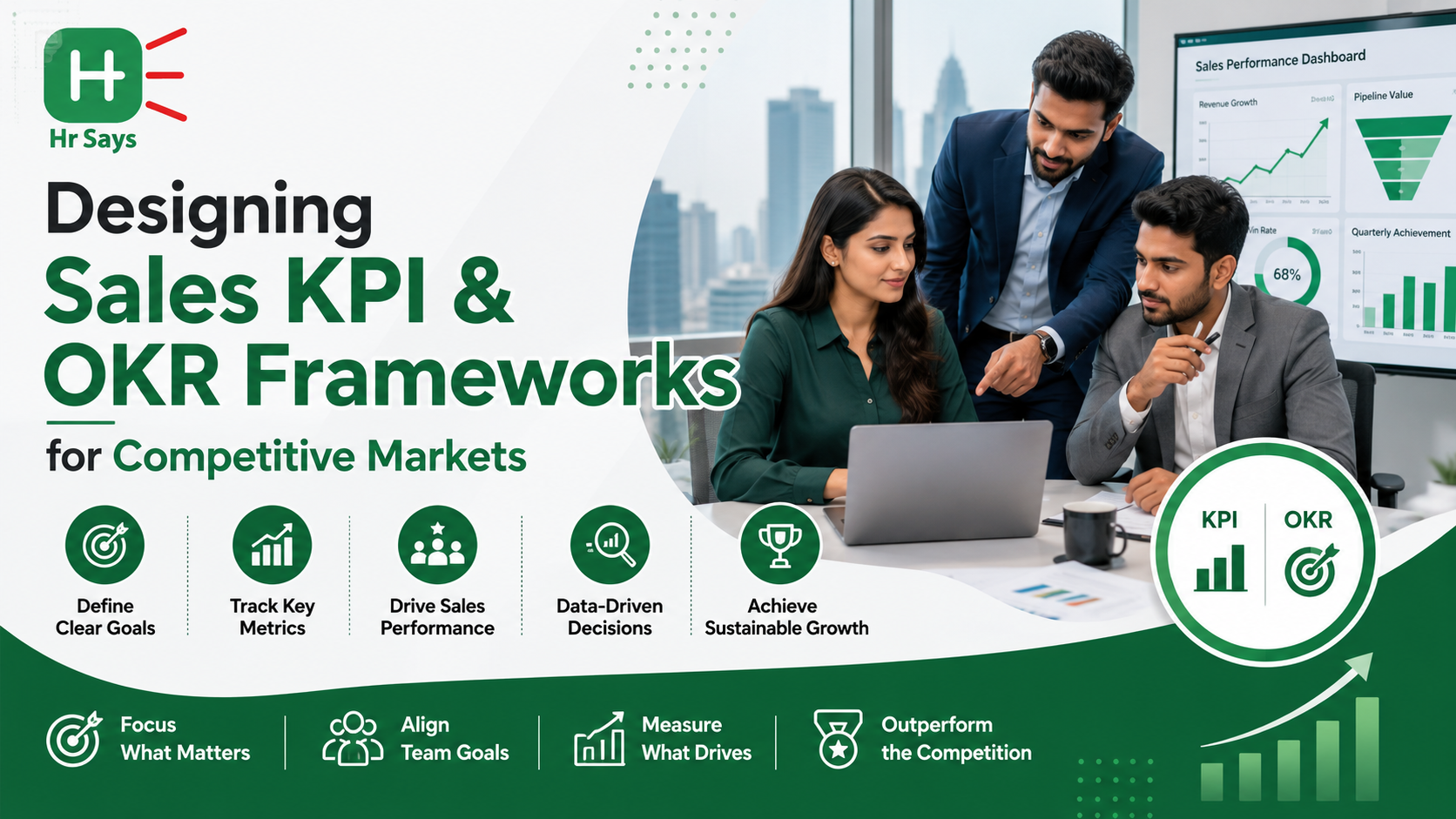
 In highly competitive, market-saturated sectors, relying on legacy sales management approaches—such as simply raising annual revenue targets by 15% and pushing reps to make more cold calls—inevitably leads to pipeline stagnation, margin erosion, and high sales rep turnover.




In highly competitive, market-saturated sectors, relying on legacy sales management approaches—such as simply raising annual revenue targets by 15% and pushing reps to make more cold calls—inevitably leads to pipeline stagnation, margin erosion, and high sales rep turnover. When customer acquisition costs (CAC) rise and buyers face an abundance of alternative choices, sales velocity depends on precision performance management.
To achieve consistent growth, forward-thinking Revenue Operations (RevOps) and sales leaders must move beyond viewing Key Performance Indicators (KPIs) and Objectives and Key Results (OKRs) as interchangeable tools.
When properly integrated, OKRs provide the ambitious vector (where the sales organization needs to pivot or expand), while KPIs supply the operational telemetry (whether the fundamental health of the revenue engine remains strong). Unifying these frameworks builds an agile sales organization capable of outmaneuvering aggressive competitors.
1. Demystifying the Architecture: OKRs vs. KPIs in Sales
To prevent confusion across sales floors, leadership must establish clear structural definitions for both metrics:
Key Performance Indicators (KPIs): The Business-as-Usual TelemetryKPIs measure the health, efficiency, and stability of an existing sales process. They track baseline operational standards that must be maintained consistently over time.
- Leading KPIs: Outbound discovery calls logged, executive meetings scheduled, pipeline creation value, and stage-1-to-stage-2 conversion rates.
- Lagging KPIs: Total closed-won revenue, average deal size (ACV), win rates, customer acquisition cost (CAC), and sales cycle length.
OKRs are time-bound, aspirational targets designed to alter performance baselines, enter new markets, or fix broken operational loops. They answer: What bold strategic shift must we achieve in the next 90 days?
- Objective (Qualitative & Inspiring): "Dominate the mid-market fintech sector by out-positioning legacy competitors on speed-to-value."
- Key Result 1 (Quantitative): Increase win rate against Tier-1 competitors from 22% to 40% in Q3.
- Key Result 2 (Quantitative): Decrease average mid-market sales cycle length from 75 days to 45 days.
- Key Result 3 (Quantitative): Generate $1.8M in qualified pipeline specifically from competitive displacement campaigns.
2. Designing Balanced Sales OKR/KPI Cascades for Competitive Sectors
In aggressive markets, focusing solely on total revenue numbers encourages sales reps to discount heavily or sign bad-fit clients who churn quickly. A balanced sales framework must anchor across four strategic dimensions:
The Pipeline Health & Velocity AxisIn competitive markets, pipeline length is the primary killer of deals. Your framework must track how fast opportunities move through the funnel (Sales\ Velocity = \frac{\text{Active Deals} \times \text{Average Deal Size} \times \text{Win Rate}}{\text{Sales Cycle Length}}).
The Competitive Displacement AxisWhen buyers already use a competitor's solution, sales teams must track specific displacement metrics—such as competitor-switch win rates, objection-handling conversion percentages, and buyer feature-gap feedback.
The Account Expansion & Land-and-Expand AxisAcquiring new logos in crowded spaces is expensive. Frameworks must track expansion efficiency, measuring Net Revenue Retention (NRR), cross-sell velocity, and multi-threaded buyer engagement (number of executive stakeholders engaged per deal).
3. Structural Evaluation: Legacy Revenue Metrics vs. Modern Integrated Frameworks
When evaluating how sales organizations handle competitive pressure, the shift from traditional quota management to an integrated performance architecture changes operational outcomes across five key axes:
- Goal-Setting Agility: Legacy setups rely on static annual quotas divided into equal quarters, making it difficult to adapt when competitors lower prices or release new features. Modern integrated frameworks deploy agile quarterly OKRs alongside continuous health KPIs, allowing leadership to pivot tactical focus within days.
- Pipeline Operational Visibility: Traditional models focus almost exclusively on lagging metrics like closed-won revenue, which only reveal problems after a quarter is missed. Integrated telemetry tracks leading metrics—such as stage-to-stage conversion velocity and C-suite meeting volume—flagging pipeline bottlenecks weeks before they impact revenue.
- Outreach Strategic Focus: Legacy approaches push reps toward high-volume, generic outreach like mass emailing, which yields low conversion rates in crowded markets. Integrated frameworks focus outreach on targeted competitor displacement campaigns and high-value Account-Based Marketing (ABM) loops.
- Sales Rep Discounting Behavior: Traditional quotas motivate reps to offer end-of-quarter price slashes to close any deal available, hurting long-term margins and increasing early churn. Outcome-linked KPIs prioritize deal quality, minimum contract values, and Net Revenue Retention (NRR) targets.
- Coaching & Mentorship Mechanisms: Legacy managers default to reactive monthly reviews centered on missed numbers. Integrated frameworks utilize data-driven weekly coaching sessions that target specific stage-conversion drops, accelerating ramp times for new hires.
4. High-Performance Action Plan for Revenue Operations Leads
To successfully deploy an integrated KPI/OKR sales framework across regional teams, execute this multi-phase operational roadmap:
- Audit Current Pipeline Baselines and Isolate Bottlenecks
Phase 1
Clean historical CRM data. Calculate true baseline metrics for sales cycle lengths, win rates against primary competitors, and stage-to-stage drop-off percentages across all account tiers. - Deploy Top-Line Company OKRs and Cascade to Sales Cohorts
Phase 2
Establish 1 to 2 company-wide strategic objectives for the quarter (e.g., Enterprise Expansion). Translate these into specific Key Results for Account Executives (AEs), Business Development Reps (BDRs), and Customer Success (CS). - Align Compensation Levers and Weekly Review Cadences
Phase 3
Adjust commission structures, SPIFFs, and accelerator tiers to reward strategic OKR achievements (such as non-discounted multi-year deals or competitive displacements), and embed KPI telemetry into weekly 1-on-1 coaching sessions.
Actionable Strategy: Digital Governance and Credential Integration
- Link Sales Upskilling Natively via National Academic Registries: Ensure all advanced consultative sales certifications, negotiation workshops, and RevOps training completed by sales staff are logged natively using verified registries like the APAAR ID system within the Academic Bank of Credits (ABC) network to standardize internal promotion paths.
- Integrate Field Sales Safety and Health Profiles: For field sales teams managing high-volume travel across regions, ensure mandatory employee health check-ups and travel insurance clearances sync smoothly through secure systems like the ABHA ID pipeline.
- Establish Semi-Annual Performance Scorecard Audits: Review your sales framework twice yearly. Eliminate obsolete KPIs, adjust OKR stretch levels based on market shifts, and confirm CRM workflows capture metrics automatically without adding administrative friction for reps.
Frequently Asked Questions (FAQs)
Q1. What is the main difference between a sales KPI and a sales OKR?A sales KPI measures the ongoing operational health and stability of an existing sales process (e.g., monthly win rate or call volume). A sales OKR is an ambitious, time-bound goal designed to transform performance or execute a strategic shift (e.g., breaking into a new enterprise market segment within 90 days).
Q2. How many OKRs should a sales team set per quarter?Sales teams should focus on 1 to 2 Objectives per quarter, with each Objective supported by 3 to 4 quantitative Key Results. Setting too many OKRs dilutes focus and causes reps to default back to basic daily routines.
Q3. Should sales compensation and commissions be tied directly to OKRs?Directly tying commissions to stretch OKRs can backfire. Because OKRs are designed to be ambitious (where achieving 70–80% is considered success), linking basic pay directly to them can encourage reps to set safe, easy targets. Instead, base primary commissions on revenue KPIs, and use bonuses or accelerators for OKR achievements.
Q4. How do you prevent sales reps from discounting heavily to hit quota in competitive markets?Integrate deal quality KPIs—such as Minimum Contract Value (MCV), Gross Margin thresholds, or multi-year commitment bonuses—into compensation plans. Commission rates should scale down when discounts exceed pre-approved percentage caps.
Q5. What is the most critical leading KPI to track in a high-competition B2B environment?Qualified Pipeline Generation Velocity (the rate at which new, fully qualified opportunities enter Stage 2 or higher) is the most critical leading metric. It provides early warning of future revenue gaps 60 to 90 days before deals close.
Q6. How does an APAAR ID help in enterprise sales team management?An APAAR ID acts as a secure digital ledger that records a professional's verified academic accomplishments, specialized sales credentials, and executive training credits across national databases, simplifying credential validation during internal talent assessments.
Q7. What are the key warning signs that a sales team's KPI framework is failing?Primary red flags include sales reps spending over 20% of their time manually logging data into the CRM, high deal drop-offs at the proposal stage due to poor initial qualification, and reps hitting activity quotas (calls/emails) without generating pipeline.
Q8. How do you design OKRs for Business Development Reps (BDRs) vs. Account Executives (AEs)?BDR OKRs should focus on strategic pipeline quality and target account access (e.g., penetrating C-suite contacts in Fortune 500 target accounts). AE OKRs should focus on deal velocity, win rates against key competitors, and expansion deal size.
Q9. How fast can a sales organization expect results after implementing an integrated OKR/KPI framework?When clear metrics, weekly coaching cadences, and aligned incentives are deployed, early improvements in pipeline quality and stage velocity are typically visible within 30 to 45 days, with measurable revenue impacts emerging by the end of the first 90-day quarter.
Q10. What immediate step should a sales director take if an OKR is tracking far behind schedule mid-quarter?The director should conduct a bottleneck audit during week 6: analyze leading KPIs to isolate whether the failure stems from low activity volume, poor messaging, or aggressive competitor pricing, and adjust tactical support (such as deploying specialized battle cards or marketing air cover) without lowering the ultimate target.