 Monday, September 21, 2026
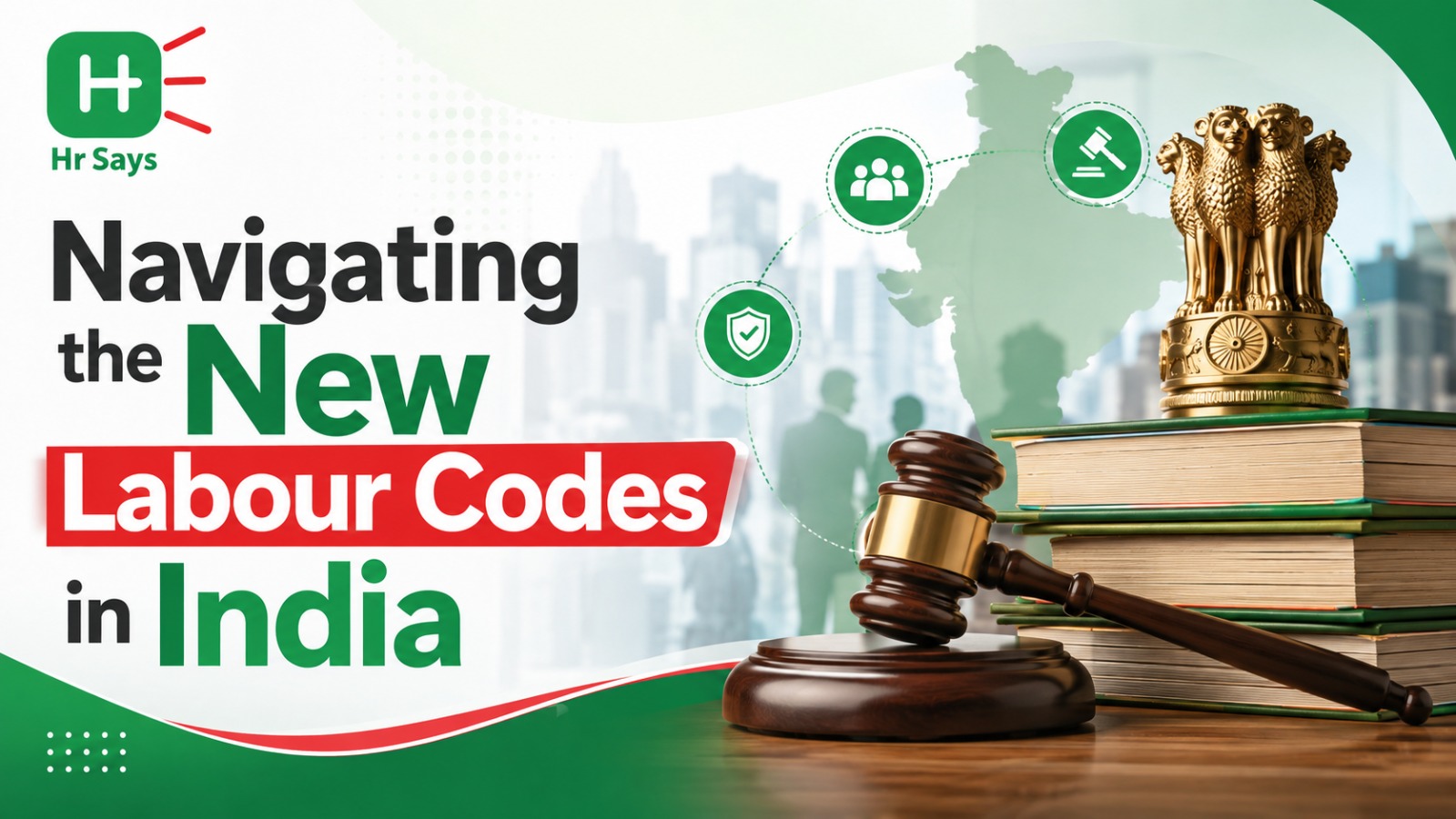
 India’s New Labour Codes modernize employment laws by consolidating 29 labor statutes into four unified codes. The reforms reshape wages, social security, working conditions, and industrial relations, requiring businesses to update payroll systems, HR policies, compliance processes, and employment contracts for regulatory readiness.




The regulatory framework governing human resources, industrial relations, and wage structures in India is undergoing its most significant overhaul since independence. The central government’s consolidation of 29 legacy central labor laws into 4 distinct New Labour Codes has fundamentally shifted from a collection of fragmented statutes to a unified, streamlined legal framework.
As state governments finalize their respective state-specific rules, corporate legal counsels, HR executives, and business leaders face an immediate operational challenge. Adapting to this shifting compliance landscape requires looking beyond outdated payroll processing habits. Implementing the new codes demands an active, strategic restructuring of core wage formulas, working hour schedules, social security registrations, and employee contracts. Failure to align your organizational systems with these frameworks introduces severe statutory penalties, back-pay liabilities, and operational bottlenecks.
1. The Quad-Code Compliance Framework
The consolidation rearranges the entire legal landscape into four primary architectural pillars, each governing a distinct zone of the modern workplace ecosystem:
- Code on Wages: Establishes a unified definition of "Wages," enforces a mandatory 50\% cap on flexible allowances relative to gross compensation, standardizes overtime calculation rules, and guarantees minimum wage protections across all sectors.
- Code on Social Security: Expands Provident Fund (PF) and Employee State Insurance (ESI) coverage, reduces the gratuity eligibility threshold to 1 year for fixed-term workers, and introduces dedicated social security funds for gig and platform workers.
- Occupational Safety, Health and Working Conditions (OSH) Code: Standardizes daily and weekly working hour limits (including 4-day workweek provisions), mandates annual health checks for eligible workers, enforces gender-neutral night-shift safety protocols, and unifies operating licenses.
- Industrial Relations (IR) Code: Elevates the threshold for mandatory Standing Orders from 100 to 300 employees, mandates internal Grievance Redressal Committees, and enforces a strict 14-day notice window prior to initiating industrial strikes.
2. Deep-Dive: The Critical Operational Shifts
Shift A: The New Universal Wage Definition & Payroll Restructuring
The single most high-impact change across the entire framework is the standardized definition of the term "Wages." Historically, corporate payroll architectures minimized basic salary footprints while inflating flexible allowances (such as house rent, travel, and special allowances) to lower the company's financial liability toward Provident Fund (PF) and gratuity contributions.
- The 50% Statutory Cap: Under the Code on Wages, your core allowances can no longer exceed 50% of the total gross compensation package. If the aggregation of your flexible allowances crosses this 50% threshold, the excess amount is automatically pulled back and added to the basic wage component.
- The Bottom-Line Impact: This mathematical recalculation instantly drives up the employer’s monthly contribution toward PF and long-term gratuity. For employees, while their long-term social security safety net expands significantly, their immediate monthly net take-home pay will experience a visible drop.
Shift B: Restructuring Working Hours, Overtime, and Leave Policies
The Occupational Safety, Health and Working Conditions (OSH) Code introduces strict operational boundaries to handle modern shifts and flexible workspace models:
- Working Hour Flexibilities: The code preserves the standard 48-hour weekly ceiling, but allows organizations the flexibility to offer a 4-day work week (incorporating 12-hour daily shifts) or a standard 5-day work week, provided the daily hours align with employee consent and health standards.
- Overtime Recalibration: The minimum threshold to trigger overtime pay has been lowered. Any work extending beyond 15 minutes past a scheduled shift must be tracked and compensated as a full half-hour of overtime, calculated at twice the standard wage rate.
- Unified Leave Accumulation: Employees become eligible for earned leave benefits within just 180 days of service instead of the legacy 240-day requirement. Furthermore, carry-forward limits are standardized to a maximum of 30 days per calendar year.
Shift C: Standing Orders and Industrial Relations Adjustments
The Industrial Relations (IR) Code heavily alters the compliance burden for large-scale operations, manufacturing facilities, and corporate offices:
- The 300-Employee Threshold Reset: Legacy laws forced any establishment employing more than 100 workers to draft and register rigid, formal "Standing Orders" governing internal discipline and termination. The new code elevates this threshold significantly to 300 employees, granting mid-sized enterprises unprecedented operational agility to scale their workforce up or down based on market conditions without deep bureaucratic bottlenecks.
3. Structural Breakdown: Legacy Statutes vs. The New Labour Codes
Evaluating core compliance domains highlights how modern unified rules alter operational risk profiles across Indian corporate environments:
- Wage Component Structuring: Legacy frameworks allowed allowances to account for 70%–80% of total Gross CTC. The new Code on Wages enforces a mandatory 50% allowance cap, requiring basic wage to equal or exceed half of total CTC to eliminate under-funded social security assets.
- Gratuity Eligibility Threshold: Legacy rules strictly required 5 consecutive years of continuous service. The Code on Social Security reduces this threshold to just 1 year for fixed-term contract workers and extends social security coverage to gig/platform workers.
- Standing Orders Mandate: Legacy statutes triggered rigid standing order mandates upon reaching 100 on-roll workers. The Industrial Relations Code elevates this threshold exclusively to facilities holding 300+ workers, granting mid-sized enterprises operational flexibility.
- Overtime Calculation Window: Legacy practices frequently rounded down or lost minor fractions of overtime hours. The OSH Code mandates that any work extending past 15 minutes triggers a full 30-minute double-pay ledger, requiring automated biometric tracking.
4. Action Plan: Your 2026 Compliance Onboarding Roadmap
To achieve compliance and protect your organization against retroactive statutory liabilities, execute a structured three-phase operational roadmap:
- Execute a Complete Payroll Restructuring Audit
Phase 1: Payroll Simulation
Instruct finance and payroll teams to run dummy models matching active employee databases against the 50% basic wage cap rule, computing exact financial impacts on employer PF liabilities, gratuity provisions, and employee net take-home pay. - Upgrade Biometric & Time-Tracking Frameworks
Phase 2: Time-Tracking Infrastructure
Replace manual logs with automated, tamper-proof biometric time systems capable of tracking precise 15-minute overtime thresholds and logging 48-hour weekly limits across physical and remote workspaces. - Update Employment Contracts and HR Manuals
Phase 3: Legal & Contract Realignment
Proactively rewrite employment contract templates to reflect fixed-term gratuity disclosures (1-year eligibility), standardized 30-day leave carry-forward caps, and gender-neutral night-shift safety compliance protocols.
Actionable Strategy: Digital Governance & Identity Compliance
- Verify Credentials via Central Academic Repositories: Ensure HR and payroll compliance specialists maintain verified qualifications logged through universal digital registries—such as the APAAR ID system within the Academic Bank of Credits (ABC) network.
- Integrate Employee Profiles with Universal Health Registries: For organizations managing employee health insurance under ESI or corporate wellness programs, ensure digital health records link accurately to national health infrastructure—including pipelines like the ABHA ID (Ayushman Bharat Health Account) network.
- Maintain Automated Compliance Audits: Establish digital audit trails for overtime pay, gender-neutral safety sign-offs, and social security filings to prepare for transparent, web-based inspections by statutory authorities.
Frequently Asked Questions (FAQs)
Q1. Will the implementation of the new labor codes reduce an employee's take-home pay?
Yes, for a significant portion of corporate employees, immediate monthly take-home pay will decrease. Because the codes demand that basic salary must comprise at least 50% of the total gross package, the mathematical baseline used to compute Provident Fund (PF) and Gratuity contributions expands. Consequently, higher monthly employee deductions will divert cash out of immediate take-home pay and route it into long-term retirement assets.
Q2. What exactly is a "Fixed-Term Employment" structure under the new codes?
Fixed-Term Employment is a formalized contract option that allows companies to hire professionals for an explicitly defined, temporary duration. Fixed-term employees are legally entitled to receive identical working hours, wages, social security benefits, and healthcare access as permanent on-roll employees on the same floor, completely removing historical disparities.
Q3. How has the gratuity payout rule changed for fixed-term contract workers?
Under legacy laws, an employee had to complete 5 consecutive years of unblemished service with a single employer to qualify for a gratuity payout. The New Social Security Code completely removes this 5-year barrier for fixed-term contract professionals, granting them pro-rata gratuity rights based on a heavily reduced threshold of just 1 single year of active service.
Q4. Are gig workers, independent freelancers, and platform delivery partners covered under the new laws?
Yes, this represents a major inclusive milestone within the Social Security Code. The framework officially defines "Gig Workers" and "Platform Workers" for the first time in Indian legal history. It outlines the construction of a centralized Social Security Board tasked with funding accident insurance, maternity covers, and old-age pensions for gig workers, powered by a mandatory 1% to 2% revenue contribution tax levied on major aggregators.
Q5. Can an employer implement a 4-day work week under the Occupational Safety Code?
Yes, the code provides the structural flexibility to operate a 4-day work week. However, because the absolute weekly working ceiling remains strictly locked at 48 hours, moving to a 4-day structure requires your employees to log 12-hour working shifts daily. This shift requires formal corporate transparency and individual employee consent frameworks.
Q6. What is the penalty for non-compliance under the Code on Wages?
The new frameworks implement a progressive, high-velocity penalty infrastructure designed to deter persistent corporate negligence. First-time offenses regarding underpayment or structural wage manipulation attract heavy financial fines crossing ₹50,000. Repeat offenses within a 5-year window transition out of simple fines into mandatory criminal prosecution, carrying jail terms up to 3 months.
Q7. How do the new labor codes simplify the historical compliance burden for HR managers?
The primary operational benefit of the New Labour Codes is deep structural consolidation. The framework replaces a messy network of dozens of archaic legacy laws with a single, streamlined compliance gateway. Instead of filing multiple independent returns, maintaining disparate physical registers, and interacting with separate inspectors, companies now transition to unified web returns and web-based transparent inspections.
Q8. What has changed regarding the legal employment of women in night shifts?
The Occupational Safety Code implements progressive, gender-equal workplace rules. Women are legally entitled to work night shifts (extending between 7 PM and 6 AM) across all industries, provided the employer satisfies strict, non-negotiable safety conditions: securing explicit employee consent, providing secure dedicated transit, maintaining well-lit spaces, and deploying robust anti-harassment monitoring mechanisms on the floor.
Q9. Do the new codes mandate a formal notice window before employees can go on a strike?
Yes. To protect public infrastructure and enterprise stability from sudden disruptions, the Industrial Relations Code mandates that employees across all industrial and corporate establishments must provide a binding 14-day written notice window prior to initiating a strike. Furthermore, staging a flash strike while legal reconciliation proceedings are actively underway is classified as completely illegal.
Q10. How should a business prepare for state-level differences in the Labour Codes?
While the central government created the primary statutory master drafts, labor exists on the "Concurrent List" of the Constitution of India. This means individual state governments are actively drafting their unique regional rulebooks. Businesses operating across multiple states must track these localized updates closely, ensuring their central HR templates adapt cleanly to regional variations in state allowances and registration fees.