 Monday, September 21, 2026
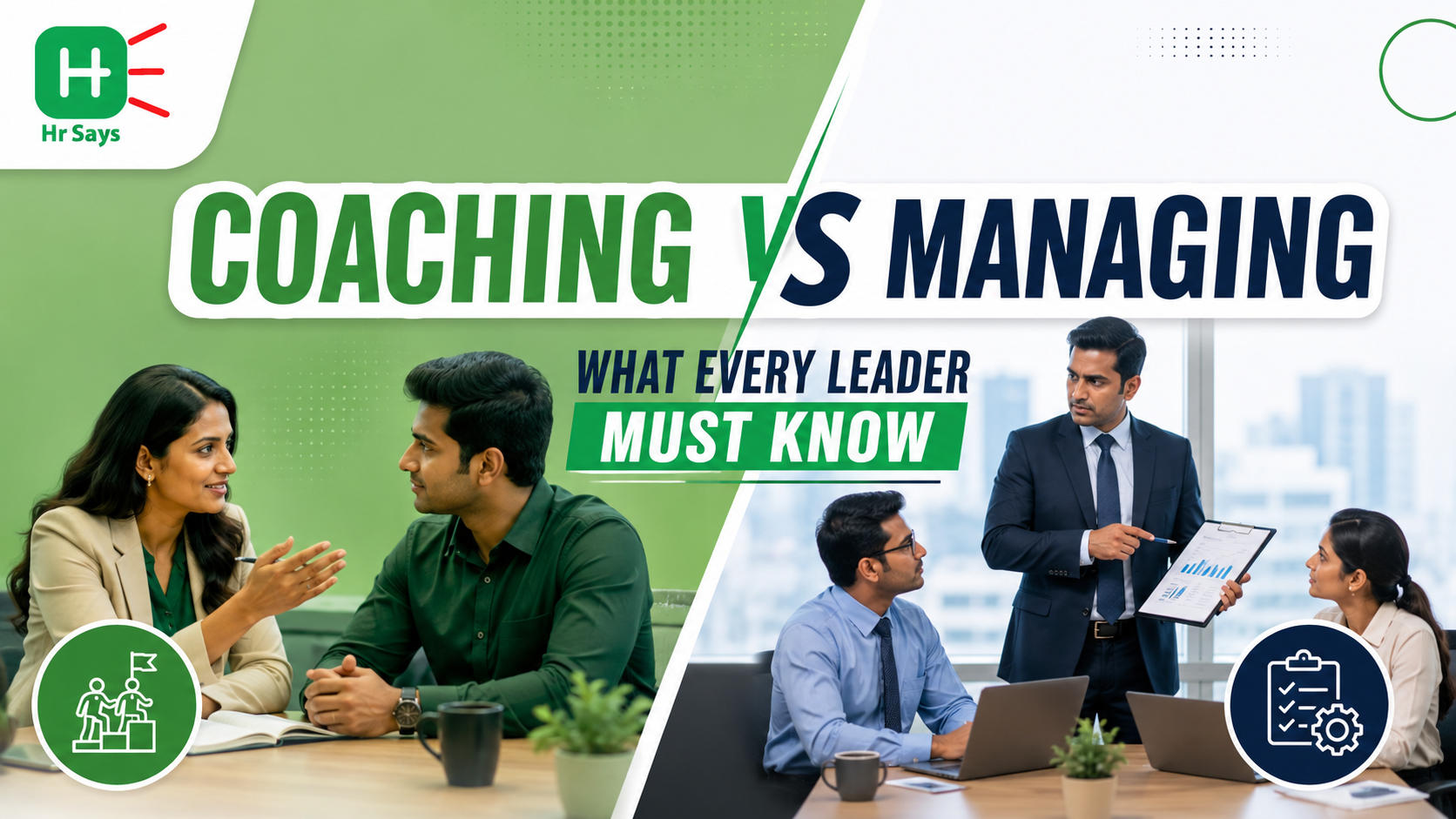
 Coaching and managing are distinct leadership approaches. Effective leaders know when to direct and when to develop, building high-performing, engaged teams in Indian workplaces.





Introduction
Every leader in India today faces a version of the same tension. There is a deliverable due on Friday. A team member is falling behind. A new hire needs direction. And somewhere in the middle of it all, a senior employee is quietly disengaged, not because the work is hard, but because nobody has invested in helping them grow.
In moments like these, the question is not just what to do. The more important question is how to lead. Should the leader step in, assign tasks, and drive accountability? Or should the leader slow down, ask the right questions, and help the team member find the answer within themselves?
This is the central difference between managing and coaching. Both are essential. Both serve a purpose. But most leaders in India rely heavily on one and rarely use the other. Understanding when to manage and when to coach is one of the most underrated skills in workplace leadership, and it is a skill that directly shapes team performance, employee retention, and organizational culture.
This article breaks down the distinction clearly, explains why coaching is becoming a strategic priority in Indian workplaces, and helps leaders recognize which approach fits which situation.
Understanding the Difference Between Coaching and Managing
The words "coaching" and "managing" are often used interchangeably in workplace conversations, but they represent two fundamentally different leadership behaviors.
Managing is directive in nature. A manager sets goals, assigns responsibilities, monitors progress, ensures deadlines are met, and solves problems that block the path forward. Managing is most effective when outcomes are clearly defined, timelines are tight, and clarity of execution matters more than exploration of alternatives. It is about getting the work done today.
Coaching, on the other hand, is developmental. A coach asks questions rather than giving answers. A coach listens more than they speak. A coach helps a team member discover their own capabilities, develop their problem-solving skills, and build the confidence to handle bigger challenges in the future. Coaching is about building the person so that they can get more work done tomorrow, and do it better.
The International Coach Federation (ICF) defines coaching as a thought-provoking and creative partnership that inspires individuals to maximize their professional and personal potential. That definition says a great deal. Coaching is a partnership. It assumes the employee already has the capacity to find solutions. The coach's role is to help that capacity surface.
Neither approach is superior to the other. A leader who only coaches may allow urgent tasks to slip through while spending time on long reflective conversations. A leader who only manages may meet every short-term target while quietly building a team that depends on direction rather than developing independent thinkers. The most effective leaders know how to use both, and they know which one a situation is calling for.
Why Indian Leaders Tend to Default to Managing
In most Indian organizations, the management style that gets rewarded is directive and results-oriented. The pressure to deliver quarterly outcomes, manage attrition, and hit targets leaves little room for leaders to slow down and coach. Many managers were promoted because they were high performers in their individual roles, not because they had developed coaching skills. When they step into leadership, they do what they know: they manage.
There is also a cultural dimension to consider. In many Indian workplace environments, hierarchy is deeply embedded. Leaders are expected to have answers. Asking questions rather than providing solutions can sometimes be perceived as indecision. This perception creates a structural barrier to coaching behavior even when leaders recognize its value.
A LinkedIn Workplace Learning Report found that a significant proportion of employees in Asia would stay longer at a company if there was more investment in their learning and development. In India specifically, companies that invest in leadership coaching and manager development consistently report better employee engagement scores and lower attrition. Organizations such as Infosys, HCL Technologies, and several large BFSI sector companies have built internal coaching programs precisely because the data supports the business case.
The challenge is not awareness. Most HR professionals and business leaders in India know that coaching is important. The challenge is application. Knowing when to switch from manager mode to coach mode in the middle of a real workday is a practical skill that most leaders are still developing.
When to Manage and When to Coach
There is no fixed rule that tells a leader exactly when to manage and when to coach, but there are reliable signals that make the decision clearer.
Managing is the right approach when the task is time-critical and the path forward is well-defined. When a new employee needs onboarding, when a crisis requires immediate resolution, when compliance is non-negotiable, or when the team member genuinely lacks the knowledge to proceed without guidance, directive management is not just acceptable. It is necessary.
Coaching becomes the right approach when the issue is more about capability and confidence than task clarity. When a mid-level manager keeps escalating problems instead of solving them independently, that is not a task problem. It is a development problem, and it calls for a coaching conversation. When a high performer starts playing it safe and losing their creative edge, a managing approach will not fix that. A deeper conversation will.
Three useful questions can help leaders in the moment:
- Is this person lacking information, or lacking confidence?
- Is the problem about the task, or about the person's relationship with the task?
- Does this situation need direction today, or development over time?
When the answer points to the person and their growth, coaching is the better investment of a leader's time.
Core Coaching Skills Every Manager in India Should Develop
Moving from a purely directive management style to a coaching-oriented approach requires deliberate practice. The following skills form the foundation of effective coaching behavior in workplace settings.
Asking Powerful QuestionsThe single most visible difference between a managing conversation and a coaching conversation is the quality of the questions being asked. Managers tend to ask "what went wrong" and "how do we fix it." Coaches ask "what do you think is driving this challenge" and "what options have you considered." The shift from solution-giving to question-asking is not easy, but it is transformational. It signals to the employee that the leader believes in their ability to solve the problem.
Active ListeningCoaching requires a leader to listen with full attention, not to formulate a response, but to genuinely understand what the other person is experiencing. This is harder than it sounds in a busy workplace where leaders are juggling multiple priorities. Active listening means staying present, noticing what is not being said, and resisting the urge to fill silence with answers.
Giving Developmental FeedbackFeedback in a managing context is often evaluative. It tells people what they did wrong and what they need to correct. Feedback in a coaching context is forward-looking. It focuses on patterns of behavior, explores the reasons behind those patterns, and helps the individual identify what they want to do differently. For managers in India, who are often more comfortable giving directive feedback, shifting to a developmental feedback style requires both training and practice.
Building Psychological SafetyCoaching only works in environments where employees feel safe enough to be honest about their struggles, their uncertainties, and their ambitions. Google's Project Oxygen research, which studied thousands of managers across the organization, found that the most effective managers were those who created psychologically safe environments. In India, where performance pressure is high and admitting a gap can feel career-threatening, building this kind of safety is a conscious leadership act.
The Business Case for Coaching in Indian Organizations
The argument for coaching is not just philosophical. There is a measurable business impact.
Organizations that have strong coaching cultures report significantly higher employee engagement compared to organizations that rely primarily on directive management. Engaged employees are more productive, more innovative, and far less likely to leave. In a country where the war for skilled talent is fierce and attrition costs are significant, this matters enormously.
Coaching also supports the development of leadership pipelines. One of the most consistent challenges that Indian CHROs and HR leaders report is the shortage of people-ready leaders in the middle management layer. Managers who coach create conditions for their team members to develop leadership capabilities over time. The organization ends up with a deeper bench of capable leaders, which reduces dependence on external hiring and shortens the time it takes to fill senior roles.
Startups and mid-sized Indian companies are increasingly recognizing this. Many organizations in the technology, healthcare, and financial services sectors are now investing in internal coach training programs, peer coaching communities, and leadership development frameworks that include coaching as a formal competency. For HR professionals, creating these ecosystems is both a people priority and a business priority.
Challenges Leaders Face When Transitioning to Coaching
The transition from a directive management style to a coaching approach is genuinely difficult, and it would be misleading to suggest otherwise.
The most common challenge is time. A coaching conversation takes longer than giving a direct answer. When a manager has twelve things demanding attention before noon, sitting down for a twenty-minute developmental conversation can feel like a luxury. This is why organizations need to embed coaching not as an add-on activity but as a legitimate use of a manager's time.
Another challenge is measurement. The outcomes of managing are visible and immediate: the report was submitted, the project moved forward, the deadline was met. The outcomes of coaching are slower and less tangible: the employee is gradually becoming more confident, the quality of their problem-solving is improving, their engagement score has nudged upward. For leaders who are measured primarily on short-term results, investing in coaching can feel like it has no immediate return.
Finally, not every leader has the emotional intelligence or the training to coach effectively. Coaching without skill can come across as evasive or unhelpful. An employee who asks a direct question and receives a series of questions in return can feel frustrated rather than supported. This is why coaching capability needs to be deliberately developed, not assumed.
Building a Coaching Culture in the Workplace
For HR leaders and CHROs in India, the opportunity is not just to help individual managers become better coaches. It is to build organizations where coaching is embedded in the culture of leadership.
This starts with how organizations define what good leadership looks like. If the leadership competency framework only rewards task delivery and target achievement, coaching behavior will always be secondary. Organizations that are serious about coaching culture include developmental leadership behaviors in their performance evaluation frameworks, their promotion criteria, and their learning and development investments.
It also starts with how managers are trained. Most management development programs in India focus on operational skills: financial acumen, project management, communication, and stakeholder management. Coaching skills are rarely given the same priority. Building coaching capability into leadership development programs, especially for first-time managers and mid-level leaders, creates a structural shift in how leadership is practiced.
Platforms like HRSays offer HR professionals and business leaders a space to explore these conversations, share real workplace insights, and engage with the kind of practical, people-focused knowledge that helps organizations move forward with clarity and purpose.
Conclusion
The question of whether to coach or to manage is not a philosophical debate. It is a practical leadership decision that plays out dozens of times every week in every team across every organization. Getting it right matters because it shapes how employees experience their work, how their capabilities develop, and how committed they feel to the organization's purpose.
The most effective leaders in India's evolving workplace are not those who have mastered one style. They are those who have developed the awareness to recognize what each situation needs and the flexibility to respond accordingly. They manage when clarity and direction are needed. They coach when growth and development are what the moment is calling for.
Building that dual capability is not optional anymore. It is the foundation of the kind of leadership that builds workplaces worth belonging to.
Frequently Asked Questions
Q1: What is the main difference between coaching and managing in the workplace?
Managing is a directive approach focused on task completion, goal achievement, and operational accountability. Coaching is a developmental approach focused on helping employees grow their capabilities, build confidence, and solve problems independently. Both are necessary leadership behaviors, but they serve different purposes and are suited to different situations.
Q2: When should a manager use coaching instead of managing?
Coaching is most appropriate when an employee has the potential to solve a problem on their own but needs guidance, encouragement, or a different perspective. It works best in situations involving career development, skill-building, or helping an employee move past a confidence barrier. Managing is more suitable when speed, compliance, or clear task direction is required.
Q3: Can a manager be both a coach and a manager at the same time?
Yes. Effective leaders regularly move between coaching and managing depending on the situation. A single conversation can involve a managing moment followed by a coaching moment. The skill lies in recognizing which mode is needed and shifting between them with awareness and intention.
Q4: How can Indian organizations build a coaching culture?
Building a coaching culture requires embedding coaching behaviors into leadership competency frameworks, performance reviews, and manager development programs. Organizations should invest in training managers in coaching skills, create psychological safety within teams, and formally recognize developmental leadership alongside task delivery in how leaders are evaluated and promoted.
Q5: What are the benefits of coaching for employee retention in India?
Employees who feel their managers invest in their growth and development are significantly more likely to stay with an organization. Coaching builds trust, increases engagement, and helps employees see a long-term future within the company. For Indian organizations dealing with high attrition in sectors like technology, BFSI, and retail, investing in manager coaching capability is one of the most practical retention strategies available.
Resources
- International Coach Federation (ICF): Global body for professional coaching standards, research, and coach certification frameworks applicable to workplace coaching.
- LinkedIn Workplace Learning Report: Annual research on employee learning preferences, manager development trends, and the business impact of coaching cultures across Asia-Pacific markets.
- Harvard Business Review, Leadership and Management Research: Peer-reviewed articles and case studies on coaching effectiveness, management styles, and leadership development in organizational settings.
- SHRM (Society for Human Resource Management): Research, toolkits, and frameworks on building coaching cultures, manager effectiveness, and HR leadership development programs.
- National HRD Network (NHRDN) India: India-based professional body for HR practitioners offering research, events, and frameworks relevant to leadership and people management in Indian organizations.
Interlinking Keywords
leadership coaching, coaching culture, manager vs leader, employee engagement strategies, people management skills, HR leadership India, workplace learning and development, first-time manager training, performance management, talent development
Last Reviewed By:
Hr Says Advisory Panel on 6 August, 2026
Disclaimer:
The information presented in this article is intended for general informational and educational purposes only. It reflects broad research and professional insights on leadership and management practices. Readers are advised to evaluate all suggestions in the context of their specific organizational environment and consult qualified HR and leadership development professionals before implementing any significant changes to management practices or organizational culture frameworks.