Tuesday, September 22, 2026
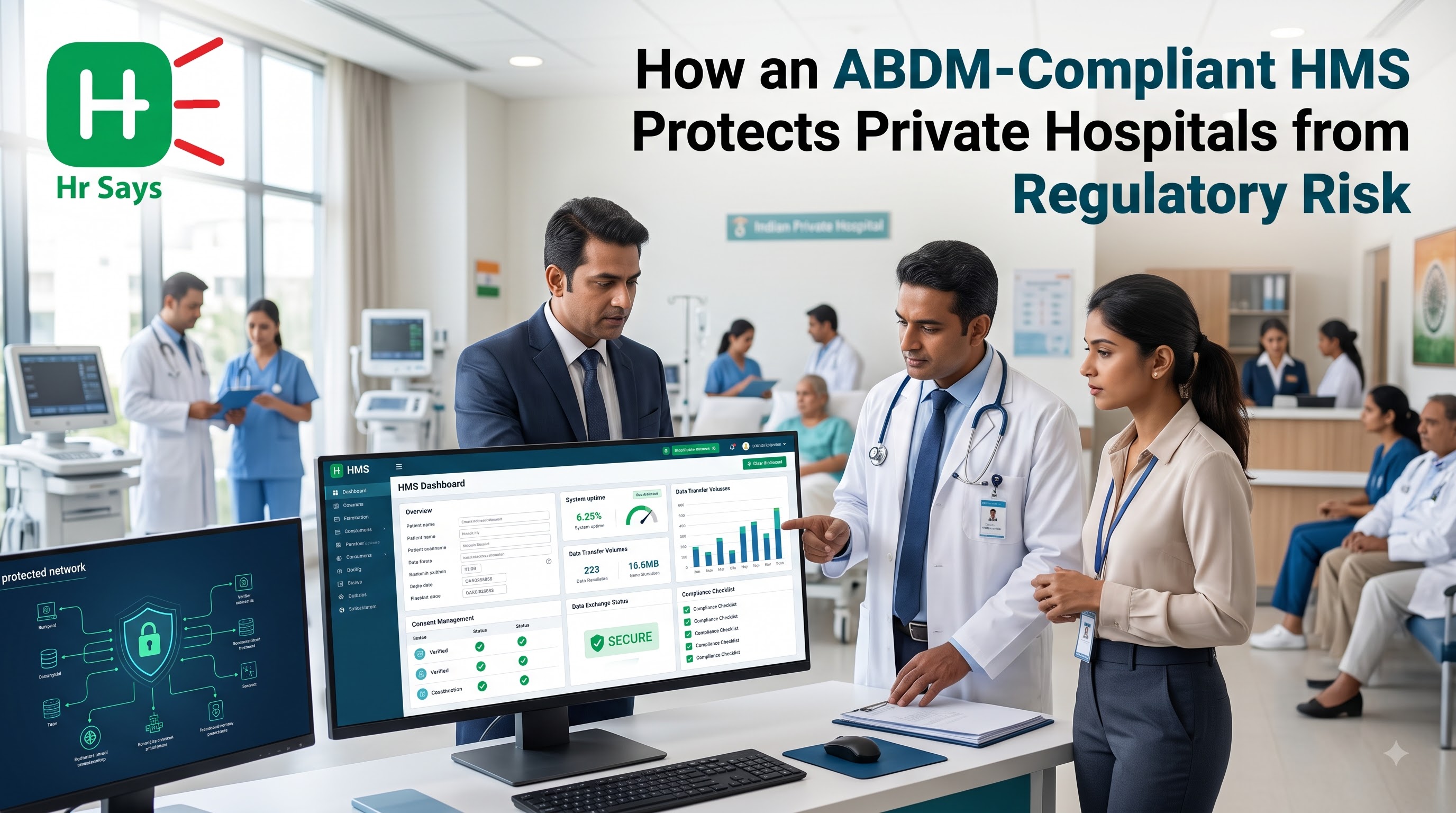
 ABDM-compliant hospital management software strengthens private hospitals through secure digital records, consent-based data exchange, interoperability, audit trails, insurance integration, and regulatory compliance, reducing operational, legal, and financial risks.




The regulatory and operational landscape for healthcare providers across India is undergoing an extensive compliance evolution. Driven by the National Health Authority (NHA) and the Ministry of Health and Family Welfare (MoHFW), the nationwide rollout of the Ayushman Bharat Digital Mission (ABDM) is transitioning digital health infrastructure from an optional administrative upgrade into a baseline operational mandate.
For private nursing homes, secondary-care surgical centers, and multi-specialty hospitals, maintaining legacy paper charts or disconnected, non-certified desktop software introduces severe clinical and legal exposures: untraceable medical records, non-compliance with statutory data protection frameworks, vulnerability to medical malpractice litigation, and rejection from cashless insurance panels.
To navigate this tightening regulatory environment, adopting a pre-certified, interoperable hospital management software India platform is essential. Beyond optimizing outpatient queue speeds and stopping billing leakage, an ABDM-compliant Hospital Management Information System (HMIS) functions as a legal and administrative shield against compliance penalties, data privacy breaches, and insurance claim denials.
1. The Legal and Regulatory Reality: Mapping Modern Hospital Liabilities
Operating a private healthcare facility in India requires navigating interconnected national statutes and clinical governance standards:
- National Medical Commission (NMC) Registered Medical Practitioner Regulations:
- The NMC mandates the maintenance of clear, legible, and time-stamped electronic medical records for all patients.
- Incomplete, illegible, or unauthenticated handwritten records significantly impair a hospital's legal defense during consumer court disputes, state medical council inquiries, or allegations of medical negligence.
- The Digital Personal Data Protection (DPDP) Act:
- Classifies patient diagnostic reports, prescription histories, and clinical notes as sensitive digital personal data.
- Storing unencrypted patient health data on unprotected local hard drives or transferring medical files via unverified consumer messaging channels exposes healthcare organizations to statutory enforcement notices and severe financial penalties for data fiduciary non-compliance.
- The Clinical Establishments (Registration and Regulation) Act:
- Requires private healthcare institutions to maintain standardized digital records and submit structured public health surveillance returns (e.g., notifiable infectious disease data, maternal-infant health indicators) to district health authorities.
- Public and Private Insurance Empanelment Criteria:
- Participation in government-sponsored health assurance schemes (such as Ayushman Bharat PM-JAY) and private Third-Party Administrator (TPA) cashless networks increasingly requires providers to maintain certified digital health endpoints to prevent fraudulent billing and accelerate claims adjudication.
2. Core Operational Safeguards Delivered by an ABDM-Compliant HMS
Transitioning to a certified, standards-based hospital management software India architecture embeds statutory compliance directly into daily clinical workflows:
- A. Consent-Driven, Traceable Health Data Exchange:
- Under the DPDP Act and the ABDM framework, patient records cannot be accessed or shared across external providers without explicit, verifiable consent.
- Compliant software connects directly to the national Electronic Consent Manager. When a clinician requests prior diagnostic records from an external hospital, the system triggers a push notification to the patient's mobile device (via personal health record apps).
- The patient explicitly defines the scope, purpose, and time window of access. Every access event is immutably logged, providing verifiable, court-admissible audit trails demonstrating that data privacy boundaries were strictly observed.
- B. Direct Integration with National Professional and Facility Registries:
- Integrates natively with the Health Facility Registry (HFR) and Healthcare Professionals Registry (HPR).
- Every electronic prescription, laboratory validation, and operative note is digitally signed using the consulting doctor's verified HPR credentials.
- This integration protects the hospital from vicarious liability associated with uncredentialed staff, expired medical council registrations, or unauthorized signature cloning during official audits.
- C. Standardized Data Formatting via HL7-FHIR Profiles:
- Uncertified software typically stores clinical data in proprietary, unstructured databases that cannot communicate with external networks.
- ABDM-certified hospital management software India solutions format all clinical narratives, diagnostic panels, and discharge summaries using international HL7-FHIR (Fast Healthcare Interoperability Resources) data definitions. This standardization ensures that clinical data remains structured, encrypted, and legally defensible across the care continuum.
3. Structural Comparison: Certified ABDM-Compliant HMS vs. Legacy Local Systems
- Patient Data Access & Audit Logging:
- Certified ABDM-Compliant HMS: Automated, cryptographic audit logs capturing user identity, timestamp, and purpose for every record accessed.
- Legacy Local / Uncertified Software: Absent or easily altered local logs; vulnerable to unauthorized internal viewing or tampering.
- National Health ID (ABHA) Integration:
- Certified ABDM-Compliant HMS: Native, one-click creation and verification of Ayushman Bharat Health Account (ABHA) IDs via secure OTP authentication.
- Legacy Local / Uncertified Software: Requires manual paper verification; prone to typo errors, duplicate patient charts, and mismatched records.
- Data Security & Storage Architecture:
- Certified ABDM-Compliant HMS: Cloud-hosted in MeitY-empaneled tier-3/tier-4 data centers with enterprise-grade encryption (TLS 1.3 in transit and AES-256 at rest).
- Legacy Local / Uncertified Software: Unencrypted plain-text storage on local desktop hard drives; highly susceptible to ransomware and hardware crashes.
- Regulatory Compliance & Policy Updates:
- Certified ABDM-Compliant HMS: Continuous cloud deployment of statutory updates (NHA guidelines, GST revisions, DPDP rules) managed entirely by the software vendor.
- Legacy Local / Uncertified Software: Manual, infrequent software patches requiring expensive developer visits, often leaving systems non-compliant.
- Cashless Insurance Claims Processing (PM-JAY / TPAs):
- Certified ABDM-Compliant HMS: Direct electronic synchronization of pre-authorizations, itemized bills, and digital clinical summaries with claims gateways.
- Legacy Local / Uncertified Software: Manual re-entry of data into disjointed web portals; elevated risk of documentation queries and claim rejections.
4. Preventing Insurance Fraud and Audit Denials under PM-JAY and TPAs
Cashless claim rejections represent a major operational risk for private facilities. Denials frequently stem from missing clinical proof, inconsistent billing line items, or unlinked diagnostic documentation:
- Eliminating Billing Discrepancies: An integrated platform automatically links every ordered medication, laboratory test, and ward movement to the patient's verified digital admission record, preventing unrecorded or duplicate line items.
- Tamper-Proof Verification for Audits: When government insurance auditors or private TPAs review high-value surgical claims, the software produces complete, time-stamped clinical dossiers—including operative reports, anesthesia logs, and serial diagnostic markers—significantly reducing claim turnaround time and preventing arbitrary financial penalties.
5. Strategic 5-Step Implementation Roadmap for Private Healthcare Leadership
To bring an existing healthcare facility into full regulatory compliance, hospital administrators should follow this phased operational blueprint:
- Step 1: Cleanse Master Data and Standardize Service Tariffs: Audit and standardize internal hospital master files: clean the pharmacy formulary, standardize laboratory test names to LOINC standards, and map surgical packages to clear billing codes.
- Step 2: Formalize Institutional Registrations (HFR & HPR): Register the facility on the official National Health Authority portal to obtain a verified Health Facility Registry (HFR) ID. Ensure all full-time and visiting medical consultants complete their individual Healthcare Professionals Registry (HPR) onboarding.
- Step 3: Deploy Certified Cloud-Native Hospital Management Software India Infrastructure: Transition from offline desktop tools to an NHA-certified, cloud-hosted platform that natively incorporates ABDM milestone capabilities (M1: ABHA creation, M2: Document linking, M3: Health data exchange).
- Step 4: Train Front-Desk and Nursing Personnel on Digital Onboarding: Conduct practical training workshops for reception staff on generating ABHA IDs via OTP routes, and train ward nurses on real-time bedside chart updates.
- Step 5: Transition to 100% Consent-Driven Electronic Data Workflows: Phase out loose paper consent forms. Enforce mandatory digital signing for discharge summaries and process all external record transfers through the integrated digital consent gateway.
10 Frequently Asked Questions (FAQs)
Q1. What does ABDM certification mean for private hospital management software in India?ABDM certification means the software platform has undergone rigorous testing and validation by the National Health Authority (NHA). It confirms the software meets strict national standards for digital health interoperability, secure data transmission (HL7-FHIR), ABHA ID creation, and consent-driven clinical record sharing.
Q2. How does an ABDM-compliant HMS protect doctors from legal malpractice claims?By generating structured, time-stamped e-prescriptions and linking them securely to the doctor's verified national HPR profile, the software creates an immutable, legally valid audit trail. This documentation provides clear, defensible evidence during consumer court reviews or medical council investigations.
Q3. Can private nursing homes be fined under the DPDP Act for using unencrypted spreadsheets?Yes. The Digital Personal Data Protection (DPDP) Act enforces strict obligations on "Data Fiduciaries" handling personal health data. Maintaining unencrypted patient files on insecure computers without access controls or consent mechanisms exposes the facility to substantial statutory fines for data privacy non-compliance.
Q4. Does linking to the ABDM network make patient medical records publicly accessible to the government?No. The ABDM architecture operates on a federated, consent-based model. Patient health data is not stored in a centralized government database; it remains securely encrypted at the individual hospital level and can only be accessed by external medical providers when the patient grants explicit, time-bound digital permission.
Q5. How does the software operate during local broadband or internet outages?Enterprise-grade hospital management software India solutions feature local edge caching and offline synchronization modes. Staff can continue registering walk-in patients and charting notes locally during network interruptions; the data automatically syncs with the secure cloud repository once connection is restored.
Q6. Is an in-house IT team required to manage cloud-based HMS compliance?No. Cloud-native SaaS platforms eliminate the need for dedicated in-house IT engineers. The software vendor manages server maintenance, security patches, offsite data backups, and regulatory updates remotely within certified tier-3 or tier-4 data centers.
Q7. How does front-desk ABHA generation reduce administrative check-in errors?Generating an ABHA ID pulls verified demographic details directly through government-authorized digital identification systems via OTP authentication. This eliminates manual typing mistakes, prevents misspelled names on diagnostic reports, and stops the accidental creation of duplicate patient hospital numbers.
Q8. What are the operational risks of using uncertified legacy medical software?Uncertified software lacks encryption, standardized audit logging, and national interoperability features. This leaves the facility vulnerable to ransomware attacks, non-compliant with NMC guidelines, and ineligible for lucrative government health panels and digital insurance networks.
Q9. Can role-based access control (RBAC) prevent unauthorized staff from viewing private clinical notes?Yes. Advanced software enforces granular permissions: receptionists access only demographic and billing screens, pharmacy staff view prescription items without full medical histories, and sensitive clinical notes are restricted strictly to authorized attending physicians and ward nurses.
Q10. How does a certified HMS manage differential pricing for PM-JAY and private corporate panels?Modern platforms allow administrators to configure multi-tiered tariff sheets. The system automatically applies the correct pre-negotiated package rates, co-pays, and deductible rules based on the patient's specific insurance provider, eliminating manual calculation errors and reducing claim rejection rates.