 Wednesday, November 18, 2026
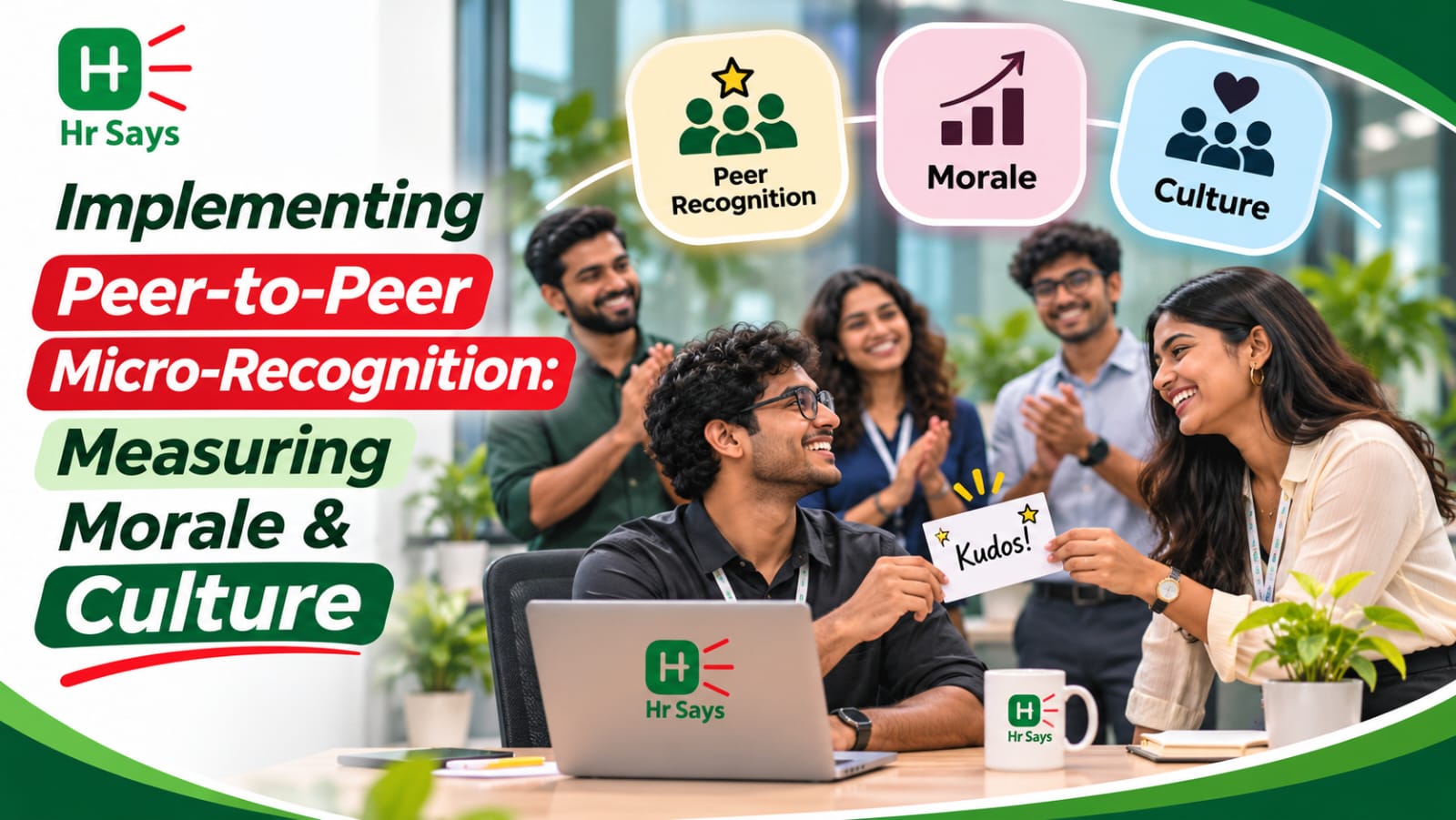
 Peer-to-peer micro-recognition encourages employees to appreciate everyday contributions, boosting morale and strengthening workplace culture. Tracking recognition and employee engagement helps HR teams build a more positive, collaborative work environment.





Executive Overview: The Structural Limits of Top-Down Recognition
Traditional enterprise reward and recognition frameworks have historically relied on centralized, top-down cadences: annual performance bonuses, quarterly departmental awards, and tenure-based longevity banquets (e.g., service pins awarded every five years). While these legacy mechanisms fulfill formal compensation and administrative milestones, they fail as behavioral conditioning engines.
Annual and episodic top-down recognitions suffer from fundamental operational liabilities:
- The Latency and Recency Gap: Recognition delivered months after an event fails to reinforce the specific micro-behaviors that drove project success. Human behavioral conditioning requires immediate feedback loops to anchor positive conduct into individual and collective habits.
- Supervisory Blind Spots: In matrixed, cross-functional, and hybrid workplace ecosystems, executive leaders and middle managers observe less than twenty percent of daily collaborative effort. The crucial micro-contributions that prevent project failure—cross-functional troubleshooting, code reviews, unblocking stuck peers, or calming anxious clients—occur horizontally, largely hidden from formal managerial appraisals.
- Demotivating Scarcity Architecture: Traditional award models operate on artificial scarcity: one "Employee of the Quarter" is recognized while dozens of equally vital contributors are ignored, breeding resentment, cynicism, and destructive internal competition.
Overcoming these limitations requires democratizing recognition across the organizational hierarchy.
Peer-to-Peer (P2P) Micro-Recognition Programs decentralize praise, empowering every employee to acknowledge colleagues in real time through small, high-frequency recognitions tied directly to corporate values.
Deploying an enterprise-grade micro-recognition framework requires an integrated operational architecture:
- Anchoring peer recognitions in operant conditioning and behavioral economics.
- Enforcing core-value tagging and non-monetary social validation to prevent platform gaming and transactional commodification.
- Designing frictionless, multi-channel digital platform workflows integrated into daily collaboration tools (Slack, Microsoft Teams, enterprise HRMS).
- Deploying advanced organizational network analysis (ONA) and sentiment analytics to measure psychological safety, team morale, and retention impacts.
1. Theoretical Foundations: Behavioral Economics and Operant Conditioning
Understanding why peer micro-recognition alters organizational culture requires examining how human neurochemistry and psychological incentives respond to social validation.
Operant Conditioning and the Power of Variable Intermittent Reinforcement- B.F. Skinner’s model of operant conditioning proves that behaviors reinforced immediately and unpredictably recur with the highest frequency and resilience.
- Traditional annual bonuses function as fixed-interval reinforcers: employees accelerate effort right before performance reviews and coast immediately afterward.
- Peer-to-peer micro-recognition functions as a variable-ratio reinforcement mechanism: praise arrives unexpectedly and continuously from horizontal peers immediately following an exceptional behavior, stimulating dopamine release and neurologically cementing that behavior as a social norm.
Deci and Ryan’s Self-Determination Theory articulates that sustainable intrinsic motivation requires fulfilling three basic psychological needs:
- Autonomy: Peer recognition gives employees the personal agency to celebrate whoever they choose, breaking free from hierarchical permission structures.
- Competence: Public, specific micro-acknowledgments validate an employee's professional mastery and problem-solving impact in real time.
- Relatedness: Being visibly valued by one’s immediate daily teammates fulfills the fundamental human evolutionary drive for tribal belonging and psychological safety, reducing feelings of workplace alienation.
A critical trap in recognition design is the overjustification effect: attaching excessive monetary value to recognition transforms an authentic social gesture into a transactional commodity.
- If a peer shout-out carries significant cash value, recognition is co-opted: employees collude to trade praise for financial gain, while the intrinsic warmth of mutual respect dissolves into cynicism.
- Successful programs enforce low monetary value or purely social recognition: points redeemable for modest branded items, charitable donation credits, or public digital badges, preserving the social authenticity of the interaction.
2. Programmatic Architecture: Designing the Micro-Recognition Engine
A sustainable peer recognition ecosystem requires clear operational rules, value tagging, and monthly point allocations to maintain platform vitality without administrative bloat.
The Monthly "Use-It-or-Lose-It" Point Economy- Every employee receives an automated, non-cumulative monthly allotment of recognition tokens or points (e.g., 100 points on the first of each month).
- The Expiration Guardrail: Points must be distributed to colleagues before month-end or they expire automatically. Points cannot be cashed out, saved, or self-awarded. This expiration mechanic eliminates artificial scarcity and incentivizes regular participation.
- Tiered Recognition Granularity:
- Micro-Kudos (1 to 5 Points): Everyday collaboration (e.g., swapping a shift, answering an urgent technical question, sharing a useful template).
- Impact Shout-Out (10 to 25 Points): Significant cross-functional assistance (e.g., staying late to resolve a production incident, delivering a critical deliverable under tight deadlines).
- Excellence Nomination (50+ Points): Exceptional, transformative contributions that trigger automated managerial notification and potential quarterly review.
To prevent generic, unhelpful praise (e.g., "Thanks for being awesome!"), the platform mandates behavioral context:
- Every recognition post must tag at least one explicit Corporate Core Value (e.g., #CustomerObsession, #RadicalTransparency, #BiasForAction, #PsychologicalSafety).
- The system enforces an eighty-character minimum context requirement, requiring the sender to describe the exact action and its business impact: "Thanks @Sarah for staying online late yesterday to debug the database failover during the client launch. Your quick work prevented hours of customer downtime (#BiasForAction)."
- This requirement transforms the recognition feed into an active, searchable repository of how abstract corporate values translate into daily operational execution.
Recognition programs collapse if they require logging into isolated, standalone HR software portals. Engagement depends on embedding recognition directly inside existing communication pathways:
- Collaboration App Integrations: Native slash-commands within enterprise messaging platforms (e.g., /recognize @Alex 10 pts #Innovation for automating our weekly data report).
- Public Social Feeds: Enterprise-wide or departmental channels where recognitions post in real time, allowing peers across the company to "boost," "like," and comment on their colleagues' wins.
- Town Hall and Digital Signage Broadcasts: Rotating displays on office lobby screens and dedicated five-minute celebration slides during quarterly all-hands meetings, amplifying individual micro-wins across the entire organization.
3. Governance, Integrity, and Bias Mitigation
Left ungoverned, peer recognition programs risk devolving into superficial popularity contests, reciprocal trading rings, or homogeneous clique reinforcement that excludes quiet or underrepresented talent.
Guardrails Against Gaming and Reciprocal Trading- Algorithmic Collision Detection: The platform monitors peer-to-peer interaction velocity. If the algorithm detects bidirectional trading rings (e.g., Employee A and Employee B systematically dumping their full monthly allowances on each other across multiple cycles), the system flags the accounts for administrative review and suppresses their entries from public feeds.
- Distribution Diversity Caps: Capping the maximum percentage of an employee's monthly allowance that can be allocated to a single colleague (e.g., no more than 30% to one individual), nudging employees to look wider across their team and cross-functional partners.
- Recognition platforms naturally risk amplifying extroverted, client-facing, or vocal roles while overlooking vital back-office contributors (e.g., software maintenance, regulatory compliance, facilities management).
- Cross-Departmental Calibration: People Analytics teams conduct quarterly equity audits, analyzing recognition flows across gender, ethnicity, remote/hybrid status, and job families.
- If back-office or remote teams show low outbound or inbound recognition volumes, HR Business Partners intervene with departmental leadership to introduce specialized category shout-outs (e.g., #BehindTheScenesChampion), re-balancing visibility across all operational tracks.
4. Analytical Synthesis: Organizational Network Analysis (ONA) and Morale Telemetry
The most transformative aspect of a digitized peer-to-peer recognition system is its capacity to generate real-time organizational health telemetry, surfacing sociometric networks that traditional org charts cannot see.
Organizational Network Analysis (ONA) MappingBy tracking who recognizes whom across departments, the recognition platform maps the informal, collaborative topology of the enterprise:
- Identifying "Unsung Central Connectors": ONA exposes informal cultural anchors—individuals who receive frequent cross-functional recognition for helping others despite occupying modest positions on the official hierarchy. These individuals are prime candidates for internal retention, high-potential tracks, and future leadership development.
- Detecting Structural Collaboration Silos: The software visualizes broken bridges: if Team A and Team B work on the same product line but share zero cross-departmental recognitions over six months, leadership identifies an operational silo that requires alignment before friction stalls delivery.
- Mapping Peripheral Isolation: Identifying isolated contributors who receive zero recognition over extended quarters, providing early-warning telemetry to People Operations regarding potential disengagement, marginalization, or flight risk.
- People Analytics platforms integrate recognition data with broader human capital metrics:
- Turnover Correlation: Longitudinal studies prove that employees who receive at least two peer recognitions per month exhibit forty to sixty percent lower voluntary attrition over twelve months compared to un-recognized peers.
- Employee Net Promoter Score (eNPS) Uplift: Teams with high active recognition velocities consistently report higher psychological safety scores and elevated team morale on annual pulse surveys.
5. Structural Comparison: Top-Down Centralized Awards vs. Decentralized P2P Micro-Recognition
Evaluating traditional hierarchical award ceremonies alongside a decentralized peer-to-peer recognition ecosystem highlights systemic operational shifts:
Frequency, Timing, and Feedback Velocity- Top-Down Centralized Awards: Episodic and delayed; awarded annually or quarterly; feedback arrives months after the event, severing the neurological link between performance and reward.
- Decentralized P2P Micro-Recognition: Continuous and real-time; daily or weekly recognitions delivered within hours of the accomplished behavior, providing immediate behavioral reinforcement.
- Operational Impact: Embeds continuous behavioral conditioning into daily team operations, driving repeatable operational excellence.
- Top-Down Centralized Awards: Vertical and limited; restricted to achievements visible to executive leadership; completely misses horizontal, backstage collaborative effort.
- Decentralized P2P Micro-Recognition: 360-degree horizontal visibility; captures hidden contributions, peer coaching, emotional support, and small operational fixes across the workforce.
- Operational Impact: Validates the unsung contributors who sustain team cohesion and operational execution behind the scenes.
- Top-Down Centralized Awards: Scarcity-driven and divisive; rewards single winners while leaving overlooked peers demoralized; fuels political positioning for executive favor.
- Decentralized P2P Micro-Recognition: Abundant and democratized; everyone can celebrate contributions; fosters authentic psychological safety, empathy, and mutual respect.
- Cultural Impact: Cultivates a high-trust, collaborative culture that celebrates collective team success over individual maneuvering.
- Top-Down Centralized Awards: Heavy administrative overhead; extensive review meetings, high management hours spent writing nominations, and high budget outlays for large lump-sum bonuses.
- Decentralized P2P Micro-Recognition: Highly cost-efficient; lightweight administrative management, automated digital point tracking, and modest point-redemption budgets that maximize enterprise-wide reach.
- Financial Impact: Delivers higher employee engagement and measurable retention gains at a fraction of the cost of annual corporate award events.
6. Phased Implementation Protocol: Institutionalizing Enterprise Micro-Recognition
Transitioning an enterprise from manual, supervisory awards into an automated, culturally embedded peer recognition ecosystem requires an organized four-phase strategy:
- Convene an interdisciplinary steering group comprising People Operations, Internal Communications, Frontline Managers, and Employee Resource Group leads.
- Codify the organization’s abstract values into explicit, observable behaviors (e.g., translating "Integrity" into specific actions like "transparently flags a project error before delivery").
- Define the recognition currency: establish the monthly 100-point "use-it-or-lose-it" economy, design the modest redemption rewards catalog, and author clear program guidelines.
- Integrate the recognition engine with the core Human Resource Management System (HRMS) to automate user provisioning and de-provisioning, syncing directly into Slack or Microsoft Teams.
- Conduct specialized coaching for people managers and senior executives: training leaders to actively model high-quality, value-tagged praise, as executive adoption is the primary predictor of frontline program usage.
- Configure algorithmic anti-gaming rules: setting single-recipient allocation caps and activating collision-detection alerts.
- Launch the platform enterprise-wide with an executive all-hands broadcast, providing all employees with an initial one-time celebratory point allocation.
- Embed live recognition feeds onto digital office monitors and start team meetings with a dedicated two-minute recognition spotlight.
- Launch a modest redemption catalog: digital gift cards, corporate social responsibility (CSR) donation options, company experiences, and branded merchandise.
- Begin ingesting peer interaction graphs into Organizational Network Analysis (ONA) dashboards to map informal leadership networks, cross-functional dependencies, and isolated teams.
- Conduct quarterly equity and demographic audits to verify that recognition flows equitably across gender, ethnicity, remote/hybrid status, and non-client-facing roles.
- Cross-reference recognition metrics against annual turnover data and engagement surveys, refining point allocations and corporate value tags to ensure the program drives long-term business performance and culture.
Strategic Summary: Cultivating an Unshakable High-Trust Culture
An organization’s culture is not shaped by the corporate slogans printed on boardroom walls; it is defined by the daily behaviors that teammates tolerate, celebrate, and reward. Relying exclusively on infrequent, top-down award ceremonies leaves the vast majority of vital collaborative efforts uncelebrated, fostering cynicism and talent attrition.
By deploying decentralized peer-to-peer micro-recognition, enforcing mandatory core-value tagging, preserving social authenticity over high cash rewards, and capturing real-time organizational network telemetry, enterprises replace administrative praise with an active cultural reinforcement engine.
This modern framework amplifies psychological safety, builds deep cross-functional cohesion, eliminates voluntary high-performer turnover, and ensures that every individual’s daily dedication is seen, honored, and woven into the fabric of organizational success.
10 Frequently Asked Questions (FAQs)
Q1. What is the fundamental difference between traditional employee awards and peer micro-recognition?Traditional awards are hierarchical, episodic, and scarce:
- They are awarded by upper management once a quarter or year to a select few high-profile employees, creating long delays between performance and recognition while ignoring the majority of contributors.
- Peer-to-peer micro-recognition is horizontal, continuous, and democratized:
- It empowers every employee to recognize teammates in real time for small, meaningful daily contributions.
- It delivers immediate behavioral reinforcement that reinforces positive habits across the entire organization.
A "use-it-or-lose-it" point mechanic is critical to maintaining a healthy recognition economy:
- If points accumulate indefinitely, employees hoard them, treating recognition like a private bank account and avoiding participation until points are urgently needed.
- Forcing monthly expiration removes artificial scarcity, resets the playing field every thirty days, and nudges employees to actively observe and appreciate their colleagues' efforts every month.
Yes, and research shows that non-monetary or low-monetary rewards often produce better cultural results:
- High cash rewards trigger the overjustification effect, turning genuine gratitude into a transactional, gamified race for money that breeds peer suspicion.
- True motivation stems from social validation, public appreciation, and professional respect.
- Programs that offer digital badges, public executive callouts, or modest redemption options (e.g., team lunch perks, charitable donations, or branded company gear) sustain higher engagement and authenticity than purely financial schemes.
Preventing collusion requires clear platform design and automated oversight:
- The system enforces algorithmic collision detection: flagging instances where two or more employees repeatedly exchange points in matching patterns.
- Platforms enforce allocation caps: restricting the maximum number of points an individual can award to the same colleague in a single month (e.g., no more than 30% of their allowance).
- Requiring all recognitions to be published on an open, public social feed with detailed behavioral context makes collusive or disingenuous praise visibly obvious to the wider team.
Organizational Network Analysis (ONA) uses mathematical graph theory to map informal relationships and communication pathways within a company:
- While a traditional organizational chart shows formal reporting lines, recognition data reveals who teammates actually turn to for help, technical advice, and moral support.
- ONA maps these transactions to identify central cross-functional connectors (unsung high-value cultural leaders) and spot isolated departments or individuals who are disconnected from collaborative networks.
Recognition directly impacts the primary psychological drivers of voluntary resignation:
- Employees who leave companies often cite feeling invisible, undervalued, or unsupported by their immediate teams.
- Frequent peer recognition directly satisfies core psychological needs for competence and belonging.
- People Analytics studies demonstrate that employees who receive at least two peer recognitions per month exhibit forty to sixty percent lower voluntary attrition rates compared to unacknowledged peers.
Organizations must intentionally highlight behind-the-scenes work:
- Frontline, sales, and executive roles are naturally high-visibility, which can lead to disproportionate recognition volume.
- Companies counter this by introducing specific, dedicated core-value tags like #OperationalHero, #BehindTheScenesMastery, or #SystemUnblocker.
- People Analytics teams run quarterly demographic audits to ensure engineering, compliance, facilities, and administrative teams receive balanced platform participation, prompting leaders to highlight quiet operational excellence.
Mandatory value-tagging prevents recognition from devolving into meaningless social banter:
- Simply clicking a button or sending an empty "Great job!" carries low psychological impact and reinforces no specific behavior.
- Requiring employees to select an explicit company value (e.g., #CustomerObsession) and write a brief description of the action and its business impact anchors corporate values in real-world practice, creating an educational public feed of what organizational excellence looks like in daily work.
Integration depends on embedding recognition directly into daily communication tools:
- Remote workers cannot see physical award boards or gather for casual hallway praise.
- The recognition engine must integrate directly with platforms like Slack, Microsoft Teams, or Google Workspace via quick slash-commands.
- Broadening recognitions onto live company-wide communication feeds and celebrating micro-wins during virtual stand-ups keeps remote workers visibly connected, appreciated, and integrated into the broader team culture.
Track three prioritized, operational metrics:
- Monthly Active Participation Velocity: The percentage of the workforce that actively gives and receives at least one peer recognition every month (target: > 75\%).
- Cross-Departmental Collaboration Flow: The percentage of recognitions awarded between individuals in different functional business units, measuring the breakdown of organizational silos.
- Retention and Engagement Delta: Measuring the difference in voluntary turnover and employee Net Promoter Scores (eNPS) between high-recognition cohorts and low-recognition cohorts over a 12-month period.