 Thursday, November 19, 2026
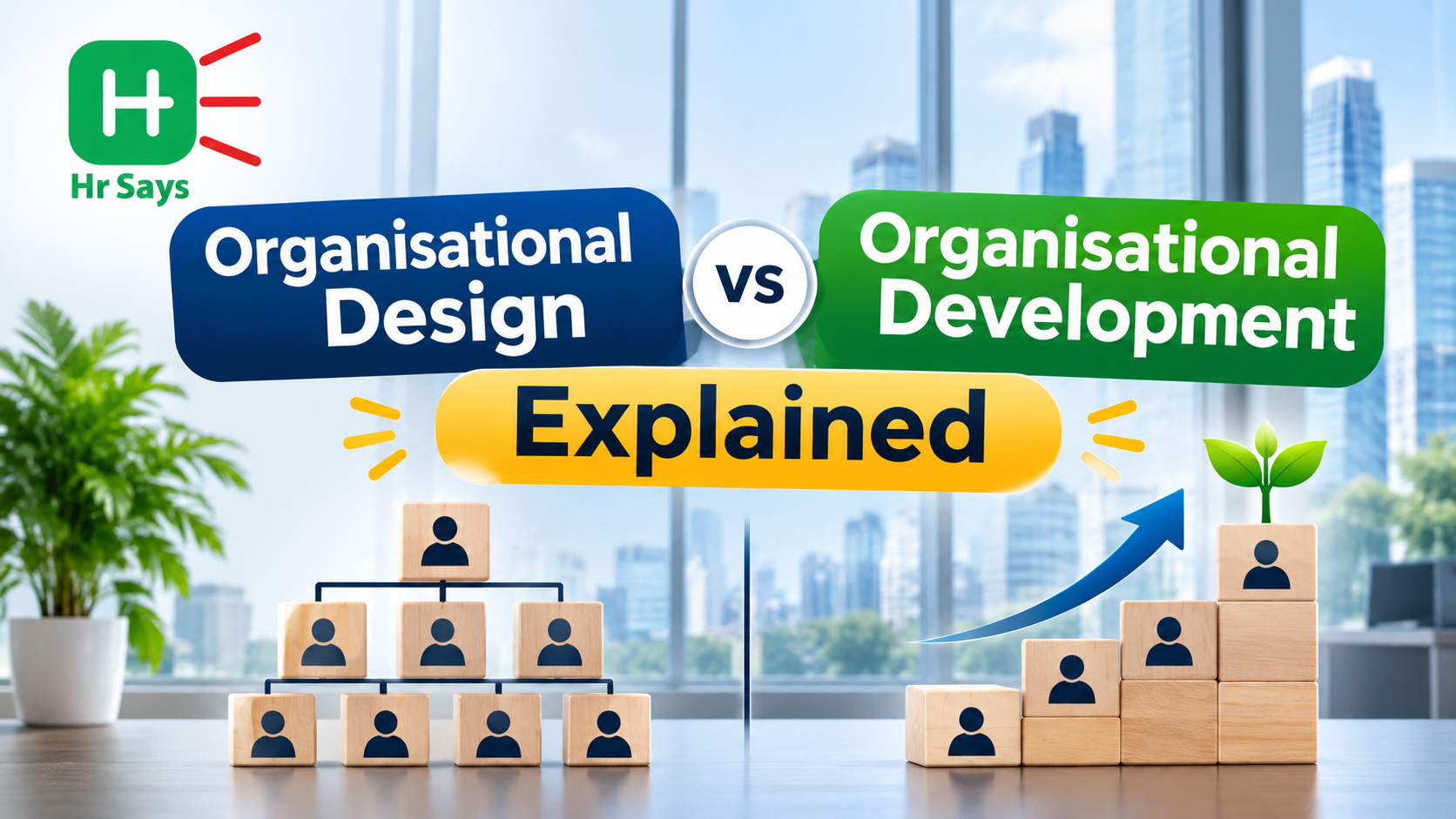
 Organisational design shapes structures and roles while organisational development builds culture and human capability. Both are essential for HR leaders driving sustainable, high-performing workplaces in India.





Introduction
Two concepts that frequently appear in HR strategy conversations are organisational design and organisational development. They are often used interchangeably, which creates genuine confusion for HR leaders, founders, and business owners trying to build stronger, more agile workplaces. The reality is that these two disciplines, while closely related, serve distinct purposes and operate on different timelines.
Understanding the difference between them is not just an academic exercise. For HR heads, CHROs, and founders leading growing Indian companies, knowing when to apply organisational design thinking versus organisational development thinking can be the difference between a business that scales smoothly and one that repeatedly faces structural or cultural breakdowns. This article breaks down both concepts clearly, explores their relationship, and offers practical insight into how Indian organisations can use both effectively.
Understanding the Core Concepts
What Is Organisational Design?Organisational design refers to the deliberate process of shaping how a company is structured, how work flows through it, and how decision-making authority is distributed. It is primarily concerned with the formal framework of an organisation, including its hierarchy, reporting lines, roles, teams, processes, and governance systems.
When a company decides to shift from a functional structure to a business unit structure, that is organisational design. When a startup scales from 20 to 200 employees and needs to build formal departments, that is organisational design. When a conglomerate restructures after a merger, that is also organisational design.
The goal of organisational design is to create a structure that supports the business strategy, enables efficient operations, and positions the right people in the right roles to deliver results. It tends to be a relatively defined project with a beginning, a middle, and an end, even though the resulting structures must be revisited periodically.
What Is Organisational Development?Organisational development, often abbreviated as OD, is a planned, long-term effort to improve an organisation's overall health, effectiveness, and capacity to change. It focuses on the human side of work: culture, leadership behaviour, team dynamics, communication, values, and the psychological environment in which people operate.
Where organisational design reshapes the structure, organisational development works on the system of people within that structure. OD practitioners use diagnostics, interventions, coaching, learning programmes, change management, and culture-building initiatives to help organisations become more adaptive, collaborative, and high-performing over time.
Organisational development does not have a fixed endpoint in the same way organisational design does. It is an ongoing commitment to building a healthier, more capable organisation.
Key Differences Between Organisational Design and Organisational Development
While both disciplines aim to make organisations more effective, they differ significantly in focus, timeline, methodology, and outcomes.
Focus and ScopeOrganisational design focuses on structures, systems, and processes. It answers questions such as: How should teams be grouped? Who reports to whom? How should work be divided and coordinated? In contrast, organisational development focuses on people, culture, and behaviour. It answers questions such as: How do leaders communicate? What values guide decision-making? How does the organisation handle conflict and change?
Timeline and DurationOrganisational design is typically project-based. A redesign initiative may run for three to twelve months, involving structured analysis, design workshops, role mapping, and implementation. Organisational development, by contrast, is a continuous process. Culture does not change in a quarter. Leadership behaviour evolves over years of coaching, feedback, and reinforced practice.
MethodologyOrganisational design relies heavily on frameworks such as the McKinsey 7-S Model, the Galbraith Star Model, and the RACI matrix. It involves structural analysis, benchmarking, and process mapping. Organisational development draws on applied behavioural science, action research, survey feedback, team interventions, and systems thinking. It uses tools such as employee engagement surveys, 360-degree feedback, change readiness assessments, and leadership development programmes.
OutcomesA successful organisational design results in a clear, functional structure with defined roles, reduced duplication of effort, improved accountability, and better alignment between strategy and operations. A successful organisational development effort results in stronger leadership, a more engaged workforce, a learning culture, improved trust, and an organisation that can adapt to change without breaking down.
Why Both Matter for Indian Organisations
India's business landscape is evolving rapidly. Startups are scaling into mid-sized enterprises. Family-owned businesses are professionalising. Large corporations are restructuring to remain competitive in a volatile global environment. In all of these scenarios, both organisational design and organisational development are essential, not as alternatives to each other, but as complementary forces.
Consider a growing technology company in Bengaluru or Pune that has just raised Series B funding. The founders need to design a scalable organisational structure that can support 500 employees within three years. That is an organisational design challenge. But simultaneously, they need to preserve the culture of innovation, trust, and speed that made them successful in the first place. That is an organisational development challenge.
Indian organisations also face unique contextual pressures:
- High attrition rates in sectors such as IT, BFSI, and retail demand stronger employee engagement strategies rooted in OD principles.
- The rapid expansion of business operations into Tier 2 and Tier 3 cities requires carefully designed structures that allow local flexibility while maintaining central accountability.
- The post-pandemic shift to hybrid and remote work has fundamentally altered how teams collaborate, making organisational development interventions around communication norms, manager effectiveness, and culture alignment more relevant than ever.
- The push for diversity, equity, and inclusion in Indian workplaces is as much an organisational development initiative as it is a policy matter.
The Relationship Between Design and Development
One of the most important insights for HR professionals is that organisational design and organisational development must be aligned. A beautifully designed structure built on a dysfunctional culture will not perform. Equally, a highly engaged workforce operating within a poorly designed structure will face constant friction, duplication, and confusion.
The two disciplines reinforce each other in several ways. When an organisation undergoes a redesign, it creates significant human uncertainty. Employees wonder about their roles, their reporting relationships, and their future. This is precisely when organisational development practices, particularly change management, transparent communication, and leadership coaching, become essential. The design creates the new framework; the development work helps people navigate and embrace it.
Conversely, organisational development work often surfaces structural problems. An engagement survey might reveal that employees feel decisions are made without their input, pointing to a governance design issue. A leadership development programme might expose a gap between the company's stated values and the behaviour that gets rewarded in its performance management system, revealing a structural misalignment that only design can fix.
How HR Teams Can Apply Both Effectively
HR leaders who want to use both disciplines well need to develop fluency in both structural thinking and behavioural science. Here are some practical principles:
Start with strategy, not structure. Before designing or redesigning an organisation, HR teams must understand the business strategy clearly. What markets is the company entering? What capabilities does it need to build? The structure should follow the strategy, not the other way around.
Use diagnostics before interventions. Both organisational design and organisational development require a solid understanding of the current state before any changes are made. This means conducting organisational health assessments, capability gap analyses, and culture diagnostics before recommending solutions.
Treat change as a people process. Even the most logically sound redesign will fail if employees do not understand why it is happening and how it affects them. OD principles around stakeholder engagement, transparent communication, and psychological safety must be embedded into every design process.
Build internal OD capability. Many large Indian corporations rely exclusively on external consultants for OD work. While external expertise has value, building in-house OD capability ensures that culture-building and leadership development are sustained between consulting engagements.
Measure outcomes, not just activities. HR teams must track the impact of both design changes and development interventions through metrics such as employee engagement scores, manager effectiveness ratings, decision-making speed, attrition rates, and business performance indicators.
Conclusion
Organisational design and organisational development are two of the most powerful levers available to HR leaders and business founders who want to build high-performing, resilient, and adaptable workplaces. Design gives shape to the organisation. Development gives it life. Neither is sufficient on its own.
For Indian HR professionals navigating the complexity of rapidly growing companies, evolving workforce expectations, and the need for both agility and accountability, understanding how to apply both disciplines with intention is a defining professional skill. The organisations that get this balance right are the ones that do not just survive disruption but consistently outperform in the face of it.
Platforms such as HRSays play a meaningful role in this landscape by providing HR leaders with the insights, conversations, and thought leadership needed to make better decisions about how their organisations are structured, how their cultures are shaped, and how their people thrive.
Frequently Asked Questions
Q1: What is the main difference between organisational design and organisational development?
Organisational design focuses on structures, roles, reporting lines, and processes. Organisational development focuses on culture, leadership behaviour, employee engagement, and the capacity for change. Design creates the structural framework; development builds the human effectiveness within it.
Q2: Can a company do organisational design without organisational development?
Technically, yes, but the results are often limited. A restructured organisation without accompanying culture and change management work typically struggles with low adoption, employee resistance, and a gap between the intended design and how work actually happens on the ground.
Q3: Which should come first, organisational design or organisational development?
There is no universal answer, but most organisations benefit from a baseline level of OD maturity before undertaking major design changes. When people trust their leaders, understand the purpose behind decisions, and feel psychologically safe, structural changes are far more likely to succeed.
Q4: How is organisational development relevant for small and medium enterprises in India?
OD is often seen as relevant only for large corporations, but SMEs in India benefit enormously from OD principles. Building a learning culture, developing first-time managers, improving communication norms, and creating a clear sense of values are all OD interventions that can dramatically improve retention and performance in small and growing businesses.
Q5: What role does technology play in modern organisational design and development?
Technology is both a tool and a driver of change in both disciplines. HR technology platforms support OD through engagement surveys, learning management systems, and performance feedback tools. At the design level, technology enables new ways of working such as remote teams, agile structures, and digital collaboration models that traditional hierarchies cannot support.
Resources
- Society for Human Resource Management (SHRM): Global body for HR professionals offering frameworks and research on organisational effectiveness and workforce planning.
- McKinsey and Company Organisational Health Index: A widely used diagnostic tool for measuring and improving organisational health across leadership, culture, and structure dimensions.
- National HRD Network India (NHRDN): India's premier HR professional body, offering insights and resources relevant to OD and HR strategy in Indian organisational contexts.
- Harvard Business Review: A leading source of thought leadership on organisational design, change management, leadership development, and HR strategy.
- Academy of Management Journal: A peer-reviewed source offering research-backed insights on organisational behaviour, design theory, and development interventions.
Interlinking Keywords
Workforce planning, organisational structure, HR strategy, change management, employee engagement, talent development, leadership development, culture building, HR transformation, people strategy
Last Reviewed By
Dr. Manthan Tripathi and Hr Says Advisory Panel on 18 November 2026.
Disclaimer
The information provided in this article is intended for general informational and educational purposes only. It does not constitute professional HR consulting, legal, or business advisory guidance. Organisations are encouraged to consult qualified HR professionals and business consultants before implementing any structural or developmental changes. HRSays does not take responsibility for decisions made based on the content of this article.