Sunday, September 20, 2026
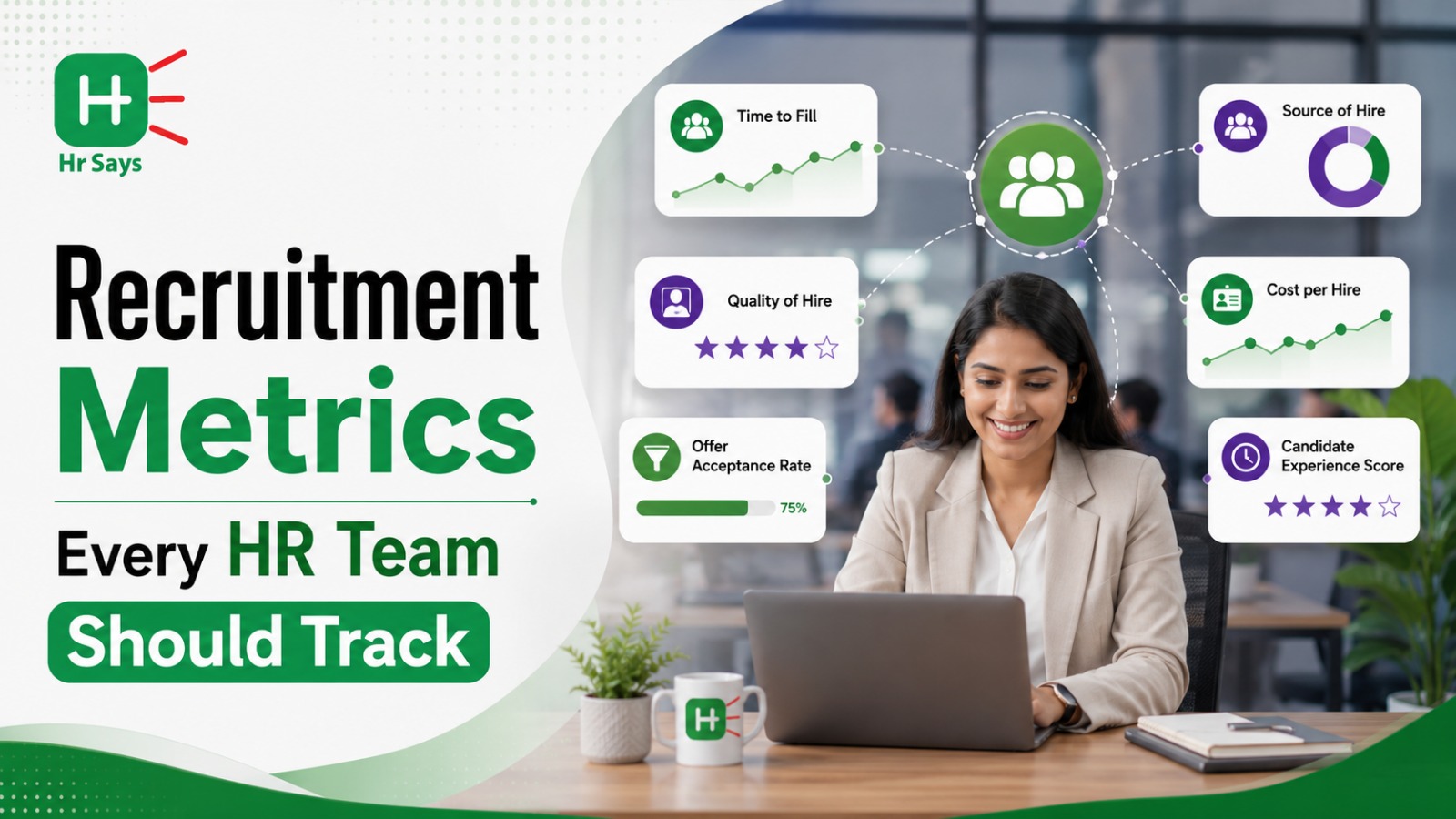
 Recruitment metrics help Indian HR teams measure hiring efficiency, reduce costs, and improve talent quality. Tracking key indicators like time to hire, cost per hire, quality of hire, and candidate experience enables data-driven talent acquisition decisions.





Introduction
Hiring decisions shape the future of any organization. Yet far too many HR teams in India still measure success by the number of positions filled rather than the quality, speed, or cost of those hires. In a talent landscape that is growing increasingly competitive, from the technology corridors of Bengaluru and Hyderabad to the manufacturing belts of Pune and Chennai, relying on instinct alone is no longer sufficient.
Recruitment metrics change that equation. They convert scattered hiring activity into structured insight, enabling HR professionals to pinpoint exactly where a process is working, where it is leaking talent, and where money is being spent without return. For growing Indian organizations, whether a funded startup in a Tier 1 city or a mid-sized enterprise expanding into Tier 2 markets, tracking the right hiring data is what separates reactive recruitment from strategic talent acquisition.
This guide covers the essential recruitment metrics every HR team should be monitoring, why each one matters, how to calculate it, and what action it should prompt.
Why Recruitment Data Is No Longer Optional for Indian HR Teams
For years, recruitment in India operated on relationships, rolodexes, and referral chains. That model still holds value, but it no longer tells the full story. India's workforce is changing rapidly. The National Skill Development Corporation regularly highlights growing skill gaps across sectors. Employee expectations have shifted post-pandemic, with candidates in metros and smaller cities alike prioritizing employer reputation, career growth, and cultural fit alongside compensation.
At the same time, HR technology has become far more accessible. Applicant tracking systems, recruitment analytics platforms, and HR dashboards are no longer the preserve of large corporations. Even small and mid-sized Indian companies can now afford to collect and act on meaningful hiring data. The question is not whether to track recruitment metrics, but which ones to prioritize and how to use them to build smarter hiring practices.
Without measurement, HR teams cannot identify whether a high time to fill is caused by a sourcing problem, a poorly written job description, slow internal approvals, or a compensation mismatch. Metrics bring clarity to that conversation and allow HR leaders to walk into board meetings with evidence, not anecdotes.
The Core Recruitment Metrics Every HR Team Should Monitor
Time to FillTime to fill measures the total number of calendar days between the date a job requisition is formally approved and the date a candidate accepts the offer. It is one of the oldest and most widely tracked metrics in talent acquisition, and for good reason.
In practical terms, time to fill tells HR leaders how long a position stays vacant and what that vacancy costs the business in lost productivity, overwork on remaining team members, and delayed project timelines. A persistently high time to fill often signals one or more structural problems: job descriptions that do not attract the right candidates, sourcing channels that reach too narrow a pool, or internal approval processes that create unnecessary delays.
Indian organizations should benchmark time to fill against their sector. Technology roles typically take longer to fill than support functions, and senior positions naturally require more time than entry-level roles. The benchmark matters less than the trend: if time to fill is consistently rising quarter over quarter, that is the signal to investigate.
Time to HireTime to hire is frequently confused with time to fill but measures something distinctly different. It counts the number of days from when a specific candidate first enters the recruitment pipeline to when that candidate accepts the job offer. It is a measure of process efficiency rather than sourcing effectiveness.
A long time to hire often results in losing strong candidates to faster-moving competitors. In India's technology, BFSI, and e-commerce sectors, high-demand candidates routinely hold multiple offer letters simultaneously. An HR team that takes three weeks to schedule a second interview may find that the shortlisted candidate has already accepted elsewhere. Streamlining interview scheduling, reducing the number of rounds for non-senior roles, and building clear decision-making timelines can meaningfully reduce time to hire without compromising the quality of selection.
Cost Per HireCost per hire is calculated by adding all internal and external recruitment costs over a defined period and dividing that total by the number of hires made in the same period. Internal costs include recruiter salaries, time spent by hiring managers on interview preparation, HR administrative costs, and onboarding expenses. External costs include job portal subscriptions (Naukri, LinkedIn, Shine, and others widely used in India), background verification charges, assessment tool fees, and agency or consultancy placement charges.
The goal is not simply to minimize cost per hire. A very low cost per hire achieved through cheap sourcing channels can result in poor quality hires that cost far more in training, underperformance, and eventual replacement. The metric should be read alongside quality of hire to ensure that cost efficiency is not coming at the price of talent quality.
Quality of HireQuality of hire is widely considered the most strategically valuable recruitment metric. It assesses whether new employees actually perform as expected once they join the organization. Because it is multidimensional, different companies measure it differently. The most commonly used components include:
- Performance rating at the 90-day review
- Hiring manager satisfaction score collected shortly after the new hire joins
- Attainment of first-year goals
- Retention at the 12-month mark
Indian HR teams often find quality of hire difficult to track consistently because it requires coordination between HR and business functions, and because performance management systems are not always standardized across levels or departments. Building a simple post-hire scorecard that captures two or three of these components consistently is a practical starting point. Even an imperfect quality of hire measure is more useful than none at all.
Offer Acceptance RateOffer acceptance rate calculates the percentage of candidates who formally accept a job offer after it is extended. The formula is straightforward: divide the number of offers accepted by the total number of offers made and multiply by one hundred.
A low offer acceptance rate is a symptom rather than a cause. It usually points to one of several underlying problems: compensation packages that are not competitive against the market, a candidate experience that has eroded enthusiasm by the time the offer arrives, or a gap between what was communicated during the interview process and what was reflected in the final offer letter. Indian HR teams should review declined offers carefully. Systematically capturing reasons for rejection at the offer stage provides direct and actionable insight into where the employer value proposition needs strengthening.
Source of HireSource of hire tracks which recruitment channel delivered each successful hire. Common channels for Indian organizations include employee referrals, job portals, LinkedIn sourcing, recruitment consultancies, campus placements, and the company's own career page.
Tracking the source of hire allows HR teams to direct budget toward the channels that are generating the best results and reduce spend on those that are not. Employee referrals deserve particular attention: across industries and geographies, referred candidates consistently outperform other sourcing channels on quality of hire, time to hire, and retention. Indian companies with underdeveloped referral programs are leaving a significant competitive advantage unused.
Candidate Experience ScoreCandidate experience refers to how job applicants perceive the organization and its hiring process from their very first interaction to the final communication, regardless of whether they are hired. It is typically measured using a candidate Net Promoter Score survey sent after key stages of the process.
This metric matters because candidates talk. A poor experience shared on platforms like Glassdoor, AmbitionBox, or LinkedIn can quietly damage an organization's employer brand and reduce the quality of future applicant pools. Indian companies, particularly those in sectors where talent is scarce and reputation-sensitive, should view candidate experience as an employer branding investment rather than a post-process administrative task. Collecting feedback from unsuccessful candidates is as important as collecting it from those who join.
Recruitment Funnel Conversion RateThe recruitment funnel describes the journey from application to hire, and conversion rate analysis measures how many candidates successfully move from one stage to the next. A typical funnel tracks transitions from applications received to candidates screened, from screened candidates to those interviewed, from interviewees to those who receive offers, and from offers to accepted hires.
Analyzing funnel conversion rates at each stage helps HR teams identify exactly where strong candidates are being lost. A high drop-off between application and screening may suggest that job descriptions are too vague, attracting mismatched applicants. A drop-off between interviews and offers may suggest that the assessment process is too long or too demanding relative to the role's seniority. For Indian organizations recruiting at scale, funnel analysis is one of the most powerful diagnostic tools available.
First-Year Retention RateA successful hire does not end when the offer letter is signed. First-year retention rate measures the percentage of new employees who remain with the organization at the 30-day, 90-day, and 12-month marks. High early attrition is costly. It negates the entire investment made in sourcing, interviewing, and onboarding, and it restarts the recruitment cycle at full cost.
When first-year retention is low, the root cause often lies in one of three areas: a misalignment between how the role was positioned during hiring and what the employee actually experiences on the job, an onboarding process that fails to integrate new hires effectively, or a cultural mismatch that was not assessed during the selection process. First-year retention data, reviewed alongside exit interview feedback, gives HR teams the information needed to address these issues structurally.
Diversity Hiring MetricsDiversity hiring metrics track the representation of various demographic groups across each stage of the recruitment funnel. For Indian organizations, this includes gender diversity, regional representation, inclusion of persons with disabilities, and representation across educational backgrounds and socioeconomic profiles.
These metrics are not merely a compliance exercise. Research consistently shows that diverse teams produce better decisions and stronger business outcomes. Tracking diversity data stage by stage reveals where bias, whether structural or unconscious, may be entering the process. Comparing application rates with shortlisting rates and offer acceptance rates across demographic groups gives HR teams the evidence needed to design more equitable and effective hiring processes.
Building a Recruitment Metrics Practice That Sustains Itself
Collecting data is only half the work. The value of recruitment metrics lies in what HR teams do with that data after they have it. A few principles make the difference between a metrics practice that drives improvement and one that produces reports nobody reads.
First, identify the three to five metrics most relevant to the organization's current stage and priorities. An early-stage startup scaling rapidly will prioritize time to hire and source of hire. A mid-sized company experiencing high turnover will focus on quality of hire and first-year retention. Trying to track everything at once tends to produce volume without insight.
Second, establish baselines before attempting to optimize. Understanding the current state is a prerequisite to knowing whether any intervention is working. Third, review metrics quarterly with hiring managers, not just within the HR team. Recruitment data should inform business decisions, not just HR reporting cycles. HR leaders who bring data into conversations with department heads about workforce planning, headcount budgets, and team performance are practicing the kind of strategic HR that organizations need, and that platforms like HRSays exist to support and amplify.
Frequently Asked Questions
Q1: What are recruitment metrics and why do they matter?
Recruitment metrics are quantifiable data points used to evaluate the efficiency, effectiveness, and quality of an organization's hiring process. They matter because they help HR teams make informed decisions, reduce cost per hire, improve candidate quality, and build stronger talent pipelines aligned with business goals.
Q2: What is the difference between time to fill and time to hire?
Time to fill measures the total number of days from when a vacancy is approved to when it is successfully filled. Time to hire measures the number of days from when a specific candidate enters the recruitment pipeline to when they accept the offer. Time to fill reflects workforce planning capacity, while time to hire reflects the speed of the selection process itself.
Q3: How do Indian companies calculate cost per hire?
Cost per hire is calculated by adding all internal and external recruitment costs and dividing that total by the number of hires made in the same period. Indian companies often factor in platform costs for job portals such as Naukri, LinkedIn, and Shine, along with background verification and onboarding expenses, when computing this figure.
Q4: Which recruitment metric is considered the most valuable by HR professionals?
Quality of hire is widely regarded as the most valuable recruitment metric because it directly reflects the long-term business impact of hiring decisions. It takes into account factors such as employee performance ratings, first-year retention, hiring manager satisfaction, and contribution to team goals.
Q5: How can HR teams in India use recruitment metrics to improve diversity hiring?
Indian HR teams can track the representation of women, persons with disabilities, and candidates from varied educational and regional backgrounds across each stage of the recruitment funnel. Comparing application rates, shortlisting rates, and offer acceptance rates across demographic groups helps identify unintentional bias and design more inclusive hiring processes.
Resources
- Society for Human Resource Management (SHRM): Research, benchmarks, and frameworks for recruitment metrics and talent acquisition best practices
- National Skill Development Corporation (NSDC), Government of India: Data on skill gaps, workforce trends, and sector-specific talent availability across Indian states
- LinkedIn Talent Insights: Benchmarking data on time to hire, source of hire, and quality of hire across industries and geographies, including India
- Ministry of Labour and Employment, Government of India (labour.gov.in): Official workforce statistics, employment data, and labour market insights relevant to Indian HR practices
- Chartered Institute of Personnel and Development (CIPD): Evidence-based guidance on recruitment effectiveness, candidate experience, and hiring metrics for HR professionals
Interlinking Keywords:
talent acquisition strategy, quality of hire, cost per hire, candidate experience, employee referral program, HR analytics, recruitment funnel, employer branding India, first-year retention, diversity and inclusion hiring
Last Reviewed By:
Hr Says Advisory Panel on 30 July, 2026
Disclaimer:
The recruitment metrics, formulas, and benchmark figures referenced in this article are intended for general informational and educational purposes only. Actual values will vary based on industry, organization size, role seniority, geographic market, and individual business context. HR professionals should validate all benchmarks against their specific sector norms and consult qualified HR advisors before making significant changes to recruitment strategy or budgets. HRSays does not guarantee outcomes based on the application of any metric or framework mentioned in this article.