 Thursday, October 01, 2026
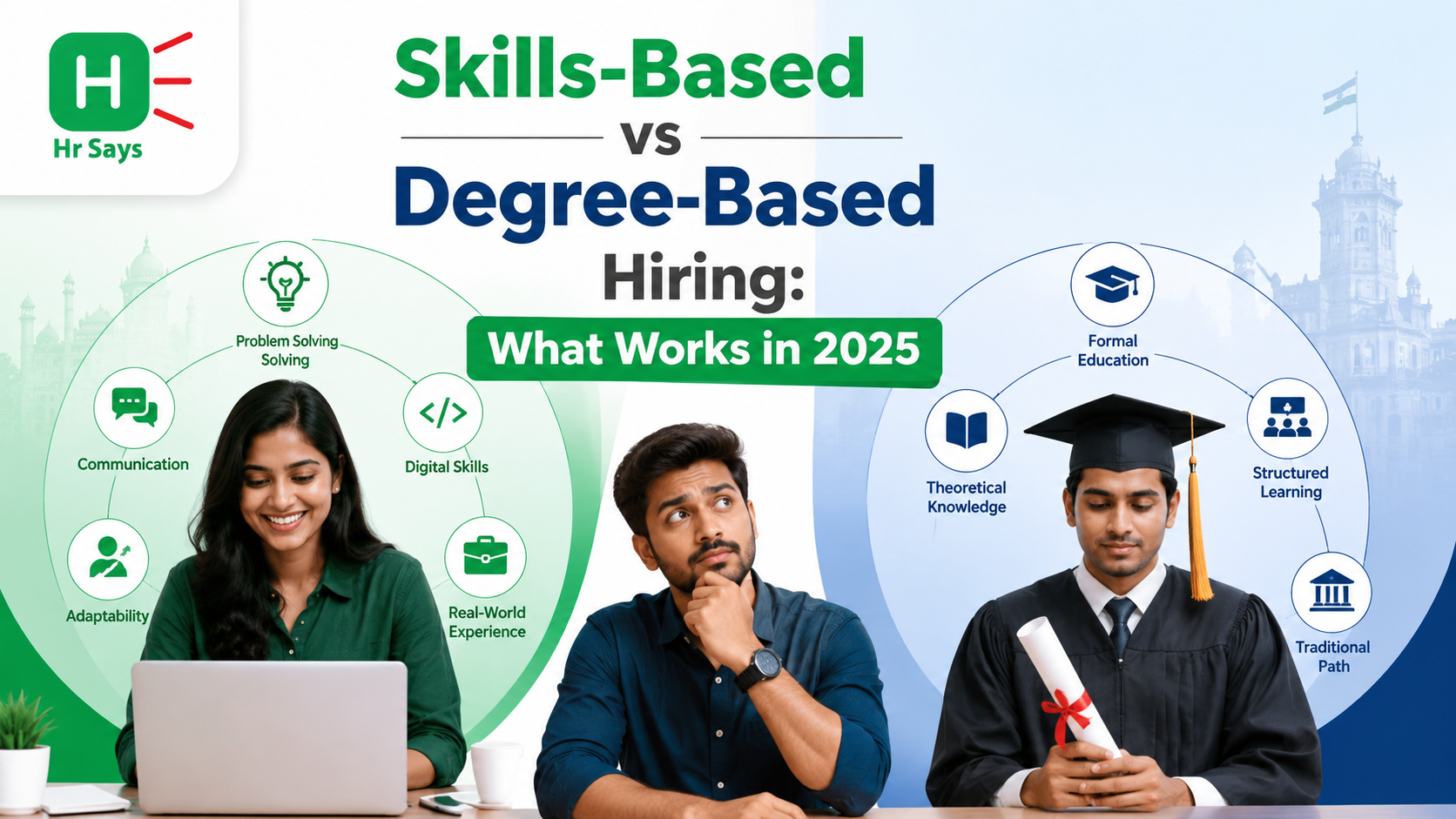
 Skills-based hiring is reshaping Indian recruitment as organisations seek capable, job-ready talent over formal credentials. This article explores both models, India-specific trends, and practical guidance for HR leaders navigating this shift in 2025.




Introduction
The way Indian organisations find and select talent is undergoing a quiet but significant transformation. For decades, a formal degree from a recognised university was treated as the most reliable signal of a candidate's potential. It opened doors, filtered applicants, and served as a proxy for capability. That assumption is now being questioned, not just in boardrooms in Bengaluru and Mumbai, but across recruitment teams in Pune, Hyderabad, and even tier-2 cities that are becoming new talent hubs.
Skills-based hiring is gaining serious momentum. According to data compiled by Dheya Career Mentors, approximately 53 percent of Indian employers eliminated formal degree requirements in 2025, up from around 30 percent in 2024. Roughly 48 percent of Indian Global Capability Centres now prioritise demonstrated skills over academic credentials. These are not marginal changes. They represent a fundamental rethinking of how talent is identified, evaluated, and onboarded.
This shift, however, does not mean that degrees have become irrelevant. What it means is that the conversation around hiring criteria has become more nuanced, more data-driven, and far more important for HR leaders and business decision-makers to understand clearly. This article explores both approaches, examines how they apply to the Indian talent market, and helps organisations determine what hiring philosophy genuinely serves their growth ambitions.
Understanding the Two Approaches
What Is Degree-Based Hiring?Degree-based hiring is the traditional model in which educational qualifications serve as the primary filter in the recruitment process. Under this approach, candidates are shortlisted based on the institution they attended, the degree they hold, and occasionally the percentage or grade point average they achieved. A candidate without a relevant degree is typically not considered, regardless of what they can actually do.
This model has its roots in a period when formal education was the primary channel through which individuals acquired professional knowledge. When access to information was limited and structured learning was rare, a degree from a recognised institution was genuinely a strong predictor of a candidate's baseline competence.
What Is Skills-Based Hiring?Skills-based hiring is a recruitment approach that evaluates candidates primarily on the basis of what they can do, not where they studied. It involves identifying the specific competencies required for a role and then assessing candidates against those competencies through structured tests, practical assignments, portfolio reviews, work simulations, or behavioural interviews.
Under this model, a candidate who can write clean code, analyse data accurately, manage client relationships effectively, or lead a cross-functional project is given serious consideration, regardless of whether they hold a Bachelor's degree from a top-tier institution or completed a certification from an online platform.
Skills-based hiring is not new, but it has accelerated significantly in recent years, driven by the rapid emergence of new job categories, the widening gap between what universities teach and what industries need, and the growing availability of credible alternative learning pathways.
Why the Debate Matters More in India Today
India is facing a talent paradox. On one side, the country produces millions of graduates every year. On the other hand, employers report persistent difficulty finding candidates who are genuinely ready to contribute from day one. According to Forbes India projections referenced by Online Manipal, India faces a potential shortfall of nearly 47 million skilled workers in sectors such as electronics manufacturing, semiconductors, and healthcare. This is not a shortage of degree holders. There is a shortage of people with the right, job-ready capabilities.
The National Education Policy 2020 has explicitly acknowledged this disconnect, pushing for a shift toward skill-based and applied learning across higher education institutions. The University Grants Commission has since approved guidelines for the introduction of skill-based courses and micro-credentials within universities, allowing up to 50 percent of total credits to come from skill-based programmes. These are policy-level signals that the government recognises the gap between formal credentials and practical preparedness.
Simultaneously, the Deloitte Campus Workforce Trends 2025 report, which draws on data from over 200 organisations and 500 campuses across India, confirms that skill-first strategies are no longer a niche experiment. Organisations that have embraced skills-based assessment have reported meaningful reductions in campus attrition, stronger alignment between hire expectations and business outcomes, and faster time-to-productivity for new employees.
For HR leaders in India, this is not an abstract global trend. It is a present, practical challenge that affects hiring quality, team performance, and organisational capability.
Strengths and Limitations of Each Approach
The Case for Skills-Based HiringThe most compelling argument for skills-based hiring is predictive validity. Research cited by the Society for Human Resource Management and multiple global HR bodies consistently shows that skills assessments are significantly more predictive of on-the-job performance than academic credentials alone. When organisations use structured competency evaluations, they get a far more accurate picture of what a candidate will actually deliver in the role.
Skills-based hiring also expands the talent pool considerably. Many high-performing professionals in India have reached their level of expertise through non-traditional routes: self-taught developers, digital marketing professionals who learned through freelance projects, finance analysts who built expertise through online certifications and practice. A degree-first filter would have eliminated these candidates entirely.
From a diversity and inclusion standpoint, skills-based hiring is particularly powerful. India has significant socioeconomic diversity. Not every talented individual has had access to a premium college education. Skills-based hiring creates a more level playing field, allowing organisations to access talent from tier-2 and tier-3 cities, from underrepresented communities, and from non-conventional educational backgrounds.
There is also a retention advantage. Data from Testlify's skills-based hiring research notes that employees hired through skills-based methods tend to stay in their roles longer than those hired primarily on the basis of academic qualifications. When a hire is made based on genuine capability fit, the transition into productive work is smoother, and the individual experiences less of the performance anxiety that comes from being hired for credentials that do not match actual job demands.
The Limitations of Skills-Based HiringSkills-based hiring is not without its challenges. The most significant one for organisations is the operational complexity involved in building reliable assessment infrastructure. Designing role-specific skills tests, validating them for accuracy, and standardising them across hiring teams requires significant investment in tools, time, and expertise.
There is also the question of foundational knowledge. Some roles genuinely require structured academic preparation. A candidate for a medical role, a legal position, or a chartered accountancy function cannot bypass formal qualifications. In these domains, degrees are not just signals of capability; they are regulatory requirements.
Additionally, skills assessments can inadvertently disadvantage candidates who are high-potential but currently lower-skilled due to limited access to quality learning resources. A skills test measures current ability, not future trajectory. Without careful design, skills-based processes can create new forms of exclusion even as they seek to remove old ones.
The Case for Degree-Based HiringDegree-based hiring offers consistency and simplicity. A recruiter handling hundreds of applications can use educational qualifications as an initial filter that is transparent, easy to apply, and legally defensible. This is particularly relevant for large-volume recruitment drives or government sector hiring where standardised eligibility criteria are required.
A formal degree also signals a set of soft attributes that are genuinely valuable: the discipline to complete a multi-year programme, the ability to manage structured learning under institutional pressure, and exposure to diverse academic disciplines that can broaden a candidate's thinking. These are not trivial qualities, particularly for roles that require long-term intellectual engagement.
The Limitations of Degree-Based HiringThe central weakness of degree-based hiring is its assumption that a degree guarantees job-readiness, an assumption that the Indian talent market has challenged quite publicly. The NASSCOM employability reports and multiple industry surveys have repeatedly shown that a significant proportion of Indian graduates, even from tier-1 institutions, require three to six months of additional training before they can independently contribute at a professional level.
Degree-based filtering also introduces structural bias. It systematically excludes first-generation college graduates who may have attended less prestigious institutions, candidates who dropped out of formal education due to financial constraints, and experienced professionals who upskilled through alternative programmes. In doing so, it narrows the talent pool and can work against organisational goals around diversity, innovation, and inclusion.
What Indian Organisations Are Actually Doing
The trend in India is not a clean pivot from one model to the other. It is a movement toward what many practitioners are calling a hybrid evaluation model. As noted by research on Indian recruiter behaviour in 2026, a recognised degree continues to function as a compliance filter in many organisations, it confirms a baseline level of commitment and cognitive discipline. But it rarely closes the hiring decision. What closes the decision is demonstrated capability.
In practical terms, this means that Indian companies, from Bengaluru-based product startups to Mumbai-headquartered conglomerates are increasingly combining degree verification with skills assessments, portfolio reviews, structured case interviews, and practical problem-solving exercises. They are evaluating both what candidates know and what candidates can do.
Global companies with India operations have gone further. Many have formally removed degree requirements for specific roles. This shift is particularly visible in technology, digital marketing, data analytics, and customer experience functions where skill proficiency can be demonstrated, measured, and compared reliably.
The Deloitte Campus Workforce Trends 2025 report notes a 38 percent increase in AI-powered hiring tool adoption across Indian campus recruitment, reflecting a broader willingness to embrace more sophisticated candidate evaluation methods that go beyond the resume and the marksheet.
Practical Guidance for HR Leaders and Recruiters
For HR professionals and business leaders navigating this question, a few practical considerations are worth keeping in mind.
The decision between skills-based and degree-based hiring is most effective when it is made at the role level, not at the organisational level. Roles that are highly technical, creative, or operational benefit greatly from skills-first evaluation. Roles that carry regulatory, compliance, or fiduciary responsibilities may legitimately require formal qualifications.
Building a robust skills assessment process takes time and requires internal alignment between HR teams and business function heads. The investment is worthwhile, but it should be approached deliberately. Starting with high-volume roles or roles where skill gaps are most visible is often a practical entry point.
Communicating transparently with candidates also matters. When organisations use skills-based assessments, they should ensure the process is fair, relevant, and explained clearly. Candidates invest significant time in completing assessments, and a respectful, well-designed process reflects well on the employer brand.
Finally, HR leaders should use data to track outcomes. If skills-based hires are outperforming degree-based hires in terms of performance ratings, retention, and time to productivity, that is valuable evidence for continuing and expanding the approach. Platforms like HRSays are increasingly becoming useful spaces where HR practitioners share such evidence and insights, helping the broader community make more informed talent decisions.
The Road Ahead for Indian Recruitment
The direction of travel in Indian hiring is clear. Skills matter more than ever. Credentials still matter, but they matter differently. The goal for any organisation is not to choose a rigid hiring philosophy and apply it uniformly. The goal is to build a talent evaluation process that is accurate, fair, efficient, and aligned with what the role genuinely demands.
India's talent challenge is real and significant. Organisations that invest in building the capability to identify, assess, and develop genuine talent, regardless of where that talent went to school, will find themselves with a meaningful competitive advantage in the years ahead.
Frequently Asked Questions
Q1: What is the main difference between skills-based hiring and degree-based hiring?
Skills-based hiring evaluates candidates based on demonstrated competencies and what they can actually do in a role. Degree-based hiring uses formal educational qualifications as the primary selection criterion. Skills-based hiring is more focused on job-readiness and practical capability, while degree-based hiring relies on academic credentials as a proxy for potential.
Q2: Is skills-based hiring suitable for all types of roles in India?
Skills-based hiring works particularly well for roles in technology, digital marketing, data analytics, sales, and customer experience. However, roles that carry regulatory requirements, such as medicine, law, chartered accountancy, and government positions, still require formal degrees as mandatory eligibility criteria. Most organisations are adopting a hybrid model that combines degree verification with skills assessment.
Q3: How are Indian companies implementing skills-based hiring in practice?
Indian companies are increasingly using structured competency assessments, practical assignments, portfolio reviews, and work simulations alongside traditional interviews. Many technology firms and Global Capability Centres have removed minimum CGPA requirements and replaced them with skills-based evaluation tools. AI-powered hiring platforms are also being adopted at scale, as noted in Deloitte's Campus Workforce Trends 2025 report.
Q4: Does skills-based hiring improve employee retention in Indian organisations?
Evidence from global research suggests that employees hired through skills-based methods tend to stay longer in their roles compared to those hired primarily on academic credentials. When there is a genuine match between a candidate's demonstrated skills and the actual demands of the role, the transition to productive work is smoother and the risk of early attrition is lower.
Q5: How is India's education policy influencing the skills-based hiring trend?
The National Education Policy 2020 has placed strong emphasis on skill-based and applied learning in higher education. The University Grants Commission has approved guidelines allowing universities to offer skill-based courses and micro-credentials, with up to 50 percent of degree credits available through such programmes. These policy changes are gradually closing the gap between formal education and industry expectations, making skills-first hiring more viable at scale.