 Sunday, September 20, 2026
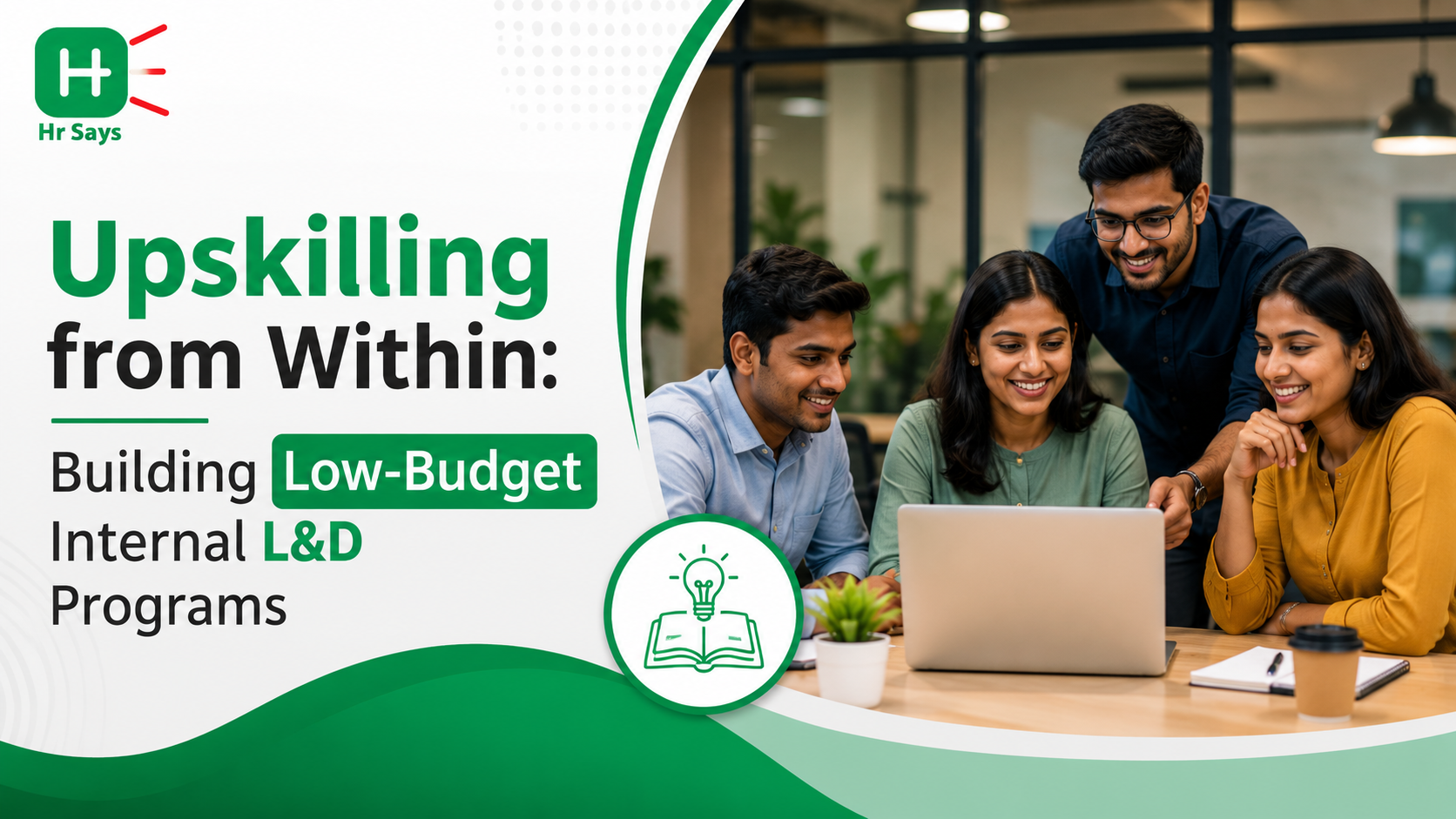
 Building a high-impact, internal Learning & Development (L&D) strategy doesn’t require a massive budget or expensive, third-party enterprise platforms. In fact, externally purchased training often fails to stick because it lacks the specific context of your company's workflows, tools, and culture.





Building a high-impact, internal Learning & Development (L&D) strategy doesn’t require a massive budget or expensive, third-party enterprise platforms. In fact, externally purchased training often fails to stick because it lacks the specific context of your company's workflows, tools, and culture.
The secret to upskilling on a shoestring budget lies in unlocking the knowledge already sitting inside your organization. By relying on internal expertise, smart low-cost tech, and peer-to-peer frameworks (grounded in the 70-20-10 Model, where 90% of learning happens on the job and through relationships), you can build an agile upskilling engine.
Here is a practical, cost-effective framework to build an internal L&D program from scratch.
1. Map Skills Gaps with "Job Shadow Audits"
Before building content, you need to know what to teach. Skip expensive competency-mapping software and use internal, qualitative data gathering instead:
- Conduct a Skills-Gap Audit: Partner with department leads to identify the top 3 friction points slowing down their teams (e.g., "Our junior devs don't know how to write efficient SQL queries" or "Mid-level managers struggle with giving constructive feedback").
- Target "High-Frequency, Low-Complexity" Wins: Focus your early L&D efforts on skills that are used daily and can be taught quickly.
2. Mobilize Subject Matter Experts (SMEs) as Internal Instructors
Your senior employees are your most valuable teaching asset. However, top performers rarely have time to build massive multi-week courses. Make it effortless for them:
- Launch "Brown Bag" Lunch & Learns: Host casual 30-to-45-minute virtual or hybrid sessions where senior staff break down a tool, process, or soft skill.
- Establish "Knowledge Hours": Encourage senior leaders or specialists to host 1-hour weekly "Office Hours" where employees can drop in with specific technical or strategic questions.
- Train Your Trainers: Give SMEs a basic 1-page template for how to structure a 20-minute presentation (10 min concept \rightarrow 10 min real example \rightarrow 10 min Q&A) so they don't feel overwhelmed by lesson planning.
3. Leverage the "70-20-10" Framework (Low-Cost Execution)
70% Experiential (On-the-Job Practice)
- Stretch Assignments: Give employees low-risk opportunities to practice new skills (e.g., letting a junior designer present a deck to a client or a junior engineer lead a sprint retrospective).
- Cross-Department Rotations: Allow employees to spend a half-day per month shadowing another department (e.g., Customer Support shadowing Product Managers to better understand feature roadmaps).
- Mentorship Matching: Pair junior team members with mid- or senior-level employees for monthly 1-on-1 career and skill-focused catch-ups.
- Co-Working & Code/Work Reviews: Turn routine code reviews, copy edits, or design reviews into explicit learning sessions rather than just critique passes.
- Curate high-quality, free external resources (e.g., YouTube tutorials, Coursera/edX audit tracks, industry podcasts, and official software documentation) into structured, internal reading lists.
4. Utilize the "Zero-Budget" L&D Tech Stack
You don't need a $20,000/year Learning Management System (LMS) to host courses. Leverage tools your company already pays for:
- Knowledge Base (Notion, Coda, Confluence, Google Docs): Create a centralized "Learning Hub" wiki with categorized SOPs, templates, and reading lists.
- Video Training (Loom, Zoom recordings): Ask SMEs to record 3-to-5-minute screen shares explaining a single task or troubleshooting step.
- Communication (Slack, Microsoft Teams): Create dedicated channels (e.g., #learning-and-growth, #tech-tips, #book-club) to share articles and tips.
- Tracking & Feedback (Google Forms, Typeform): Use quick 3-question surveys to test knowledge retention and gather feedback on internal sessions.
5. Build a Microlearning & Documentation Culture
To keep programs manageable, avoid 3-hour lecture blocks. Embrace microlearning—delivering knowledge in small, highly digestible bites:
- SOPs as Learning Tools: Require teams to create short Standard Operating Procedures (SOPs) or screen recordings whenever they build or fix something complex.
- "Five-Minute Fixes": Encourage teams to post short, weekly 5-minute video tips in company channels detailing a shortcut, AI prompt, or productivity hack they discovered.
6. Gamify & Reward Internal Learning
To drive engagement when you can't offer massive monetary incentives, leverage recognition and career progression:
- Tie Learning to Career Pathing: Clearly communicate how mastering specific skills unlocks promotions, lateral transfers, or title upgrades.
- Public Recognition: Celebrate employees who host workshops, contribute to knowledge bases, or complete skill tracks during all-hands meetings or in company-wide channels.
- Internal Certification: Issue simple digital badges or certificates (using basic graphics tools like Canva) for employees who complete internal upskilling paths.
7. Measure ROI on a Budget
To prove the value of your low-budget L&D program to leadership, avoid tracking "vanity metrics" like hours spent in meetings. Instead, focus on lightweight impact metrics:
- Pre/Post Confidence Ratings: Send a 1-minute survey before and after a training asking: "On a scale of 1-5, how confident do you feel executing [Skill]?"
- Productivity Gains: Track metrics like reduction in onboarding ramp time, lower software bug rates, or faster support ticket resolution speeds.
- Internal Mobility Rates: Track how many open roles are filled by upskilled existing staff versus costly external hires.
Strategic Execution Roadmap
- Audit & Identify
Weeks 1–2
Survey department leads to identify the top 3 skill gaps. Map existing internal SMEs who can teach those skills. - Build Infrastructure
Weeks 3–4
Set up a Notion/Google Drive "Learning Hub" and create simple 1-page templates for SMEs to structure 30-minute sessions. - Pilot & Launch
Weeks 5–6
Launch 2 internal "Brown Bag" sessions and 1 peer-mentorship pilot. Collect instant feedback via Google Forms. - Iterate & Scale
Ongoing
Refine formats based on feedback, reward top SME contributors publicly, and roll out cross-department rotations.
Frequently Asked Questions (FAQs)
Q1. How do I get senior employees (SMEs) to teach when they are already busy?Keep the friction as low as possible. Ask for short, 30-minute sessions rather than full courses, and provide them with a pre-made presentation template (10 min concept, 10 min demo, 10 min Q&A). Publicly acknowledge their contributions in all-hands meetings to highlight their impact.
Q2. Do I need an expensive Learning Management System (LMS) to start?No. You can easily build a zero-cost "LMS alternative" using tools your team already uses, such as Notion, Confluence, or Google Drive for documentation, and Loom or Zoom for short video recordings.
Q3. What is the 70-20-10 model in corporate learning?The 70-20-10 model states that 70% of learning happens through hands-on experience (stretch assignments, projects), 20% happens through social interactions (peer mentorship, feedback), and 10% comes from formal training (courses, reading).
Q4. How do I measure the success of an L&D program without dedicated software?Focus on simple, high-impact metrics: send a 1-minute pre- and post-training confidence survey, track reductions in project onboarding times, monitor error/bug rates, and measure internal promotion rates.
Q5. What are the best topics for early, low-budget L&D sessions?Focus on "high-frequency, low-complexity" skills used daily across teams, such as internal tool shortcuts, effective cross-team communication, basic SQL or Excel data analysis, or writing clear documentation.
Q6. How do I encourage employees to make time for learning?Integrate learning directly into daily workflows through microlearning (5-minute video tips, short SOPs) and stretch assignments rather than requiring hours of lecture time. Clear alignment between learning and career growth also boosts motivation.
Q7. How can smaller companies set up peer mentorship programs efficiently?Keep mentorship low-maintenance by setting up simple 1-on-1 pairings focused on specific skills for 3-month blocks, with a suggested cadence of one 30-minute monthly check-in.
Q8. What is microlearning, and why is it effective for budget L&D?Microlearning delivers information in bite-sized, 3-to-5-minute formats (such as short Loom screen shares or quick SOP guides). It requires minimal creation budget and fits easily into busy workdays without disrupting productivity.
Q9. How does an internal L&D strategy help reduce recruitment costs?Upskilling existing employees allows you to fill senior or specialized roles through internal promotions rather than expensive external hires, significantly lowering agency fees, recruiter costs, and onboarding ramp times.
Q10. How do I prevent internal documentation from becoming outdated?Assign "ownership" of specific knowledge hub pages to the SMEs who oversee those processes, and make updating the relevant SOP a mandatory step in any workflow or software update.