 Friday, November 13, 2026
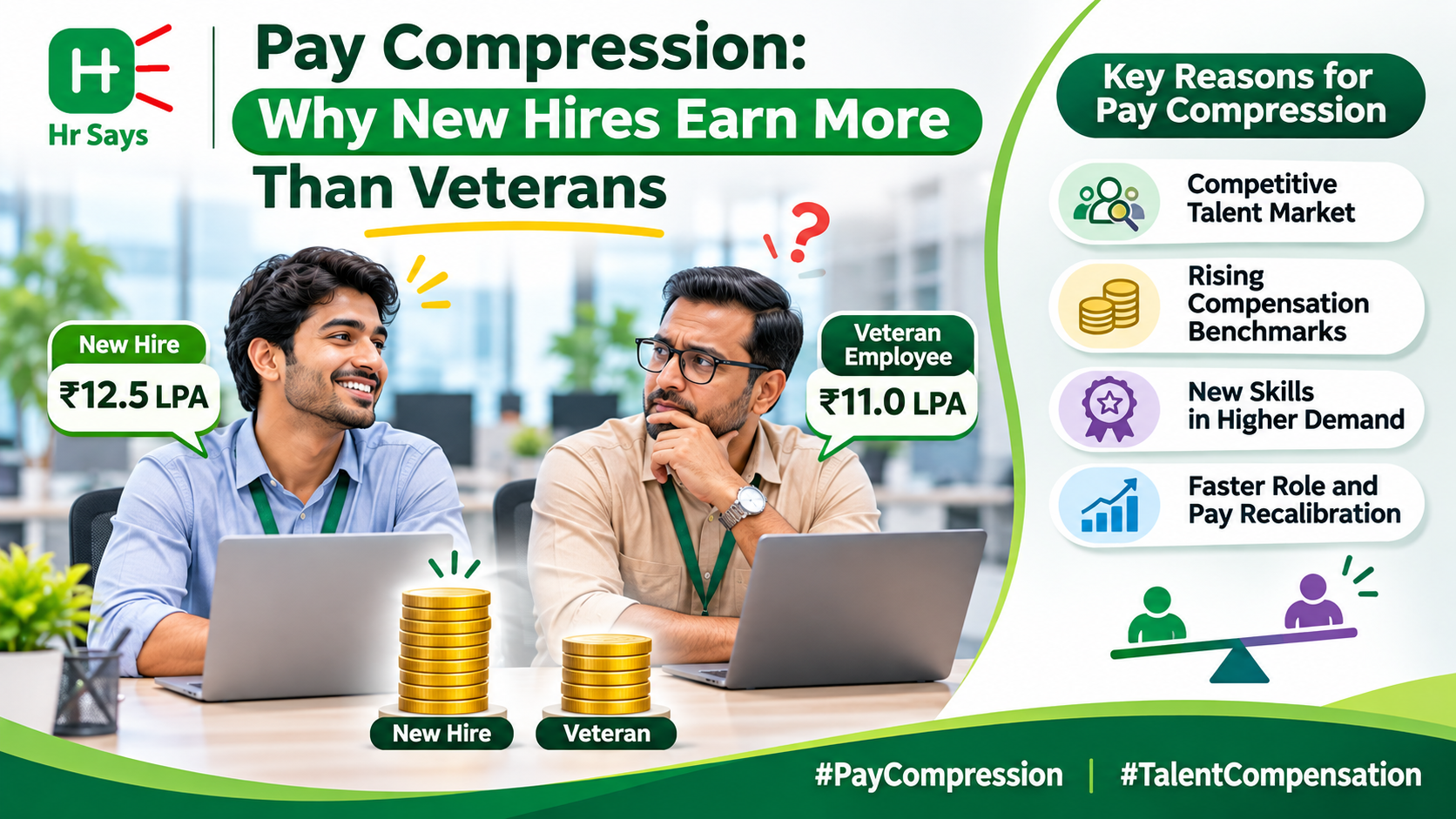
 Pay compression narrows salary gaps between new hires and experienced employees, harming morale and retention. Indian HR teams must audit, benchmark, and recalibrate compensation structures proactively to protect organizational talent and workplace fairness.





Introduction
Across Indian workplaces, a quiet but deeply damaging problem has been building for years. A software engineer joins a Bengaluru-based tech firm with five years of experience and a competitive offer. Three months later, a fresher is hired into the same team at a salary that is only marginally lower. The senior engineer finds out. The motivation drops. The resignation follows.
This situation has a name: pay compression. It is one of the most underexamined compensation challenges in HR today, and its consequences reach far beyond payroll spreadsheets. Pay compression occurs when the salary difference between employees at different levels of experience, skill, or seniority becomes disproportionately narrow or even reversed. When a new hire earns as much as or more than a colleague who has spent years building institutional knowledge, something has gone fundamentally wrong in the compensation structure.
As Indian companies compete aggressively for talent in sectors like technology, banking, healthcare, logistics, and manufacturing, pay compression has become an increasingly common outcome. HR leaders and business owners cannot afford to ignore it any longer.
Understanding Pay Compression and How It Happens
Pay compression is not a payroll error. It is a structural outcome that results from a combination of market forces, internal HR practices, and organizational inertia. To understand why it happens, it helps to look at the different forms it takes.
The most discussed form is the scenario where a new hire receives a salary that equals or exceeds that of a tenured employee doing the same or similar work. This is sometimes called external compression. A second form involves managers earning only slightly more than the people they supervise, which is referred to as hierarchical or managerial compression. A third, less discussed form affects long-serving employees who have received incremental annual raises that simply have not kept pace with inflation or market rate movements.
In all three cases, the root issue is the same: internal salary growth has not matched external market shifts.
Primary Causes of Pay Compression in Indian Organizations
Several interconnected factors drive pay compression, particularly in the Indian employment landscape.
Aggressive market-driven hiring offers are perhaps the single biggest contributor. During talent crunches in sectors like IT, fintech, and healthcare technology, companies stretch their salary bands to attract candidates. These offers are based on current market benchmarks, while the salaries of existing employees reflect what the market looked like two, three, or five years ago. The gap between the two grows silently over time.
Inadequate annual increment cycles also play a central role. Most Indian companies offer annual increments in the range of 7 to 12 percent for average performers. While this appears reasonable in isolation, it is often insufficient to close the widening distance between internal salary levels and external market rates. Over a period of three to five years, this compounding deficit creates meaningful compression.
Rigid pay band structures are another contributor. When organizations design salary bands without building in regular recalibration, those bands become outdated quickly. A pay band that made sense in 2020 may significantly undervalue the same role in 2025 or 2026.
Reactive rather than proactive compensation reviews mean that many organizations only update salaries when an employee is at risk of leaving or when a new position needs to be filled. This reactive posture consistently puts existing employees at a disadvantage compared to new entrants into the same team.
India-specific hiring dynamics add further complexity. In cities like Hyderabad, Pune, Chennai, and Noida, competition for mid-level and senior talent in technology and operations roles has pushed market salaries upward far faster than typical internal increment policies can follow. The result is that the internal-to-external salary ratio for many experienced employees has quietly deteriorated.
How Pay Compression Affects Employees and Organizations
The business consequences of pay compression are significant and well-documented.
The most immediate effect is on employee morale and engagement. When an experienced team member discovers that a new joiner earns a comparable or higher salary, the perception of fairness is damaged. Employees begin to question whether their loyalty and contribution are truly valued by the organization. Research consistently shows that perceived pay inequity is one of the strongest predictors of voluntary turnover.
Retention risk increases sharply among the employees an organization can least afford to lose. High performers with strong skill sets and significant experience are precisely the people who can most easily find better-paying opportunities elsewhere. Pay compression effectively creates an incentive for them to leave, while the organization continues to invest in onboarding and training the newer employees who triggered the compression in the first place.
Team dynamics can deteriorate when pay inequity becomes visible. Friction between team members, reduced collaboration, and declining trust in leadership are common outcomes. In performance-driven environments, this has a measurable impact on productivity and team output.
The cost of replacement is frequently underestimated. Industry estimates suggest that replacing a mid-level employee can cost between 50 and 200 percent of their annual salary when recruitment, onboarding, training, and productivity loss are factored in. Pay compression, left unaddressed, almost always results in higher replacement costs than the cost of correcting the salary structure.
For Indian organizations navigating high-growth phases or digital transformation journeys, the talent disruption caused by unchecked pay compression can derail strategic initiatives at critical moments.
Identifying Pay Compression in Your Organization
HR teams need a structured approach to identify whether pay compression exists before it starts causing attrition. Some of the most reliable indicators include:
- A rising number of exit interviews where compensation is cited as the primary reason for leaving
- Internal salary ratio analysis showing tenured employees earning within 5 to 10 percent of new hire salaries in the same role or band
- Managers and their direct reports in overlapping or near-identical salary ranges
- Job offer data showing that external candidates are consistently being brought in above the midpoint of the existing team's salary range
- Employee engagement survey results reflecting declining satisfaction with pay fairness
A formal compensation audit, conducted annually or biannually, is the most systematic way to surface these patterns before they become retention crises.
Addressing and Preventing Pay Compression
Fixing pay compression requires both short-term corrective action and long-term structural reform. HR leaders and CHROs overseeing compensation strategy need to approach this in phases.
Conduct a full compensation benchmarking exercise. This means mapping internal salaries against current market data for every role across tenure levels. Industry compensation surveys, HR consulting data, and platforms like Naukri Insights or LinkedIn Salary Insights provide useful benchmarks for the Indian market.
Create targeted equity adjustments for affected employees. Once compression is identified, organizations should prioritize salary corrections for the most critical roles and highest-impact employees. These adjustments are distinct from annual increment cycles and should be communicated transparently as a commitment to internal equity.
Redesign salary bands with regular recalibration built in. Pay bands should not be static documents. Building a formal review cycle, ideally annually, ensures that internal bands remain aligned with market reality. Organizations should also ensure that bands have sufficient spread to accommodate performance differentiation across tenure levels.
Align increment policy with market movement, not just inflation. Annual increment budgets must account for market rate movements in addition to cost-of-living adjustments. For high-demand roles, merit increments may need to be supplemented with periodic market adjustments to close emerging gaps before they become compression.
Rethink total compensation. In cases where immediate base salary corrections are constrained by budget, organizations can partially offset compression concerns through enhanced variable pay, long-term incentive structures, benefits, learning and development investments, and clear career progression frameworks. These elements do not replace pay equity, but they contribute to an employee's overall perception of being valued.
For HR professionals in India, particularly those managing mid-sized organizations in competitive talent markets, HRSays offers a consistent knowledge base of practical compensation insights, case perspectives, and workplace policy guidance to support informed decision-making.
The Link Between Pay Compression and Workplace Culture
Pay compression is not purely a compensation issue. It is also a signal about how an organization values its people. When employees observe that the fastest way to get a meaningful salary increase is to leave and come back as a new hire, the cultural message is deeply problematic. It communicates that loyalty carries no premium and that the organization treats external talent acquisition as more important than internal talent retention.
Organizations that prioritize pay equity as a matter of workplace culture, rather than just HR compliance, consistently report stronger engagement scores, higher internal promotion rates, and lower attrition. This connection between compensation fairness and organizational culture is increasingly understood by Indian HR leaders, particularly as younger employees enter the workforce with greater salary transparency and stronger expectations of fair treatment.
Frequently Asked Questions
Q1: What is pay compression in simple terms?
Pay compression occurs when the salary difference between employees at different experience levels or seniority becomes very small or is reversed. It most commonly happens when new hires are brought in at salaries close to or above what existing employees earn in the same or similar roles.
Q2: Is pay compression a common problem in Indian companies?
Yes, pay compression is increasingly common across Indian organizations, particularly in sectors such as information technology, fintech, healthcare technology, and logistics. Rapid market salary growth combined with slow internal increment cycles has made this a widespread challenge for HR teams managing retention and engagement.
Q3: How does pay compression affect employee retention?
Pay compression significantly increases voluntary turnover risk, especially among experienced and high-performing employees. When tenured staff discover that new joiners earn comparable salaries, they lose confidence in the organization's commitment to fair compensation and are more likely to explore external opportunities.
Q4: What is the difference between pay compression and pay inversion?
Pay compression refers to the narrowing of salary gaps between different employee levels. Pay inversion is an extreme form of pay compression where a junior employee actually earns more than a more experienced colleague in the same role or reporting hierarchy. Both indicate a breakdown in compensation structure that requires HR intervention.
Q5: How can HR teams fix pay compression without disrupting the entire salary structure?
HR teams can address pay compression through targeted equity adjustments for affected employees, regular compensation benchmarking, redesigned salary bands with built-in recalibration cycles, and revised increment policies that account for market rate movements. These corrections do not require a full restructuring of the compensation framework but do require a deliberate and systematic audit process.
Resources
- Society for Human Resource Management (SHRM): Global HR research, compensation benchmarking guidance, and workplace policy frameworks relevant to HR professionals.
- National HRD Network (NHRDN): India's premier HR professional body offering compensation trend data, HR best practice publications, and policy research.
- Ministry of Labour and Employment, Government of India: Official source for wage data, labor market statistics, and regulatory frameworks governing employment compensation in India.
- Mercer India: Leading HR consulting firm providing annual compensation surveys and salary benchmarking data specific to the Indian market across multiple industries.
- LinkedIn Talent Insights: Real-time salary and talent market data relevant to HR professionals benchmarking compensation for Indian roles across sectors and cities.
Interlinking Keywords
Pay compression, salary compression India, compensation benchmarking, internal pay equity, employee retention strategy, HR compensation audit, salary band structure, annual increment policy, total rewards strategy, compensation and benefits India
Last Reviewed By
Dr. Manthan Tripathi and Hr Says Advisory Panel on 12 November 2026.
Disclaimer
The information provided in this article is intended for general educational and informational purposes for HR professionals, business leaders, and workplace decision-makers. It does not constitute legal, financial, or professional compensation consulting advice. Organizations should consult qualified HR consultants or legal advisors before making structural changes to compensation policies. HRSays does not assume liability for decisions made based on the content of this article.