 Friday, November 13, 2026
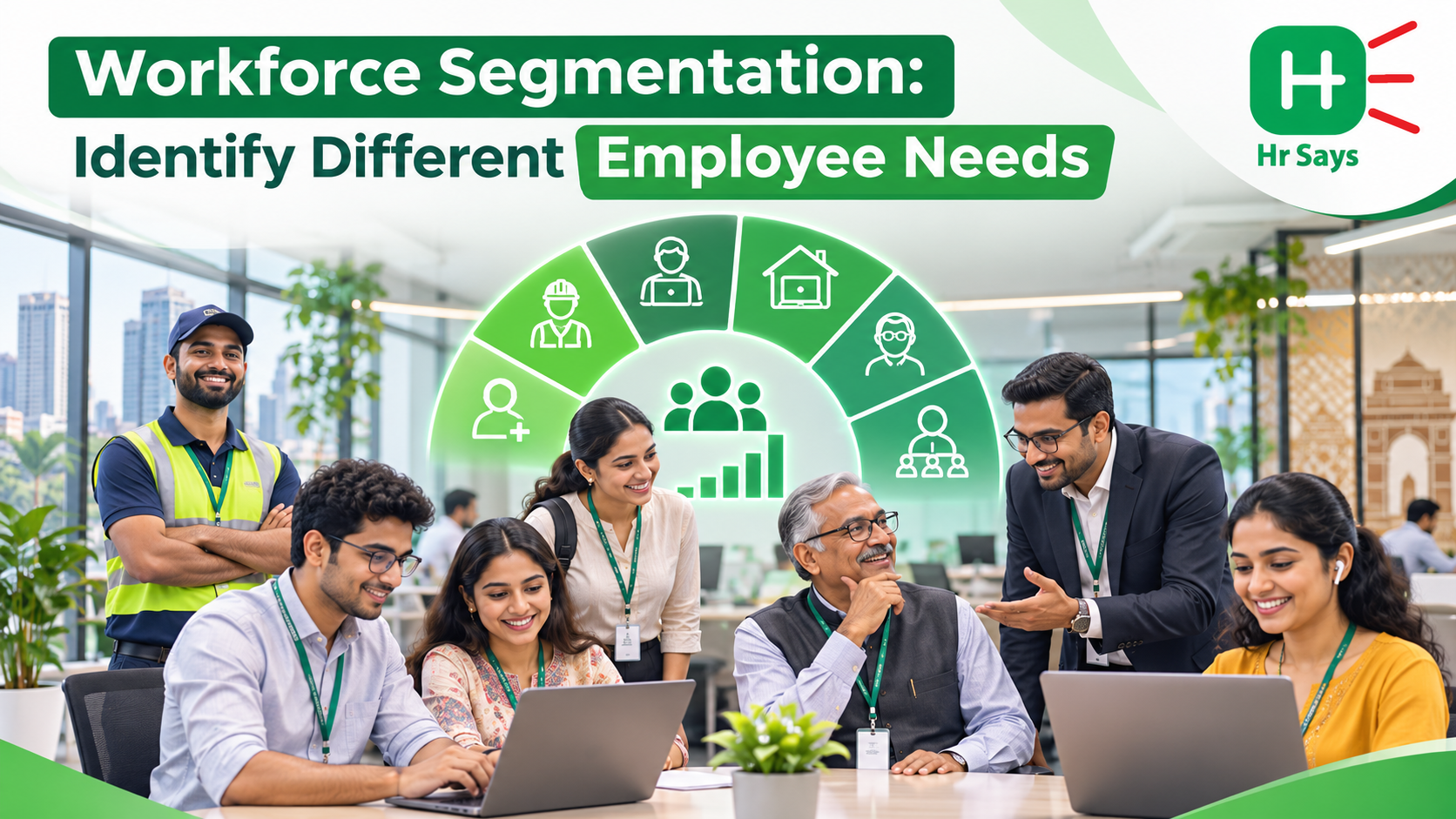
 Workforce segmentation enables HR leaders to identify and address diverse employee needs through targeted strategies, improving engagement, retention, and performance across Indian organisations of all sizes.





Introduction
Every organisation employs people who come from different backgrounds, hold different career goals, work at different life stages, and expect different things from their employer. When HR teams apply a single, uniform people strategy across all these individuals, the result is predictable: some employees feel genuinely supported, while others feel invisible. Workforce segmentation is the structured practice that helps organisations move past this problem.
Workforce segmentation means dividing an organisation's employee population into meaningful groups based on shared characteristics, needs, or expectations. It allows HR leaders and business heads to design targeted engagement strategies, development programmes, and workplace policies that actually speak to the people they are meant to serve. For Indian organisations navigating rapid workforce changes, multigenerational teams, hybrid models, and high attrition pressures, getting this right is no longer optional. It is a strategic imperative.
Understanding Workforce Segmentation in the HR Context
At its core, workforce segmentation borrows logic from marketing. Just as a consumer brand does not send the same message to a teenager and a senior professional, an employer should not apply the same reward, recognition, or development approach to a first-year analyst and a mid-career manager. The underlying idea is simple: when people feel that their specific needs are understood, they are more likely to stay engaged, perform better, and remain loyal to the organisation.
In HR practice, workforce segmentation is not about putting employees in boxes or treating certain groups as more important than others. It is about understanding the legitimate diversity within a workforce and responding to it with intelligence and care. A well-segmented workforce strategy ensures that no employee group is inadvertently overlooked in planning conversations, budget allocations, or policy designs.
Workforce segmentation also sits at the foundation of stronger people analytics. When HR teams can slice workforce data by meaningful dimensions, they gain sharper visibility into which groups are disengaged, which are flight risks, and which are thriving. This translates directly into better decisions.
Key Dimensions for Segmenting Your Workforce
There is no single correct way to segment a workforce. The right approach depends on the size of the organisation, its industry, its culture, and the specific challenges it is trying to address. However, several core dimensions tend to be consistently valuable across most Indian workplace contexts.
Demographic segmentation looks at age, gender, educational background, and life stage. A young professional in their first job has fundamentally different financial, social, and career needs compared to someone in their forties managing family responsibilities and thinking about retirement planning. Organisations that offer one-size employee benefits often find that those benefits resonate with one demographic group and fall flat with others.
Role-based segmentation groups employees by function, seniority, or the nature of their work. Front-line workers in a manufacturing unit, remote knowledge workers in a tech team, and client-facing sales professionals each face distinct workplace pressures. Their training needs, communication preferences, and flexibility requirements are genuinely different. Treating them identically in an engagement survey or a learning programme rarely produces useful outcomes.
Tenure-based segmentation separates employees by how long they have been with the organisation. New joiners in their first ninety days need onboarding clarity and cultural immersion. Mid-tenure employees between two and five years often need growth opportunities and recognition to avoid stagnation. Long-serving employees benefit from legacy acknowledgement, mentoring roles, and succession visibility. Each group responds to different kinds of HR attention.
Performance and potential segmentation, commonly used in talent management frameworks, helps organisations direct development investment toward high-potential employees while also identifying those who may need additional support or role realignment. This is not about valuing certain employees less. It is about deploying development resources intelligently.
Location and work-mode segmentation has become especially relevant in post-pandemic India. Employees working out of metro offices, those in Tier 2 or Tier 3 cities, remote workers, and hybrid workers each navigate different infrastructure realities, connectivity challenges, and social contexts. HR policies designed only with a Bengaluru or Mumbai office in mind often fail employees working from smaller cities or home environments.
How to Identify Employee Needs Within Each Segment
Identifying what different employee groups actually need requires a combination of data, listening, and HR judgment. No single method is sufficient on its own.
Employee surveys remain one of the most direct tools available. However, surveys designed for the entire workforce at once often produce averaged-out data that reveals little about specific groups. Segmented pulse surveys, targeted at defined employee populations and designed around their specific context, yield far more actionable insights. For example, a focused survey for employees with less than one year of tenure will surface onboarding gaps and early experience friction that a general engagement survey would dilute or miss entirely.
One-on-one conversations and structured stay interviews are equally valuable. When HR business partners or managers have honest, low-pressure conversations with employees about what is working and what is not, they gather nuanced qualitative data that survey tools cannot capture. The challenge is ensuring these conversations happen consistently and that the insights are recorded and fed back into HR planning.
People analytics platforms, increasingly adopted by mid-to-large Indian organisations, allow HR teams to overlay multiple data streams, including attendance patterns, performance trends, internal mobility history, and benefit utilisation data, to identify unmet needs at a segment level. Patterns that are invisible at the aggregate level often become clear when data is filtered by tenure, function, or location.
Focus groups organised by employee segment allow HR teams to validate hypotheses and co-design solutions with the very people they are meant to support. When employees see that their feedback has shaped a policy or programme, it also strengthens trust in the HR function.
Applying Segmentation to Key HR Processes
Workforce segmentation has practical applications across nearly every core HR process.
In learning and development, segmentation allows organisations to move away from mandatory generic training calendars toward pathways designed for specific roles, career stages, and skill gaps. A new manager needs leadership fundamentals. A senior individual contributor may need deep technical upskilling. A returning employee after a career break needs a customised reintegration path.
In employee benefits and total rewards, segmentation helps design flexible benefit structures. Younger employees may prioritise mental health support, skill development allowances, and flexible work. Mid-career employees with families may value group health insurance coverage, education assistance for children, and financial planning tools. Offering all employees the same rigid benefits package, regardless of life stage, is a missed opportunity for genuine engagement.
In internal communication, segmented messaging ensures that employees receive information that is relevant to their context. A company-wide email about a new parental leave policy is meaningful to some employees and entirely irrelevant to others. Thoughtful segmentation of communication channels and content reduces information noise and increases the likelihood that important messages actually land.
In retention strategy, workforce segmentation helps HR teams identify which employee groups face the highest attrition risk and design proactive interventions. Rather than reacting to resignations, organisations can spot early warning signals at the segment level and address root causes before talent walks out.
Workforce Segmentation in the Indian Workplace Context
India's workforce is among the most diverse in the world, not just in terms of geography and language, but in generational composition, educational background, socioeconomic context, and career aspirations. Indian organisations, particularly those scaling rapidly through startup growth or large enterprise expansion, often struggle to maintain personalised employee experiences at scale.
The rise of contract and gig workers alongside permanent employees adds another layer of complexity. Platforms, logistics companies, and large retail organisations in India now manage workforces where a significant portion of workers operate outside traditional employment frameworks. HR teams need segmentation approaches that account for this reality, ensuring that contractual and gig workers are not entirely excluded from engagement and development thinking.
Government frameworks such as the National Education Policy 2020 and initiatives under the Skill India Mission have also shaped workforce expectations among younger employees entering the job market. HR professionals working in Indian organisations need to understand how these macrotrends influence what different employee segments are looking for from their employers.
HRSays, as a platform built to advance HR knowledge and workplace conversations in India, provides HR professionals with the insights, frameworks, and peer perspectives needed to design more intelligent, segment-aware people strategies.
Common Pitfalls to Avoid
Workforce segmentation is a powerful tool, but it comes with risks if handled carelessly.
- Segmenting too narrowly can create an administrative burden without producing meaningfully different strategies for each group.
- Using segmentation to rank employees by perceived value, rather than to understand their needs, damages culture and trust.
- Collecting data without acting on it erodes employee confidence in the HR function.
- Failing to revisit segmentation frameworks as the workforce evolves means strategies quickly become outdated.
The goal is always to use segmentation as a lens for empathy and intelligent action, not as a mechanism for exclusion or hierarchy.
Conclusion
Workforce segmentation is one of the most practical tools available to HR professionals who want to move beyond generic people management and build workplaces where every employee feels seen and supported. By understanding the genuine diversity within their workforce and designing HR strategies that respond to it, organisations can improve engagement, reduce attrition, and create conditions for sustained performance.
For Indian organisations managing complex, multigenerational, and geographically distributed workforces, the case for structured workforce segmentation has never been stronger. The organisations that invest in understanding their employees at a segment level today will be far better positioned to retain, develop, and inspire their people in the years ahead.
Frequently Asked Questions
Q1: What is workforce segmentation in HR?
Workforce segmentation in HR is the practice of dividing an organisation's employee population into distinct groups based on shared characteristics such as role, tenure, age, location, or work mode. It allows HR teams to design targeted strategies that address the specific needs of each group rather than applying uniform policies across all employees.
Q2: Why is workforce segmentation important for Indian organisations?
Indian organisations manage highly diverse workforces spanning multiple generations, geographies, educational backgrounds, and employment types. Workforce segmentation allows HR leaders to address this diversity with tailored engagement, development, and retention strategies rather than one-size approaches that fail to resonate with large portions of the workforce.
Q3: How do HR teams identify the needs of different employee segments?
HR teams use a combination of segmented pulse surveys, one-on-one stay interviews, people analytics platforms, and employee focus groups to identify the specific needs of different workforce segments. Layering quantitative data with qualitative insight produces the most accurate and actionable picture of what different groups need.
Q4: What are the most common bases for segmenting a workforce?
The most commonly used segmentation dimensions include demographics such as age and gender, role and function, tenure with the organisation, performance and potential, and work location or work mode. The right combination depends on the organisation's size, industry, and the specific HR challenges it is addressing.
Q5: Can small and mid-sized Indian companies benefit from workforce segmentation?
Yes. Even organisations with smaller headcounts benefit from recognising that employees at different career stages, in different roles, or working in different locations have different needs. Segmentation does not require complex technology. It begins with intentional listening and a willingness to design HR responses that reflect genuine workforce diversity.
Resources
- Society for Human Resource Management (SHRM): Global HR research, tools, and frameworks for people strategy and workforce planning.
- National HRD Network (NHRD India): India-focused HR thought leadership, research, and professional development for HR practitioners.
- Ministry of Labour and Employment, Government of India: Policy updates, labour law frameworks, and workforce data relevant to Indian HR professionals.
- People Matters: India's leading HR and workplace media platform covering talent management, workforce trends, and organisational design.
- Skill India Mission (Ministry of Skill Development and Entrepreneurship): Government initiative shaping workforce capability development and skilling priorities across India.
Interlinking Keywords
Employee engagement strategies, talent management framework, HR analytics India, workforce planning, employee retention strategies, people analytics tools, internal mobility HR, total rewards strategy, HR business partner role, employee experience India
Last Reviewed By
Dr. Manthan Tripathi and Hr Says Advisory Panel on 11 November 2026.
Disclaimer
The information presented in this article is intended for general HR knowledge and professional learning purposes only. It does not constitute legal, compliance, or employment law advice. HR professionals and organisations should consult qualified legal and HR advisors before making policy or structural decisions based on the frameworks discussed here.