 Sunday, November 15, 2026
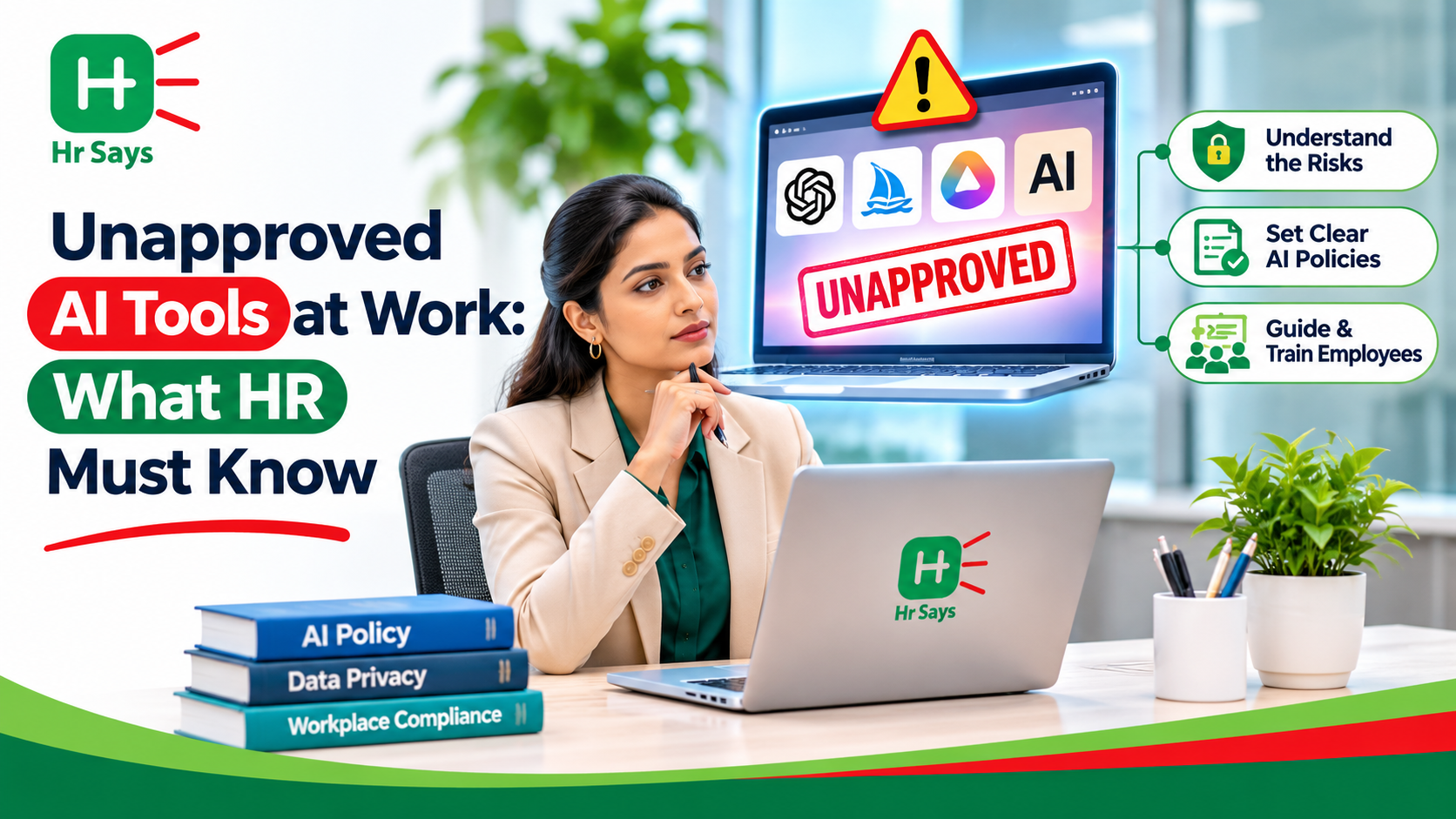
 Unapproved AI tool usage by employees creates serious data, compliance, and cultural risks. HR must build proactive governance frameworks to manage shadow AI responsibly and effectively.





Introduction
Across offices in Mumbai, Bengaluru, Hyderabad, and Delhi, something is happening quietly. Employees are turning to AI tools that their organizations never approved, never reviewed, and never even discussed. They are using free generative AI chatbots to draft client emails. They are feeding confidential project briefs into AI summarizers. They are running HR-sensitive data through third-party tools to generate reports faster. From the employee's perspective, they are simply being productive. From the organization's perspective, the risks are significant and growing.
This phenomenon has a name in technology and HR circles: shadow AI. Much like shadow IT before it, shadow AI refers to the use of artificial intelligence tools, applications, and services by employees without the knowledge, review, or authorization of the IT department, HR, or organizational leadership. As AI tools become more accessible, free, and genuinely useful, their unsanctioned adoption inside Indian workplaces is rising fast. And the consequences, when things go wrong, can be serious for companies, their clients, and the employees themselves.
Understanding what actually happens when employees use unapproved AI tools is no longer optional knowledge for HR professionals. It is a core responsibility.
Understanding Shadow AI and Why It Is Growing in Indian Workplaces
Shadow AI is not a niche problem. A growing number of knowledge workers across Indian industries, from IT services and banking to healthcare and media, are using AI tools in their daily work without telling anyone. The reasons are straightforward. These tools are genuinely helpful. They save time. They are often free. And in many organizations, there is no policy that explicitly addresses them.
The gap between what employees want to use and what organizations have approved is widening rapidly. Many Indian companies, especially small and mid-sized enterprises, have not yet developed clear AI governance frameworks. HR teams are still learning what these tools are. Meanwhile, employees who have already discovered the productivity benefits of AI are not waiting for permission.
This is not a reflection of bad intent. Most employees using unapproved AI tools are not trying to cause harm. They are trying to do their jobs better. But good intentions do not eliminate risk. The risks that shadow AI introduces into an organization are real, measurable, and in some cases, irreversible.
The Primary Risks That Organizations Face
When an employee uses an unapproved AI tool, several categories of risk are activated simultaneously.
Data Security and Confidentiality BreachesThe most immediate and serious risk is what happens to the data the employee feeds into the tool. Many free or consumer-grade AI tools process user inputs on external servers. Some retain this data for model training. Some store conversations in ways that can be accessed by third parties under certain conditions. When an employee pastes a client contract, an internal financial projection, or a patient record into one of these tools, that information leaves the organization's controlled environment. Once it is out, there is no reliable way to retrieve or contain it.
For Indian companies handling data under the Digital Personal Data Protection Act, 2023 (DPDPA), this is not just a security concern. It is a potential compliance violation that could attract regulatory scrutiny.
Intellectual Property ExposureProprietary business strategies, unreleased product details, pricing models, and source code are forms of intellectual property. When these are fed into third-party AI tools, the ownership boundaries become legally murky. Depending on the terms of service of the tool, the organization may have inadvertently shared proprietary content in ways that complicate future IP claims.
Accuracy and Decision QualityAI tools, even capable ones, produce errors. When employees use these tools to generate analysis, recommendations, or client-facing content without disclosure or review, those outputs carry organizational risk. A factual error in a report or a hallucinated statistic in a client presentation reflects on the company, not on the AI tool that produced it.
Compliance and Regulatory RiskIndustries such as banking, insurance, healthcare, and legal services operate under strict regulatory frameworks in India. Using AI tools to process client data or generate regulated communications without organizational review and approval may violate sector-specific compliance requirements from regulators such as SEBI, IRDAI, or the Reserve Bank of India.
Cultural and Trust ErosionBeyond the technical risks, shadow AI creates a cultural challenge. When parts of the workforce are quietly using AI and others are not, it creates invisible productivity disparities. When this comes to light, as it often does, it can generate internal conflict around fairness, disclosure, and organizational transparency.
Recognizing the Signs of Shadow AI Adoption
HR professionals and managers cannot address what they cannot see. Identifying whether shadow AI usage is happening in an organization requires both a cultural awareness and some practical observation.
Some indicators that shadow AI may already be present in a team or department include:
- Sudden, significant improvements in output volume from individual employees without a clear explanation
- Use of language, structure, or formatting in documents that feels inconsistent with the employee's usual output
- Employees referencing capabilities or tools in casual conversation that have not been discussed or approved
- Increased data export activity from internal systems, as employees pull data to feed into external tools
- Reluctance from team members to explain how they completed a task or produced a deliverable
None of these signals is conclusive on its own, but together they suggest that a conversation is needed.
What HR Should Do: A Practical Framework
The answer to shadow AI is not a crackdown. Prohibiting all AI tools without offering sanctioned alternatives is likely to drive behavior further underground while creating resentment among employees who feel their productivity is being restricted. The more effective approach is a structured, forward-thinking framework that HR can lead.
Develop and Communicate an AI Acceptable Use PolicyEvery Indian organization with knowledge workers needs a clear, written policy on AI tool usage. This policy should define what categories of AI tools are approved, what data may and may not be used with any AI tool, and what the reporting process is for employees who want to request approval for a new tool. The policy should be written in plain language, communicated during onboarding and refresher training, and revisited regularly as the technology landscape evolves.
Create a Controlled AI Adoption PathwayRather than treating AI tool requests as a burden, HR and IT can create a structured review process that allows employees to propose tools they want to use. This gives employees a legitimate channel, reduces the motivation for shadow behavior, and helps the organization build a curated library of approved tools with known security and compliance profiles.
Invest in AI Literacy TrainingMany employees do not understand the data implications of using consumer AI tools. They genuinely do not know that the information they input may be retained or processed externally. AI literacy training, delivered through the organization's learning and development function, should become a standard part of the professional development calendar. This training should cover how AI tools work in general terms, what data risks exist, and how to use approved tools responsibly.
Engage Managers as Frontline Culture CarriersManagers play a crucial role in determining whether employees feel safe disclosing their AI usage. If the organizational culture treats AI as a threat or as something suspicious, employees will hide it. HR should work with managers to create an environment where employees feel comfortable raising questions about AI tools and where the organization's response is guidance rather than penalty.
Align HR Processes with AI Risk ManagementPerformance management, data handling agreements, and exit processes should all be updated to reflect the AI era. Employment agreements and NDAs may need to be reviewed to address AI-related data handling. HR teams should also coordinate with legal and compliance functions to ensure that any investigation into data misuse involving AI is handled appropriately and proportionately.
Prevention and Proactive Workplace Strategies
Prevention works better than remediation. Organizations that build proactive structures around AI governance are significantly less likely to face serious shadow AI incidents than those that react only after a breach or compliance failure.
Indian HR leaders should consider positioning their organizations as AI-forward rather than AI-cautious. This means publicly acknowledging the value of AI, investing in approved tools that genuinely help employees, and treating AI governance as a business enabler rather than a restriction. When employees see that leadership understands AI and is actively working to give them good tools and clear guidance, the motivation to go around the system diminishes.
It is also worth noting that many of the most capable enterprise AI tools now available, including solutions built for HR workflows, have been developed with organizational security, data residency, and compliance requirements in mind. Helping employees transition from free consumer tools to vetted enterprise solutions is a practical step that reduces risk while maintaining productivity.
The question for HR in India is not whether to address shadow AI. The question is how quickly and how thoughtfully the organization can build the structures needed to manage it well. The organizations that move first on AI governance will be better positioned to attract talent, maintain client trust, and operate with confidence in an increasingly AI-shaped professional landscape.
Frequently Asked Questions
Q1: What is shadow AI and how is it different from shadow IT?
Shadow AI refers specifically to the use of artificial intelligence tools, platforms, or applications by employees without organizational approval or oversight. Shadow IT is the broader term for any unsanctioned technology. Shadow AI is a newer and more complex subset because AI tools often process, retain, or learn from the data they receive, making the risks around confidentiality and data security more significant than with traditional software.
Q2: Can an organization in India be held legally liable if an employee uses an unapproved AI tool that leaks client data?
Yes, liability is a genuine concern. Under India's Digital Personal Data Protection Act, 2023, organizations are responsible for how personal data is processed, regardless of whether the processing was authorized internally. If an employee uses an unapproved tool that results in a data breach involving personal data, the organization, as the data fiduciary, may face regulatory consequences. This makes organizational AI governance a legal and compliance priority, not just an HR one.
Q3: What should an AI acceptable use policy for a mid-sized Indian company include?
At a minimum, the policy should cover which categories of AI tools are approved for use, what types of data may never be input into any AI tool, the process for requesting approval of a new tool, the consequences of policy violations, and how the organization will support employees in transitioning to approved tools. It should be written in simple language, made accessible to all employees, and reviewed at least once every year given how rapidly this technology is evolving.
Q4: How can HR identify if employees are already using unapproved AI tools without conducting invasive surveillance?
HR can look for behavioral and output signals such as sudden increases in individual productivity, inconsistencies in writing style or document format, and casual references to AI tools in team conversations. Creating a psychologically safe environment where employees can voluntarily disclose their AI usage is often more effective and more respectful than technical monitoring. Culture-based approaches tend to yield better long-term outcomes.
Q5: Is it practical to ban all unapproved AI tools entirely?
A complete ban is generally not practical or advisable. It is likely to be unenforceable in organizations that cannot monitor all employee activity, and it creates a culture of restriction that can harm morale and talent retention. A more effective approach is to build a clear approved-tools framework, offer a transparent review pathway for new tool requests, and invest in AI literacy so employees understand why the guidelines exist. The goal is responsible AI adoption, not the absence of AI.
Resources
- Ministry of Electronics and Information Technology (MeitY): Official guidance on India's Digital Personal Data Protection Act, 2023, and digital governance frameworks.
- National Institution for Transforming India (NITI Aayog): Reports and policy papers on AI adoption, AI ethics, and responsible AI frameworks in India.
- Data Security Council of India (DSCI): Best practice frameworks for data security, privacy governance, and enterprise technology risk management in Indian organizations.
- Society for Human Resource Management (SHRM): Global research and guidance on AI in the workplace, HR policy development, and workforce technology governance.
- World Economic Forum (WEF): Reports on the future of work, AI and jobs, and organizational readiness frameworks for responsible AI adoption.
Interlinking Keywords
Shadow AI policy, AI acceptable use policy for employees, employee data security risks, HR technology governance, AI tools in Indian workplaces, workplace AI compliance, AI literacy training for employees, digital personal data protection India, HR policy for AI usage, enterprise AI adoption
Last Reviewed By
Dr. Manthan Tripathi and Hr Says Advisory Panel on 13 November 2026.
Disclaimer
The information provided in this article is intended for general informational and educational purposes only. It does not constitute legal, compliance, or regulatory advice. Organizations should consult qualified legal counsel, HR professionals, and compliance advisors before implementing policies related to AI tool usage, data governance, or regulatory compliance. Laws and regulations referenced in this article, including India's Digital Personal Data Protection Act, 2023, are subject to change. Readers are advised to refer to the latest official government and regulatory sources for current guidance.