 Sunday, November 15, 2026
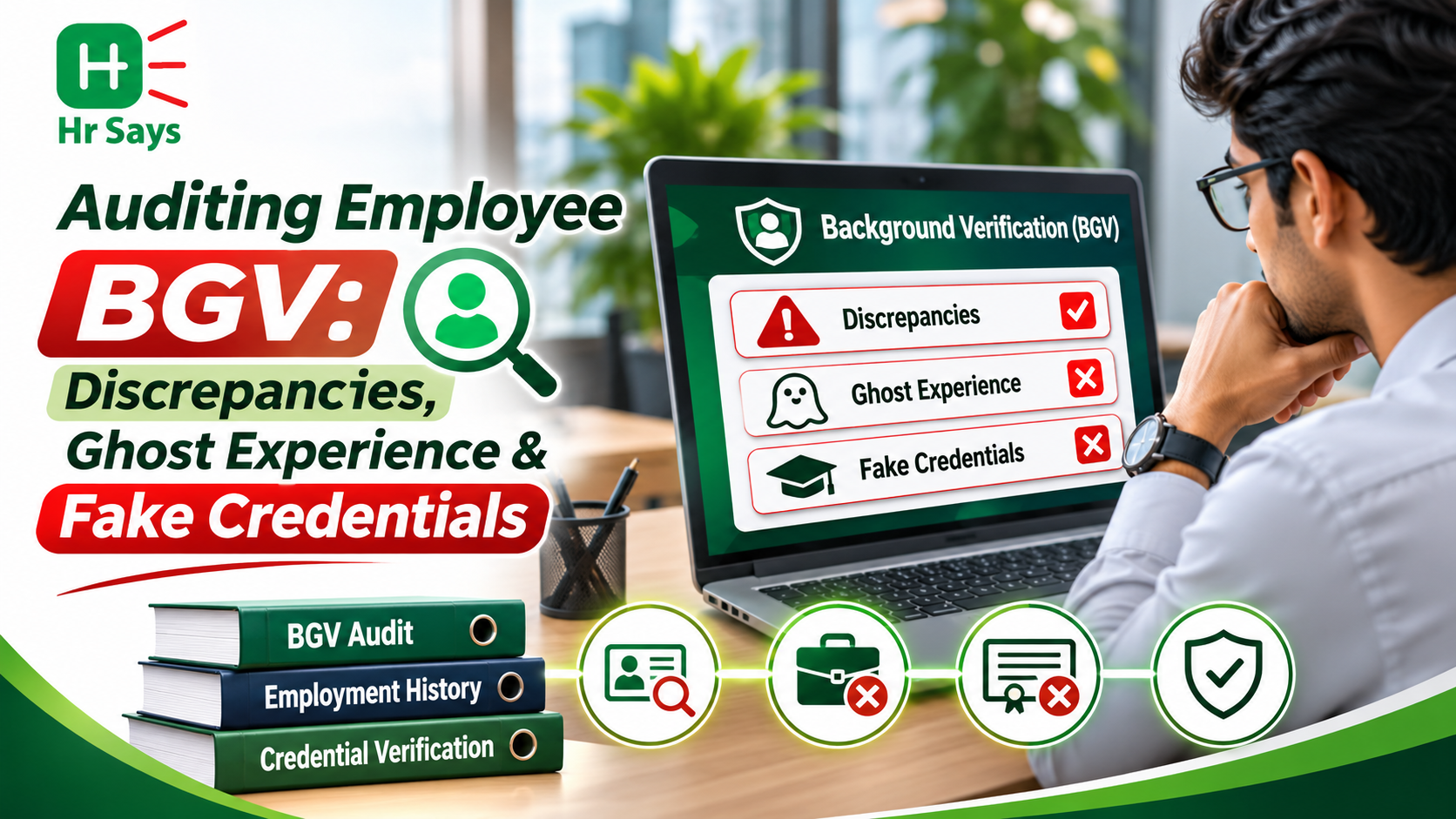
 Employee background verification helps organizations identify discrepancies, fake credentials, and ghost employment. A proper BGV audit ensures hiring transparency, workplace trust, and recruitment integrity.





Executive Overview: The Corporate Risk of Credential Fraud and Compromised BGV
In an increasingly competitive and distributed talent marketplace, the integrity of a workforce depends fundamentally on the rigor of its pre-employment and post-onboarding background verification (BGV) architecture. While human resources departments historically treated background checks as a routine administrative formality, credential fabrication, synthetic identities, and organized employment fraud have escalated into systemic operational risks.
Modern credential fraud is no longer confined to occasional resume padding or slight employment date embellishments. It encompasses sophisticated, organized networks:
- The Proliferation of "Ghost" Companies: Shell companies and fake business entities established exclusively to provide fraudulent employment verification, complete with registered domain names, active commercial phone lines, forged letterheads, falsified payslips, and compliant telephonic reference responders.
- Diploma Mills and Accredited Entity Spoofing: Unaccredited degree mills, compromised university portals, forged digital transcripts, and cloned registrar credentials that bypass surface-level document inspection.
- Moonlighting, Dual Employment, and Identity Masquerading: Employees leveraging remote work flexibility to maintain simultaneous, undeclared full-time roles, or utilizing proxy interviewees and fabricated regulatory credentials to secure technical, clinical, or fiduciary positions.
- The Passive BGV Vendor Vulnerability: Standard third-party BGV agencies frequently conduct superficial, checkbox checks—relying on unverified digital document uploads or emailing generic HR addresses without cross-referencing corporate regulatory registries, statutory tax records, or primary sources.
When fraudulent credentials penetrate an organization, the consequences extend far beyond simple performance deficits. Organizations face severe data breach liabilities, regulatory sanctions for non-compliance, financial embezzlement, catastrophic intellectual property theft, and reputational damage.
An effective corporate audit of employee background verification requires moving beyond reliance on basic screening vendor sign-offs.
It demands an integrated, forensic auditing infrastructure:
- Standardizing clear taxonomies to distinguish minor clerical discrepancies from deliberate, actionable fraud.
- Establishing forensic audit methodologies to identify ghost employers, fabricated salary certificates, and deceptive educational credentials.
- Structuring rigorous, legally defensible remediation and termination protocols adhering to principles of natural justice and employment law.
- Implementing continuous evaluation, re-screening triggers, and statutory compliance controls.
1. Discrepancy Categorization and Risk Triage Matrix
An enterprise BGV audit program must avoid binary oversimplification. Labeling every minor clerical error as fraud wastes organizational resources, invites legal disputes, and alienates valuable talent. Conversely, dismissing material misstatements as administrative oversights creates severe organizational vulnerabilities.
Organizations must categorize verification variances across a clear, three-tiered severity taxonomy:
Amber Level: Minor / Administrative DiscrepanciesMinor discrepancies represent data variances that typically lack fraudulent intent, reflecting human error, memory lapses, or administrative differences between organizational systems:
- Tenure Gaps Under Thirty to Sixty Days: A candidate lists their employment ending in June, whereas official payroll records indicate their last working day was in early May.
- Nominal Title Variances: A resume title of "Senior Software Engineer" versus an official HR designation of "Member of Technical Staff III," provided the core functional scope and seniority band remain aligned.
- Minor Compensation Variances: Stated past base pay differing by minimal amounts due to confusion between gross earnings, cost-to-company (CTC) components, or non-discretionary annual performance bonuses.
- Incomplete Academic Paperwork with Verified Conferral: An uncollected physical degree certificate where the primary university registrar officially validates successful completion, graduation date, and passing grades.
Moderate discrepancies involve material misrepresentations that alter candidate qualification parameters, requiring formal inquiry and comprehensive evaluation:
- Unexplained Tenure Discrepancies Exceeding Ninety Days: Extended employment duration claims designed to hide unannounced sabbaticals, terminations, or performance-related exits.
- Material Job Title and Scope Inflation: Listing an executive or management position (e.g., "Director of Product") when corporate records verify the role was individual contributor-level (e.g., "Associate Product Analyst").
- Omission of Previous Employers: Deliberately omitting an intermediate employer where the candidate was terminated for cause, failed a probationary review, or had a tenure of less than six months.
- Inflated Base Remuneration Exceeding Twenty Percent: Falsifying base pay records to force artificially elevated counter-offers during hiring compensation negotiations.
Critical discrepancies involve willful, deliberate deception, criminal fraud, or complete absence of mandatory professional prerequisites, warranting immediate adverse action:
- Fabricated Experience via Ghost Companies: Listing employment tenures at organizations that have no corporate legal registration, operate out of fake residential addresses, or exist solely as paid fraudulent referral services.
- Falsified Academic Degrees and Fake Universities: Submitting diplomas from known unaccredited degree mills, forged transcripts, or claiming completed degrees when the candidate either dropped out or never matriculated.
- Falsified Statutory and Financial Documentation: Submitting forged tax forms, tampered bank statements with altered font kerning or manipulated totals, and manufactured salary slips.
- Dual Simultaneous Employment (Undisclosed Moonlighting): Maintaining concurrent, overlapping full-time employment contracts without employer authorization, identified via statutory tax and social security registries.
- Fabricated Mandatory Licenses: Falsifying legal, financial, architectural, or medical licenses required for statutory regulatory compliance.
2. Forensic Detection: Uncovering Ghost Companies and Fake Experience
The most complex challenge in modern BGV auditing is the ghost company ecosystem. Fraudulent operations advertise turnkey packages online, offering candidates fake offer letters, matching pay stubs, physical verification addresses, and call-center staff trained to impersonate HR departments during phone audits.
Forensic auditing requires multi-vector validation across independent corporate, financial, and digital registries.
Corporate Legal Identity and Regulatory AuditsVerification teams must establish whether the claimed previous employer is an authentic, legally incorporated, and actively trading enterprise:
- Corporate Registry Cross-Referencing: Validating the company’s legal incorporation number through official government registries (such as the Ministry of Corporate Affairs, state business registries, or national trade registers).
- An enterprise claiming fifty employees that was incorporated three months prior or dissolved two years ago is a critical red flag.
- Tax and Revenue Identification: Requiring and verifying the entity's active tax identification numbers (corporate income tax, GST, or VAT). Cross-referencing active tax filings confirms that the organization conducts real economic activity.
- Physical Commercial Presence Audits: Using satellite mapping, commercial lease verifications, and physical on-site investigator visits to confirm the listed corporate address is an actual commercial office space, rather than a residential apartment, vacant warehouse, or generic postal box storefront.
Ghost companies create superficial online footprints that unravel under digital inspection:
- Domain Age and WHOIS Analysis: Interrogating domain registration records via WHOIS lookup tools. If a candidate claims to have worked at a software consultancy from 2018 to 2022, but the company's domain name was registered in late 2023, the credential is demonstrably fraudulent.
- Email Infrastructure Validation: Ensuring verification communications originate from configured enterprise email servers with proper MX, SPF, and DKIM records, rather than free webmail services (Gmail, Yahoo) or cloned typo-squatted domains mimicking real corporations.
- Digital Footprint and Web Presence: Checking for independent digital evidence of commercial operations: active client reviews, corporate press coverage, employee profiles on professional networking networks, and historic snapshots via web archive engines. Genuine enterprises leave persistent digital records over multi-year spans.
The most reliable countermeasure against ghost employment is auditing statutory payroll records that cannot be forged through commercial printing:
- Statutory Social Security and Provident Fund Tracking: Validating employment continuity through national social security and pension registries (such as the EPFO portal in India or official social security records internationally).
- These government-managed portals record non-tamperable contributions tied to distinct corporate employer registration codes.
- If a candidate claims five years of continuous corporate employment but their official social security ledger shows zero contributions or continuous payments from an entirely unrelated third-party payroll entity, the experience is invalid.
- Tax Deduction at Source (TDS) Cross-Verification: Reviewing official annual tax consolidation statements issued directly by tax authorities (e.g., Form 26AS in India, W-2 transcripts in the United States, or P60/P45 statements in the United Kingdom).
- These documents reflect the precise legal name of the entity remitting wage taxes on behalf of the employee, instantly exposing falsified internal payslips.
- Direct Bank Statement Verification: Where paper bank statements are provided, verifying transactions directly through secure banking application portals or account aggregator frameworks.
- Fraudulent salary slips frequently list round numbers or salary deposit transaction descriptions that do not match the originating bank’s automated corporate payroll clearing codes.
3. Academic Integrity Audits: Diploma Mills, Degree Mills, and Forged Transcripts
Educational fraud remains widespread, ranging from outright diploma mill purchases to sophisticated digital alteration of legitimate transcripts. Auditing education requires rigid adherence to primary-source verification.
Identifying Diploma Mills and Bogus Accrediting Bodies- The Accreditation Shell Game: Diploma mills circumvent standard scrutiny by manufacturing their own bogus accrediting agencies with official-sounding titles (e.g., "The Global Council for Higher Education Accreditation").
- National Authority Directories: Auditors must verify institutions against authoritative national higher education databases: the Council for Higher Education Accreditation (CHEA) and the U.S. Department of Education in North America, the University Grants Commission (UGC) and National Board of Accreditation (NBA) in India, or equivalent statutory education ministries globally.
- Operational Characteristics of Mills: Institutions that grant degrees based solely on "life experience," require no proctored academic assessments, offer graduation within thirty days of tuition payment, or operate exclusively out of postal forwarding suites are fraudulent.
- Direct Registrar Engagement: Never rely on physical paper copies of degrees, diplomas, or transcripts delivered directly by the candidate, regardless of embossed seals or watermarks.
- All academic verifications must be sourced through direct, written, or secure electronic communication with the university's central controller of examinations or registrar's office.
- National Digital Academic Depositories: Leveraging authenticated government academic digital lockers (such as the National Academic Depository / Digilocker ecosystem in India) where academic institutions deposit cryptographically signed degrees directly.
- These records eliminate the vulnerability of tampered physical paper certificates.
- Digital Transcript Verification Services: Utilizing authenticated clearinghouses (e.g., National Student Clearinghouse, World Education Services) that maintain direct digital API connections with accredited university registrar databases.
4. Legal Compliance, Adverse Action, and Principles of Natural Justice
Discovering credential fraud or a material BGV discrepancy is an operational and legal risk. Handling a discrepancy without procedural fairness exposes an organization to wrongful termination claims, defamation lawsuits, and statutory labor violations.
An adverse action workflow must incorporate four fundamental legal protections:
The Pre-Adverse Action Notice and Transparency- Formal Written Disclosure: When a BGV audit uncovers a critical discrepancy, the employer must immediately issue a formal, written Pre-Adverse Action Notice to the employee.
- Provision of Evidence: The notice must include an exact copy of the third-party background screening report, highlighting the specific data point, document, or verification failure in question.
- Summary of Rights: The notice must inform the individual of their statutory consumer and employment rights under relevant jurisdiction-specific laws (such as the Fair Credit Reporting Act in the United States or applicable data protection and labor codes internationally).
- The Mandatory Rebuttal Window: The organization must provide a reasonable, specified timeframe—typically five to seven business days—for the employee to review the findings, identify potential third-party screening errors, and submit documentary rebuttal evidence.
- Investigating Third-Party Errors: BGV vendors are not infallible. Common vendor errors include mistaking identical common names, sending verification requests to defunct registrar offices, or misinterpreting delayed university administrative updates. The employee must be afforded the opportunity to prove the verification agency reached a false-negative conclusion.
- Structured Rebuttal Review Committee: A specialized panel composed of the BGV audit lead, the head of employee relations, and in-house employment legal counsel must formally review the candidate's explanation. If the employee demonstrates the variance was caused by an institutional merger, an administrative transcription error, or an authenticated official name change, the discrepancy is downgraded and resolved.
- Issuing the Final Adverse Notice: If the employee fails to respond within the designated window, admits to intentional fabrication, or submits clearly forged rebuttal documents, the employer issues a formal Final Adverse Action Notice.
- Contractual Revocation / Summary Dismissal: For candidates who have not yet commenced employment, the formal job offer is immediately rescinded based on the failure of a mandatory condition precedent (satisfactory BGV completion).
- For onboarded employees, the contract is terminated immediately for gross misconduct and breach of trust.
- Modern employment contracts must contain explicit clauses stating that any material misrepresentation or omission discovered during pre- or post-employment screening constitutes grounds for immediate termination without notice or severance pay.
5. BGV Vendor Management: Auditing the Auditors
Many corporate BGV failures originate not within internal HR teams, but within third-party background screening vendors. Due to competitive pricing pressures, vendor agencies often cut operational corners, relying on automated digital shortcuts rather than conducting manual primary-source audits.
To protect organizational integrity, corporate internal audit teams must execute recurring, structured vendor quality audits using four core methods:
The "Mystery Candidate" Testing Protocol- The Audit Mechanism: Internal audit teams insert controlled, synthetic candidate profiles into the routine BGV intake pipeline across different operational quarters.
- Fabricated Markers: These synthetic test files contain deliberately seeded, verifiable errors: a non-existent university degree, an active ghost employer with an operational answering service, or an altered tax document.
- Vendor Performance Evaluation: If the BGV vendor returns a "Green / Clear" verification report for a candidate with a seeded bogus degree or ghost employer, the vendor has failed basic primary-source verification standards.
- This provides indisputable grounds for contract penalties, remediation mandates, or vendor termination.
- The Superficial Verification Hazard: When vendors advertise 48-hour turnarounds for complex international education or past-employment verifications, thorough primary-source checks are practically impossible.
- Rapid turnarounds often indicate the vendor simply emailed a generic address and closed the check without confirmation.
- Sampling Metric Reviews: Monthly audits must sample at least five to ten percent of all completed vendor verification files:
- Reviewing raw evidentiary attachments: verifying the authenticity of registrar email headers, inspecting telephone verification call logs, and confirming the physical address verification photographs match actual enterprise signage.
- Establishing Minimum Contact Rules: Service level agreements (SLAs) must require vendors to attempt a minimum of three independent verification contacts across distinct communication channels (certified mail, official registrar portals, and verified corporate landlines) before declaring a check "unresponsive."
- Elimination of Candidate-Supplied Verification Channels: Vendors must be contractually prohibited from accepting verification contact details (phone numbers, email addresses) provided solely by the candidate without independent validation against public corporate directories.
6. Phased Implementation Protocol: The Enterprise BGV Remediation Playbook
Executing an organization-wide audit of active employees or restructuring an underperforming screening framework requires an organized, multi-phase operational strategy:
- High-Risk Segment Stratification: Immediately identify and prioritize high-risk employee cohorts for retroactive auditing:
- Executive leadership, finance, and accounting teams with direct treasury access.
- Information security, DevOps, and database administrators with root infrastructure access.
- Legal, regulatory compliance, and medical/clinical personnel.
- Historical File Sampling: Audit one hundred percent of executive records and a random ten to twenty percent representative sample of general employee files completed over the preceding twenty-four months:
- Check for missing primary-source verifications.
- Identify files closed on "candidate self-attestation" without supporting independent evidence.
- Audit files verified during rapid crisis hiring periods when screening standards were relaxed.
- Contractual SLA Re-Structuring: Update existing third-party vendor contracts:
- Mandating primary-source statutory database verification (pension registries, tax records) for all past employment tenures.
- Establishing clear rules prohibiting candidate-supplied reference contact information without independent validation.
- Integrating Digital Identification Frameworks: Incorporate direct API-based verification platforms (e.g., identity verification registries, digital academic repositories) to transition from slow, forgeable paper inspections to cryptographically signed data checks.
- Executing the Investigation Matrix: For all employees flagged with anomalies during the baseline audit:
- Cross-reference claimed employment against official government social security and tax withholding ledgers.
- Conduct WHOIS domain lookups and corporate registration audits on past employers.
- Triage and Rebuttal Issuance: Categorize findings into Amber, Yellow, or Red tiers:
- Close Amber items administratively with corrected file notes.
- Issue formal written Pre-Adverse Action Notices for Yellow and Red findings, providing an exact five-to-seven business day rebuttal window and full disclosure of the evidence.
- Convening the Review Committee: The internal review committee evaluates employee explanations, documentation, and vendor logs.
- Executing Separations: For un-rebutted, verified Red-level fraud, coordinate with security, IT, and legal to execute immediate separation:
- Revoke digital access credentials simultaneously with HR notification.
- Recover corporate assets.
- Issue a formal termination letter citing breach of employment contract and misrepresentation of credentials.
- Institutionalizing Continuous Auditing: Amend corporate employment handbooks to mandate:
- Re-screening upon internal promotion into fiduciary or executive leadership roles.
- Periodic screening (annual criminal and regulatory credential checks) for personnel managing sensitive customer data.
- Semi-annual "mystery candidate" vendor audits to ensure continuous screening quality.
Strategic Summary: The Resilient Background Verification Blueprint
Effective employee background verification is not a mechanical administrative task; it is an essential corporate risk mitigation discipline. As commercial networks and digital tools make credential forgery, ghost employers, and fake degree mills increasingly accessible, passive document collection offers zero meaningful defense.
By establishing clear taxonomies that isolate actionable material fraud from minor clerical variances, deploying forensic validation across corporate registries and statutory tax ledgers, managing third-party vendors through active mystery audits, and adhering strictly to principles of natural justice and procedural fairness, organizations can protect their operations.
This structured auditing architecture safeguards intellectual property, ensures regulatory compliance, protects brand equity, and preserves institutional integrity across the entire organizational lifecycle.
10 Frequently Asked Questions (FAQs)
Q1. What is the fundamental difference between an administrative discrepancy and material fraud in BGV?An administrative discrepancy involves a minor, unintentional variance that does not change a candidate’s underlying qualifications or functional seniority, such as a 30-day date difference due to last-day confusion, or a minor title mismatch (e.g., "Developer" vs. "Associate Engineer").
Material fraud involves deliberate, intentional deception designed to manufacture non-existent qualifications: fabricating degrees from unaccredited diploma mills, claiming employment at non-existent ghost companies, or altering tax and payroll records.
Q2. How can an organization legally verify employment if a previous employer has permanently shut down?When a previous company is formally dissolved:
- Direct HR verification is impossible. Auditors must rely on independent statutory and financial primary sources:
- Official government social security and pension contribution ledgers that record non-tamperable corporate payments tied to the company's legal ID.
- Official annual tax return statements (e.g., Form 26AS in India, W-2 tax transcripts in the US) confirming wages were remitted by that corporate entity.
- Official business registration archives verifying the company was legally incorporated and active during the claimed dates.
A ghost company is a fictitious entity established specifically to provide fake employment credentials:
- The operators create a convincing superficial exterior: a website, corporate domain email, registered commercial phone lines, and fake payslips.
- When a BGV vendor calls or emails the listed contact, a paid responder confirms the candidate worked there in a senior capacity.
- Forensic auditors detect them by checking domain registration dates via WHOIS (often registered years after the candidate claimed to have started), searching for corporate tax filings, and auditing physical commercial addresses.
Follow a structured legal process:
- Verify the Finding: Double-check with the university registrar to ensure the vendor did not experience a false negative due to spelling errors or archival issues.
- Issue a Pre-Adverse Action Notice: Provide the employee with written notice, a copy of the verification report, and a clear 5-to-7-day window to submit formal rebuttal evidence.
- Review the Explanation: Convene a review panel (HR, Legal, BGV lead) to evaluate the response.
- Take Action: If fraud is confirmed or the employee fails to respond, execute immediate termination for cause based on contractual misrepresentation, immediately revoking all physical and digital access.
Yes, provided the employment agreement was drafted correctly:
- Employment contracts must contain an explicit clause stating that the offer and ongoing employment are contingent upon the submission of accurate credentials, and that any material misstatement or omission discovered at any point during employment constitutes gross misconduct and grounds for immediate termination without notice or severance.
- Because the contract was secured under fraudulent pretenses, the employer is legally entitled to separate the individual regardless of tenure.
Phone numbers and email addresses provided directly by candidates can lead to accomplice answering services or cheap disposable web domains:
- Fraudsters purchase domain names matching ghost companies and set up professional-sounding call-center answering scripts.
- Legitimate audits require vendors to independently source corporate contact information through verified public business registries, use enterprise email domains, and cross-reference statutory tax and pension ledgers.
Statutory registries are centralized national databases:
- When an individual is employed full-time, their employer makes regular, mandatory contributions to national provident funds or files monthly wage-withholding tax reports under the employee's unique national tax or social security identification number.
- Auditing these centralized government records reveals if multiple unrelated companies are concurrently depositing full-time wage withholdings or social security contributions for the same employee, uncovering unauthorized dual employment.
The Mystery Candidate method is an internal audit technique where the employer submits synthetic, controlled candidate profiles to their BGV vendor:
- These profiles contain known, deliberately planted fraudulent credentials, such as an unaccredited degree mill or a known ghost company.
- If the vendor returns a "Clear" report, it proves their verification teams are skipping primary-source checks and relying on superficial shortcuts, providing grounds for vendor contract penalties or termination.
Social media checks carry severe legal risks if un-curated:
- Reviewing personal social media accounts exposes auditors to protected personal characteristics (race, religion, sexual orientation, disability, pregnancy status, political affiliation).
- If a candidate is subsequently terminated or rejected, they can claim the decision was discriminatory.
- If social media screening is used, it must be conducted by an independent third party that filters out all protected demographic details, delivering only a redacted report highlighting documented, job-relevant misconduct (e.g., violent threats, hate speech, regulatory breaches, or disclosure of confidential trade secrets).
Ensure every offer letter contains three clear provisions:
- Condition Precedent Clause: State that the offer of employment and its continuation are strictly contingent upon the receipt of background verification reports deemed entirely satisfactory by the company in its sole discretion.
- The Right to Re-Screen: Reserve the explicit right to conduct periodic background, regulatory, and criminal re-verifications at any point during the employee's tenure, particularly upon internal promotion or lateral transfer.
- Summary Dismissal for Misrepresentation: Explicitly state that any false statement, material omission, or forged documentation provided during the application, interview, or onboarding process constitutes gross misconduct resulting in immediate termination for cause without notice or severance pay.