Thursday, October 01, 2026
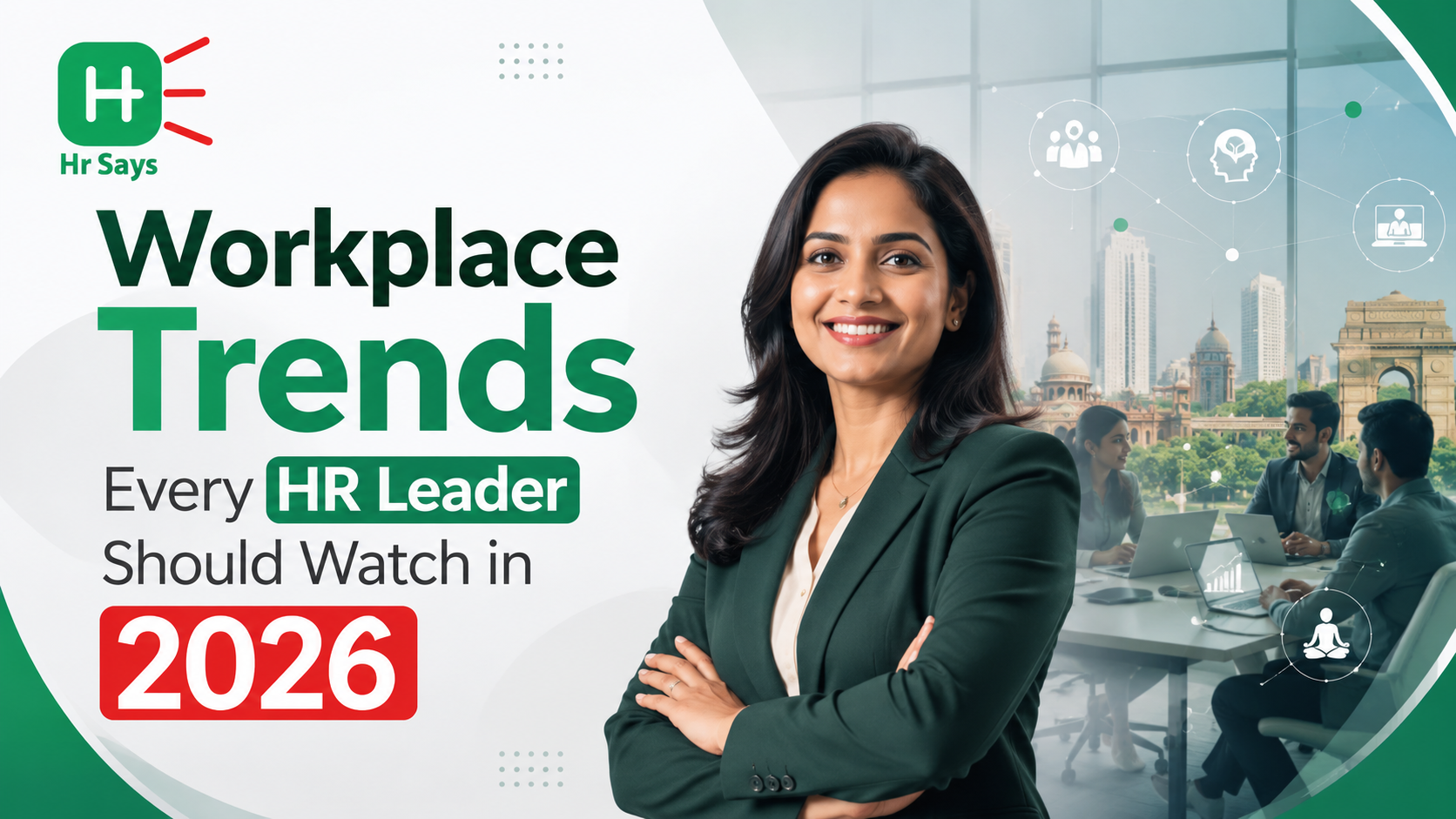
 This article examines the key workplace trends shaping Indian organizations in 2026, covering AI adoption, skills-based hiring, employee wellbeing, data-driven HR, compliance convergence, and India's unique glocal HR challenges.




Introduction
The nature of HR leadership in India has changed in ways that would have been difficult to predict even three years ago. The function that once focused primarily on hiring cycles, payroll accuracy, and policy documentation is now expected to drive organizational resilience, shape culture from the inside out, and make decisions backed by data in real time. That is not a gradual evolution. It is a fundamental redefinition of the role.
For HR leaders across Indian organizations, from high-growth startups in Bengaluru to large enterprises in Mumbai and Tier-2 cities like Pune, Coimbatore, and Jaipur, 2026 presents a unique combination of opportunity and accountability. The workforce is more diverse, more demanding, and more digitally enabled than at any point in history. At the same time, the regulatory environment is tightening, technology is accelerating faster than most organizations can absorb, and employee expectations are shifting in ways that older management models were simply not built to handle.
Understanding the trends shaping this landscape is not an academic exercise. It is a practical necessity for any HR leader who wants to build workplaces that attract good people, retain them meaningfully, and contribute to sustained organizational performance. The conversations happening in HR offices, boardrooms, and leadership retreats across India today are converging around a set of shared themes. This article brings those themes together.
The Rise of AI as an HR Operating Layer
Artificial intelligence is no longer a future consideration for Indian HR teams. It is already embedded in day-to-day operations, and the organizations that treat it as an optional experiment are falling behind those that have made it a functional priority.
The most visible applications of AI in Indian HR functions today involve recruitment automation, payroll anomaly detection, and employee engagement analytics. AI-powered tools are handling resume screening and candidate shortlisting at a scale no human team could sustain, freeing recruiters to focus on relationship-building, cultural alignment conversations, and the qualitative assessments that machines cannot replicate. In payroll, AI is detecting irregularities before they become compliance risks, a particularly valuable capability given how complex multi-state payroll calculations have become under India's evolving labour code framework.
What is worth noting, however, is that most Indian organizations are not yet using AI to its full potential. The technology exists. The platforms are available. The gap lies in organizational readiness, including manager capability, data quality, and governance frameworks that define where AI judgment ends, and human judgment must begin.
HR leaders who want to lead this transition effectively need to think beyond tool adoption. The real work is in establishing clear accountability: which decisions can AI inform, which decisions require human review, and how the organization maintain ethical oversight of automated processes. This is especially relevant in the context of India's Digital Personal Data Protection Act, notified in November 2025, which places new obligations on organizations handling sensitive employee information.
- Identify high-effort, high-impact HR processes where AI can reduce error and save meaningful time
- Audit existing HRMS platforms for underutilized AI features before investing in new tools
- Establish internal governance frameworks that define the boundaries of AI-assisted decision-making
The organizations winning with AI in India are not the ones with the most sophisticated tools. They are the ones with the clearest thinking about how and where those tools should operate.
Skills-Based Hiring and Workforce Planning
One of the most consequential shifts happening across Indian talent markets in 2026 is the move away from degree-based and designation-based hiring toward skills-based workforce architecture. This is not a trend driven by ideology. It is a response to real market conditions.
The shelf-life of technical skills in many sectors has dropped to approximately two and a half years. A candidate who graduated with a computer science degree three years ago may already need significant upskilling to perform in roles that require AI literacy, cloud infrastructure understanding, or advanced data interpretation. At the same time, Global Capability Centers operating across Indian metros are hiring aggressively for niche roles, often paying premiums of thirty to forty percent above traditional market rates. This is creating significant talent pressure for mid-sized Indian organizations that cannot compete purely on compensation.
The practical response, for HR leaders, is to move workforce planning from a designation-first model to a skills-first model. This means understanding the specific capabilities required by each function, mapping current employees against those requirements, building internal mobility pathways that allow high performers to grow into new roles without always exiting for external opportunities, and hiring externally based on verified skill credentials rather than institutional pedigree.
Skills-based approaches also make learning programs more meaningful. When employees can see a direct connection between developing a specific capability and accessing a new opportunity within the organization, professional development shifts from a checkbox activity to a genuine engagement lever. HR platforms that support this require skills mapping, internal job marketplace features, and learning management integration as core functionality.
For Indian HR leaders managing teams across Tier-1 and Tier-2 locations, skills-based planning also enables smarter hiring decisions. Talent pools in cities like Indore, Nagpur, and Lucknow are deepening rapidly across mid-management and functional leadership roles. Organizations that recognize these markets early and build skills-based assessment frameworks can access strong candidates at competitive compensation points.
Employee Wellbeing as Organizational Infrastructure
For several years, well-being in Indian workplaces was positioned as a benefit layer, an Employee Assistance Programme here, a mental health webinar there, a subsidized gym membership as a retention gesture. That framing is no longer adequate, and the leading organizations have recognized it.
The World Health Organization estimates that depression and anxiety together cost the global economy approximately one trillion US dollars annually in lost productivity. In the Indian context, that translates into higher attrition rates, declining engagement scores, and teams that appear functional on the surface but are quietly approaching breaking points. The pressure is particularly visible in high-growth sectors like fintech, edtech, and business process management, where fast-scaling teams often outpace the management capability and structural support needed to sustain them.
What the most forward-thinking HR leaders in India are doing differently is treating well-being not as a program but as a design principle. This means evaluating whether workloads are sustainable before the organization experiences a spike in attrition or sick leave. It means training managers not just on performance management frameworks but on the skills required to recognize early warning signs of burnout and respond constructively. It means measuring psychological safety alongside output metrics and treating the results as operational data.
This shift also has a direct impact on talent attraction. Research from the World Economic Forum's Future of Jobs Report 2025 highlighted that a substantial majority of global employers now identify employee health and well-being as essential for talent availability. In a competitive Indian market, where skilled professionals are evaluating employers across multiple dimensions before accepting offers, the lived experience of well-being within an organization is increasingly a deciding factor.
HR leaders who want to lead this shift should begin by separating wellbeing as a policy from wellbeing as a practice. Policies can exist on paper without influencing day-to-day culture. Practices are embedded in how managers lead, how work is structured, and how performance conversations are conducted. The gap between the two is where most organizations lose ground.
Data-Driven HR and the Move from Reporting to Insight
Indian HR teams have more data available to them today than at any previous point in history. Onboarding completion rates, time-to-productivity metrics, learning pathway progress, engagement survey results, attrition prediction scores, and compensation benchmarks are all accessible through modern HRMS platforms. The problem many organizations face is not a lack of data. It is a lack of analytical capability to translate that data into decisions that actually change outcomes.
The distinction worth making is between descriptive analytics and predictive analytics. Descriptive analytics tells HR leaders what happened, what the attrition rate was last quarter, which departments have the lowest engagement scores, and how long it took to fill specific roles. Predictive analytics tells HR leaders what is likely to happen next, which teams are at elevated risk of losing key people, where skills gaps are likely to widen in the next six months, and which managers are correlating with higher team performance.
Research by HR.com indicates that only twenty-two percent of organizations rate themselves as very or extremely effective at getting value from people analytics. That gap represents both a widespread challenge and a meaningful competitive opportunity for HR leaders who invest in building genuine analytical capability within their teams.
For HR leaders in Indian organizations, this investment does not always require large technology budgets. It often begins with defining clear questions that the organization needs answered, identifying the data sources that can answer them, and building the internal capacity to interpret and communicate insights to business leaders in terms that connect to commercial outcomes.
The HR function that demonstrates clear causal links between people practices and business performance earns its seat at the strategic table. The one that continues to present activity metrics without outcome context does not.
The Convergence of Compliance and Culture
Compliance in Indian workplaces has historically been treated as a back-office concern, something managed by legal and HR operations teams in relative isolation from the day-to-day experience of employees. That separation is breaking down, and the implications for HR leaders are significant.
Several forces are driving this convergence. India's four consolidated Labour Codes, when fully implemented, will reshape payroll structures, benefits administration, and workforce classification in ways that affect how every employee experiences their compensation. The DPDP Act places new obligations on how organizations collect, store, and process the personal data of employees and job applicants. And pay transparency, which is gradually becoming an expectation among Indian job seekers, is changing how compensation conversations are conducted and how salary ranges are communicated during recruitment.
Each of these developments is simultaneously a compliance obligation and a culture signal. How an organization handles the transition to new labour code requirements tells employees something about whether it prioritizes operational convenience over worker fairness. How it communicates DPDP-related data practices signals whether employees can trust the organization with sensitive personal information. How it approaches pay transparency either builds or erodes the sense of fairness that employees need to stay engaged.
HR leaders who approach compliance as purely a risk management exercise miss the larger opportunity. Compliance done well, communicated clearly, and implemented consistently strengthens the psychological contract between employer and employee. It creates a foundation of trust on which everything else, like engagement, performance, and retention is built.
The practical implication is that HR leaders need to be at the table not just when policies are being drafted but when they are being implemented and communicated. The gap between what a policy says and what employees experience is where culture is actually shaped.
The Glocal HR Mandate: Global Thinking, Local Execution
One phrase that has emerged from conversations with HR leaders across India's major talent markets is the concept of being "glocal." It captures something real about the challenge facing HR functions in Indian organizations today. On one side, there is pressure to operate with the efficiency, technology adoption, and strategic sophistication of global-standard HR. On the other hand, there is the deeply local reality of navigating India-specific labour codes, managing talent across markets with dramatically different compensation norms, and building cultures that resonate with a workforce spanning four generations and multiple regional identities.
The regional differentiation of India's talent markets has become more pronounced than ever. Mumbai continues to lead senior management compensation, with senior-level packages averaging significantly higher than most other metros. Bengaluru is consolidating its position as India's most dynamic technology talent hub, with AI and cloud specialists commanding disproportionate pay premiums. Tier-2 cities are no longer overflow markets; they are building genuine depth in mid-management and functional leadership, and organizations that treat them as such are building more cost-efficient and resilient workforces as a result.
For HR leaders, this regional complexity means that standardized national HR policies increasingly create friction. Compensation bands, hiring approaches, and engagement strategies that work well in one geography may actively misfire in another. The organizations gaining ground are those investing in localized workforce intelligence while maintaining consistent standards of fairness, development opportunity, and employee experience.
HRSays serves as a platform where these kinds of nuanced, India-specific workplace conversations are actively happening, making it a useful resource for HR leaders seeking perspectives from practitioners who understand this complexity from the inside.
Frequently Asked Questions
Q1: What are the most important HR trends for Indian organizations in 2026?
The most critical HR trends shaping Indian organizations in 2026 include AI-powered HR operations, skills-based hiring and workforce planning, employee wellbeing as a structural priority, data-driven decision-making using predictive analytics, and the convergence of compliance obligations with workplace culture. Each of these areas requires HR leaders to move beyond reactive management toward a more deliberate, strategic approach.
Q2: How is artificial intelligence changing the HR function in India?
AI is transforming HR in India by automating resume screening, detecting payroll anomalies, enabling predictive attrition analytics, and personalizing employee learning pathways. Most Indian organizations are now embedding AI into their HRMS platforms to support faster and more accurate decisions, though effective adoption requires governance frameworks, data quality investments, and clear accountability boundaries.
Q3: Why is skills-based hiring gaining importance in Indian workplaces?
The shelf-life of technical skills has shortened considerably, and traditional degree-based hiring no longer accurately predicts job performance across many roles. Organizations, particularly those competing with Global Capability Centers for specialized talent, are now prioritizing verified skill credentials, micro-certifications, and demonstrated capability over institutional pedigree when making hiring and promotion decisions.
Q4: How should HR leaders approach employee wellbeing in 2026?
HR leaders should move beyond isolated wellness programs and treat wellbeing as a design principle embedded in how work is structured, managed, and measured. This includes training managers to recognize early burnout signals, reviewing workload sustainability before attrition spikes occur, and ensuring that mental health support is accessible, practical, and free of stigma in day-to-day workplace culture.
Q5: What does the DPDP Act mean for HR teams in India?
India's Digital Personal Data Protection Act, notified in November 2025, places new obligations on HR teams responsible for handling sensitive employee and applicant data. Organizations are now required to establish clearer consent mechanisms, define data processing boundaries, implement role-based access controls, and ensure that AI tools used in HR functions comply with the Act's requirements. HR leaders who address this proactively reduce compliance risk while also building employee trust.