 Saturday, October 10, 2026
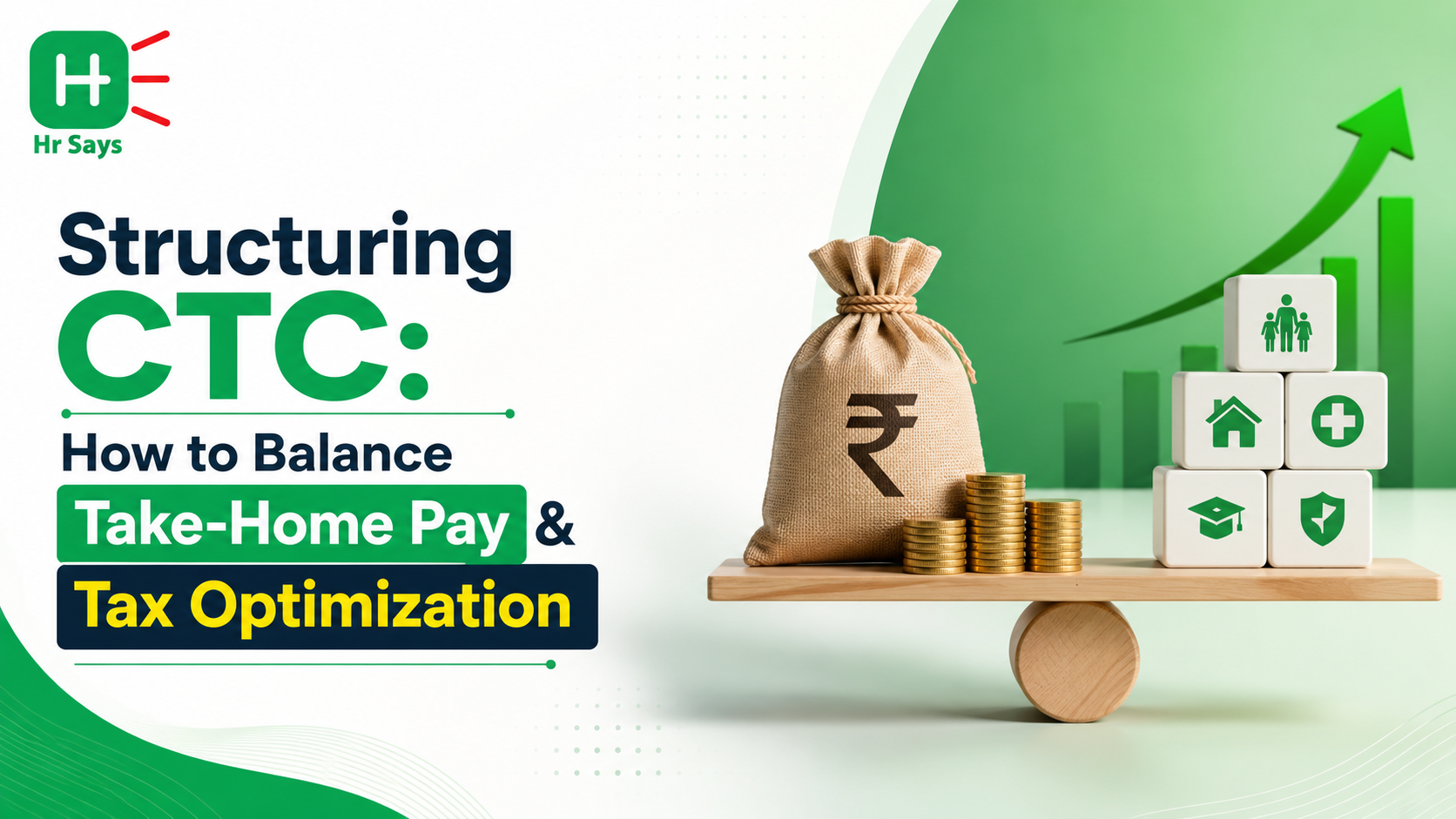
 Modern CTC design goes beyond determining salaries—it strategically balances regulatory compliance, tax optimization, and employee take-home pay. A well-structured compensation package helps organizations attract top talent while ensuring long-term financial and legal sustainability.




Designing a corporate compensation strategy has evolved into a sophisticated exercise in balancing regulatory compliance, fiscal efficiency, and talent acquisition. For human resource executives and chief financial officers, quoting a high Cost to Company (CTC) is no longer enough to secure top talent. Today's workforce focuses on two specific end-of-month metrics: liquid take-home pay and minimized tax liability.
Failing to optimize your salary architecture introduces real corporate risks. An un-restructured CTC leads to unnecessary tax slippage, causing employees to lose a significant portion of their earnings to income tax. This can create silent dissatisfaction and drive talent retention challenges.
Furthermore, the legal landscape has completely transformed. With the Code on Wages strict 50% Basic Salary rule fully active, the Income Tax Act establishing the New Tax Regime as the default pipeline, and the Income Tax Rules 2026 redefining perquisite valuations and expanding metro HRA exemptions, legacy salary templates are obsolete.
To maintain competitive talent pipelines, organizations must deploy compliance-driven, agile CTC models that optimize tax parameters while maximizing disposable cash in hand.
1. The Core Infrastructure: The Modern CTC Architecture
To build a compliant, tax-optimized compensation framework, your payroll software must divide the gross CTC into four distinct, legally sound structural blocks:
- The Core Wage Anchor (Basic Salary): In alignment with the Code on Wages mandate, your Basic Salary must comprise at least 50% of the employee’s total gross remuneration. Setting Basic Pay at this level ensures structural compliance, avoids retroactive penalties from labor inspectors, and forms a reliable base for statutory benefits like Provident Fund (PF) and gratuity, balancing near-term liquidity with long-term retirement security.
- Regime-Specific HRA Optimization: House Rent Allowance (HRA) remains highly valuable under the Old Tax Regime. Following the Income Tax Rules 2026 update, Bengaluru, Pune, Hyderabad, and Ahmedabad now officially qualify for the 50% HRA tax exemption, matching legacy metros like Mumbai and Delhi. For employees selecting the Old Regime, HRA should be set at exactly 50% of Basic Pay in these zones to maximize tax write-offs.
- Retirement Co-Factors (Employer NPS): The single most efficient component across both tax regimes is the Employer National Pension System (NPS) contribution under Section 80CCD(2). Organizations can structure up to 14% of Basic Pay as a direct employer NPS contribution. This component is fully tax-free for the employee and deductible as a business expense for the employer, making it a highly effective tool for high-earning staff.
- Exempt Perquisites and Reimbursements: Utilize tax-free reimbursements backed by bill submissions to wrap up the remaining salary space. This includes mobile and internet connectivity allowances, professional development funds, and meal vouchers (exempt up to ₹200 per meal under modern rules), helping employees lower their taxable income cleanly.
2. Dynamic Optimization Grid: Unoptimized vs. Restructured CTC Breakup
The case study below illustrates the financial difference between an outdated salary structure and an optimized architecture for an employee with a ₹15,00,000 annual CTC choosing the New Tax Regime.
|
Salary Breakdown Component |
Profile A: Unoptimized Legacy Breakup |
Profile B: Strategic Tax Architecture |
The Structural In-Hand Advantage |
|---|---|---|---|
|
Basic Salary |
₹6,00,000 (40% of CTC - Non-Compliant) |
₹7,50,000 (50% of CTC - Fully Compliant) |
Secures legal compliance while building retirement wealth. |
|
Employer NPS (14%) |
₹0 (Component missing entirely) |
₹1,05,000 (Exempt under Section 80CCD(2)) |
Cuts taxable gross income instantly by ₹1,05,000. |
|
Tax-Free Meal Vouchers |
₹0 (Allocated into Special Allowance) |
₹1,05,600 (Exempt under Rule 15(5)(a)) |
Converts a taxable allowance into tax-free purchasing power. |
|
Special / Taxable Allowance |
₹8,12,000 (Bloated balancing figure) |
₹4,27,800 (Minimized residual balance) |
Shrinks the portion of salary exposed to progressive tax slabs. |
|
Employer PF & Insurance |
₹88,000 |
₹1,11,600 |
Increases long-term savings components. |
|
Gross Taxable Income |
₹14,12,000 |
₹11,77,800 |
Brings the net taxable income under the ₹12,00,000 threshold. |
|
Final Annual Income Tax |
₹83,772 (Including 4% Cess) |
₹0 (Eligible for full Sec 87A Tax Rebate) |
Saves the employee ₹83,772 in net cash annually. |
3. High-Performance Action Plan for HR Directors
To successfully update your enterprise payroll architecture and launch optimized compensation templates across your business units, you must execute a structured, multi-phase operational protocol:
- Execute a Strict Wage Code 50% Base Compliance Audit
Phase 1
Review your entire corporate roster. Audit your current salary structures to ensure the sum of all excluded allowances does not exceed 50% of total remuneration, adjusting basic pay levels to prevent legal compliance challenges. - Integrate Employer NPS and Enhanced Meal Perquisite Blocks
Phase 2
Update your compensation profiles. Configure your payroll software to support corporate NPS enrollments up to 14% of Basic Pay and integrate modernized meal card options, replacing fully taxable allowances with tax-exempt components. - Deploy Dual-Regime Employee Projection Systems Natively
Phase 3
Ditch manual calculation methods. Launch automated payroll dashboards that display side-by-side net take-home projections under both the Old and New Tax Regimes, enabling employees to select the most tax-efficient choice for their salary level.
Actionable Strategy: Your Long-Term Corporate Governance Plan
- Link Your Payroll Informatics with the Centralized Tax API Natively: Ensure your internal Human Resource Information System (HRIS) coordinates seamlessly with central financial networks. Linking your reporting profiles natively using verified PAN data ensures automatic compliance with revised tax code reporting mandates and simplifies the filing of modern corporate tax forms.
- Launch Targeted Financial Wellness and NPS Onboarding Clinics: Do not let employees leave money on the table due to a lack of investment knowledge. Partner with certified, non-commercial financial advisors to run company-wide workshops that teach the long-term benefits of corporate pension matching, boosting adoption rates for your optimized components.
- Conduct Semi-Annual Variable Pay and Overtime Compliance Audits: Keep a continuous, objective eye on shifting compensation balances. Bring your finance heads, legal partners, and payroll managers together twice a year to analyze rolling incentive allocations, ensuring sudden quarterly bonus payouts do not push your Basic Salary ratio below the mandatory 50% compliance mark.
Frequently Asked Questions (FAQs)
Q1. What exactly does "CTC restructuring" mean in corporate finance?CTC restructuring is the legal optimization of salary components within an employee's total Cost to Company. It involves reallocating funds away from fully taxable components into tax-exempt allowances, statutory benefits, and corporate pension models to boost take-home pay without changing employer costs.
Q2. Is the 50% Basic Salary rule mandatory for all Indian employers?Yes. Under the unified Code on Wages framework, an organization's aggregate allowances cannot exceed 50% of the total compensation package. This rule requires Basic Salary (plus Dearness Allowance, if applicable) to comprise at least 50% of total remuneration.
Q3. How does the Section 87A tax rebate work under the New Tax Regime?The Section 87A rebate provides zero tax liability for resident individuals whose net taxable income does not exceed ₹12,00,000. For salaried employees, adding the standard deduction means a gross salary up to ₹12,75,000 can be completely tax-free.
Q4. Which cities officially count as "metros" for HRA tax exemptions?Historically, only Mumbai, Delhi, Kolkata, and Chennai qualified for the 50% HRA exemption. Following regulatory updates, Bengaluru, Pune, Hyderabad, and Ahmedabad now officially qualify for the 50% HRA exemption, while other urban centers remain at 40%.
Q5. Can an employee claim HRA benefits while opting for the New Tax Regime?No. The New Tax Regime features lower slab rates but removes most traditional exemptions, including HRA, Leave Travel Allowance (LTA), and Section 80C deductions. HRA optimization remains highly valuable exclusively under the Old Tax Regime.
Q6. What is the maximum limit for corporate NPS exemptions under Section 80CCD(2)?For private sector employees, the employer's contribution to the National Pension System is fully tax-exempt up to 14% of the employee's Basic Salary plus DA, serving as a highly effective tool for high-income earners across both tax regimes.
Q7. How do modernized meal vouchers deliver significant tax savings?Under modern rules, meal perquisites are exempt up to ₹200 per meal. For an employee consuming two meals per day over 22 working days monthly, this creates a ₹1,05,600 annual tax exemption, saving over ₹32,000 for professionals in the 30% tax bracket.
Q8. What parameters are evaluated on a 360-degree corporate payroll scorecard?A holistic payroll scorecard tracks data across multiple organizational layers, cross-referencing Wage Code compliance ratios, employee take-home pay percentages, tax regime selection trends, corporate NPS utilization rates, and overall administrative cost metrics.
Q9. How fast can an enterprise observe an increase in employee satisfaction after updating structures?When a corporate network updates its payroll infrastructure to deploy automated tax-exempt components, implement 50% basic rules, and offer clear digital comparisons, the return is rapid. You can observe improved talent retention and an increase in net take-home pay within 4 to 6 weeks of active execution.
Q10. What steps should an HR manager take if an employee's structure falls out of compliance due to unexpected commissions?The manager must initiate a structured adjustment workflow: program the HRIS to instantly flag whenever variable payouts push the basic salary below the 50% boundary, reallocate the excess variable components into compliant formats like performance bonuses, and ensure the basic wage base is adjusted to preserve long-term compliance.
For a step-by-step mathematical breakdown of these thresholds under the updated framework, this Section 87A New Regime Calculation Guide walks through the progressive slab layers, standard deductions, and rebate mechanisms that reduce your active tax liability to zero.