 Thursday, October 01, 2026
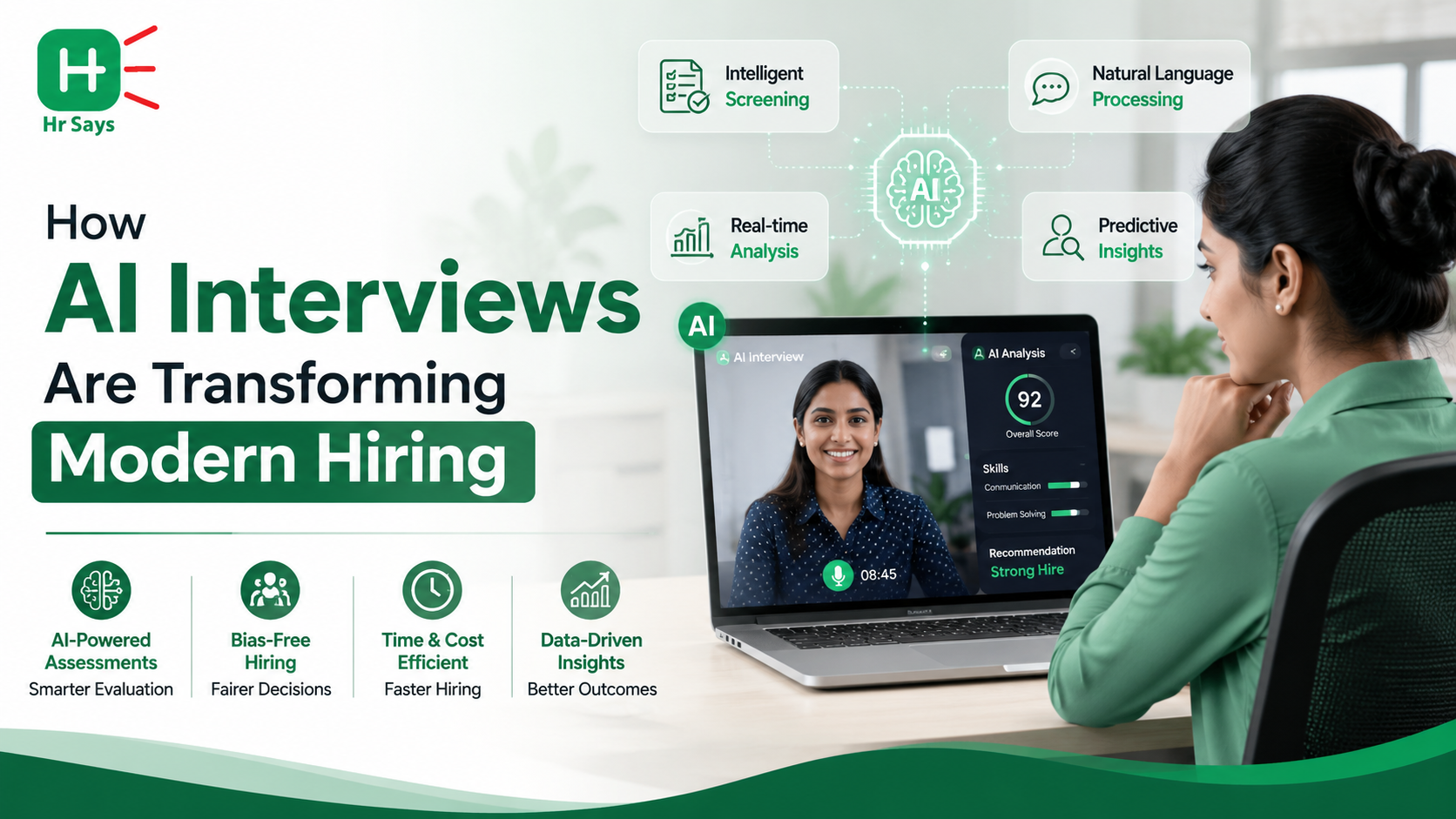
 AI interviews are reshaping recruitment through automated screening, skills-based evaluation, and data-driven hiring decisions that improve efficiency and scalability.
As artificial intelligence becomes a core part of talent acquisition, candidates and employers who adapt to these evolving recruitment technologies will be better positioned for future workforce success.
AI interviews are reshaping recruitment through automated screening, skills-based evaluation, and data-driven hiring decisions that improve efficiency and scalability.
As artificial intelligence becomes a core part of talent acquisition, candidates and employers who adapt to these evolving recruitment technologies will be better positioned for future workforce success.





How AI Interviews Are Transforming Modern Hiring
The hiring process has changed more in the last few years than it did in the previous two decades. Companies are no longer relying solely on resumes, traditional interviews, and manual screening. Instead, artificial intelligence is becoming a major part of recruitment, helping organizations evaluate candidates faster and more consistently. As AI interviews become more common, job seekers, students, entrepreneurs, and business leaders are all trying to understand what this shift means.
The question is no longer whether AI will influence hiring. The real question is how AI interviews are changing hiring processes, what opportunities they create, and what challenges both employers and candidates must prepare for.
Why Traditional Hiring Started Facing Limitations
For decades, hiring followed a relatively simple process. A candidate submitted a resume, recruiters screened applications, interviews were scheduled, and hiring decisions were made based on conversations and experience.
While this approach worked, it also created several problems.
Organizations often received hundreds or thousands of applications for a single role. Human recruiters had limited time to review every application thoroughly. This sometimes resulted in strong candidates being overlooked simply because their resumes did not stand out immediately.
At the same time, hiring managers faced another challenge. Interviews often depended heavily on personal judgment. Different interviewers could evaluate the same candidate differently. One recruiter might focus on communication skills while another emphasized technical expertise.
As businesses expanded globally and remote work became more common, these limitations became more visible. Companies needed a system capable of handling large candidate pools while maintaining consistency and speed.
This need for scalability created the environment where AI interviews began gaining attention. Rather than replacing human recruiters, AI emerged as a tool designed to help organizations process information more efficiently and make more informed hiring decisions.
What AI Interviews Actually Are and How They Work
Many people imagine AI interviews as robots replacing recruiters. The reality is far more practical.
An AI interview typically involves technology assisting in candidate evaluation. This may include automated screening questions, video interview analysis, assessment platforms, or systems that compare candidate responses against predefined criteria.
Some platforms ask candidates to record video answers to interview questions. The system then analyzes factors such as response quality, communication structure, job-related competencies, and behavioral indicators.
Other AI-driven hiring tools focus on skills assessments, coding challenges, language proficiency tests, or role-specific scenarios.
The goal is not simply to collect information. AI systems are designed to identify patterns that may indicate suitability for a role.
For example, a company hiring customer service representatives may prioritize communication clarity, problem-solving ability, and emotional intelligence. An AI system can evaluate these characteristics consistently across thousands of applicants.
This creates a more standardized process and helps recruiters focus their attention on candidates who demonstrate strong potential.
How AI Interviews Are Reshaping Candidate Screening
One of the biggest changes AI has introduced is the transformation of early-stage screening.
Previously, recruiters spent hours reviewing resumes and conducting initial phone calls. Today, AI systems can perform much of this preliminary work automatically.
Ways AI Improves Early Screening
- Large applicant volumes can be processed quickly and consistently
Organizations often receive more applications than recruiters can realistically evaluate. AI systems help analyze large datasets rapidly, ensuring every applicant receives consideration based on predefined criteria rather than recruiter availability. - Screening becomes more structured across different hiring teams
Traditional recruitment processes can vary significantly between departments. AI introduces standardized evaluation methods, helping companies create a more consistent candidate experience and improving decision-making accuracy. - Recruiters gain more time for deeper candidate evaluation
Instead of spending hours reviewing basic qualifications, recruiters can focus on interviewing shortlisted candidates, assessing cultural fit, and discussing role expectations in greater detail.
This shift has significantly reduced hiring timelines across many industries while improving operational efficiency.
The Growing Importance of Skills Over Resumes
One of the most interesting effects of AI interviews is the increasing emphasis on skills rather than credentials alone.
Historically, hiring decisions often relied heavily on education, previous employers, or resume presentation. While these factors remain relevant, modern AI systems increasingly focus on demonstrated ability.
This change benefits many candidates who may not have traditional career paths.
A self-taught programmer, for example, might outperform candidates from prestigious universities during technical assessments. Similarly, a customer service candidate with excellent communication skills may perform exceptionally well in scenario-based evaluations regardless of academic background.
For students and early-career professionals, this represents an important shift. The ability to demonstrate competence through practical assessments can sometimes matter more than traditional qualifications.
Businesses also benefit because they gain access to talent that might otherwise be overlooked during conventional screening processes.
Benefits for Employers Beyond Faster Hiring
Many discussions about AI interviews focus primarily on speed. However, the advantages extend far beyond reducing recruitment timelines.
Organizations are increasingly using AI because it helps improve hiring quality and workforce planning.
Strategic Advantages for Businesses
- Data-driven hiring decisions reduce uncertainty
AI systems provide measurable insights rather than relying entirely on subjective impressions. This helps organizations make decisions supported by evidence and structured evaluation criteria. - Global hiring becomes easier to manage
Companies recruiting across multiple countries often face logistical challenges. AI interviews allow organizations to evaluate candidates consistently regardless of location or time zone. - Recruitment resources can be allocated more effectively
Human recruiters can focus on relationship-building, candidate engagement, and strategic hiring initiatives while automation handles repetitive administrative tasks.
As organizations continue expanding remote and international hiring efforts, these benefits become increasingly valuable.
Challenges and Concerns Surrounding AI Interviews
Despite their advantages, AI interviews are not without controversy.
One common concern involves transparency. Candidates may not fully understand how decisions are being made or what factors influence evaluation outcomes.
Another concern involves fairness. AI systems learn from historical data, and if that data contains biases, the system may unintentionally reinforce existing patterns.
For example, if previous hiring decisions favored certain profiles, the AI could potentially identify those patterns and replicate them unless carefully monitored.
Privacy is another important consideration. Video interviews, behavioral assessments, and digital evaluations generate significant amounts of personal data. Organizations must ensure that candidate information is handled responsibly and securely.
These challenges do not mean AI interviews should be avoided. Rather, they highlight the importance of responsible implementation and ongoing oversight.
How Candidates Can Adapt to AI-Powered Hiring
As AI interviews become more common, candidates must understand how to prepare effectively.
The good news is that many preparation strategies remain similar to traditional interviews. Clear communication, relevant experience, and problem-solving ability still matter.
However, candidates should also focus on demonstrating skills in measurable ways.
Instead of relying solely on resume descriptions, individuals should be prepared to showcase practical capabilities through assessments, case studies, simulations, or structured interview responses.
Candidates should also pay attention to presentation quality during video interviews. Clear audio, professional environments, and thoughtful responses help create stronger impressions during AI-assisted evaluations.
Most importantly, authenticity remains critical. AI systems are increasingly designed to identify genuine competency rather than rehearsed responses.
The Future of AI Interviews and Human Decision-Making
A common misconception is that AI will eventually replace recruiters entirely.
In reality, the future of hiring is likely to involve collaboration between human expertise and artificial intelligence.
AI excels at processing large amounts of information, identifying patterns, and creating consistency. Humans excel at understanding context, evaluating cultural fit, building relationships, and making nuanced judgments.
The most successful hiring systems will combine both strengths.
Recruiters will increasingly use AI-generated insights as decision-support tools rather than decision-making replacements. This approach allows organizations to benefit from efficiency while maintaining the human elements that remain essential to effective hiring.
As technology continues evolving, AI interviews will likely become more sophisticated, personalized, and integrated into broader talent management systems.
Why Understanding This Shift Matters Today
Whether someone is a student preparing for future employment, a professional exploring career opportunities, or a business owner building a team, understanding AI-driven hiring is becoming increasingly important.
The hiring landscape is changing because organizations need faster, more scalable, and more consistent recruitment processes. AI interviews address many of these needs while introducing new opportunities and challenges.
Those who understand how these systems work will be better positioned to adapt, compete, and succeed in modern recruitment environments.
Conclusion
AI interviews are transforming hiring by improving screening efficiency, expanding access to talent, and shifting attention toward measurable skills rather than credentials alone. While concerns about fairness, transparency, and privacy remain important, the combination of human judgment and artificial intelligence is creating a more data-informed recruitment process.
For candidates and employers alike, understanding how AI interviews are changing hiring processes is no longer optional. It is becoming an essential part of navigating the future of work.
1. Can AI interviews accurately assess soft skills and personality?
AI interviews can evaluate communication patterns, response structure, and problem-solving approaches, but they do not fully replace human judgment. Modern recruitment technology combines behavioral assessment with candidate evaluation to identify strengths that may be relevant to a role. However, final hiring decisions often benefit from human interaction and contextual understanding.
2. Are AI interviews becoming common across all industries?
AI-powered hiring is expanding rapidly across technology, finance, healthcare, retail, and customer service sectors. Organizations use talent acquisition tools to manage large applicant pools efficiently, while workforce planning strategies increasingly rely on data-driven recruitment processes.
3. How can candidates prepare for an AI-based interview?
Preparation involves practicing structured responses, improving communication clarity, and demonstrating practical skills. Since many systems focus on skills assessment and competency evaluation, candidates should prioritize real examples and measurable achievements rather than memorized answers.
4. Do AI interviews reduce hiring bias completely?
AI can help standardize evaluations and support fairer recruitment processes, but it does not automatically eliminate bias. Responsible use of recruitment analytics and continuous monitoring of hiring algorithms is necessary to ensure balanced and inclusive candidate assessments.
5. Why are companies investing heavily in AI recruitment tools?
Organizations use AI because it improves efficiency, scalability, and consistency. Advanced recruitment automation systems reduce administrative workload, while data-driven hiring helps companies identify qualified candidates more effectively and make informed decisions.
6. Can AI interviews benefit students and fresh graduates?
Yes, AI interviews often focus more on demonstrated ability than traditional credentials. Through skills-based hiring and candidate screening, students can showcase practical knowledge, communication skills, and problem-solving abilities even if they have limited work experience.
7. What are the biggest challenges candidates face in AI interviews?
Many candidates struggle with unfamiliar interview formats and automated assessments. Understanding how digital recruitment platforms work and adapting to video interview technology can help individuals feel more confident and perform more effectively.
8. How do AI interviews impact remote hiring and global recruitment?
AI interviews make it easier for organizations to assess candidates regardless of location. Through virtual hiring systems and remote recruitment processes, employers can access wider talent pools while maintaining consistency across different regions and time zones.
9. Will AI eventually replace human recruiters completely?
Most experts believe AI will support rather than replace recruiters. While artificial intelligence in recruitment excels at analyzing large datasets, human professionals remain essential for relationship-building, negotiation, and understanding complex workplace dynamics within talent management processes.
10. What future trends can we expect in AI-powered hiring?
Future hiring systems are likely to become more personalized, predictive, and skills-focused. Advancements in recruitment technology and workforce intelligence may help organizations identify talent potential more accurately while improving candidate experience and hiring outcomes.