 Sunday, October 04, 2026
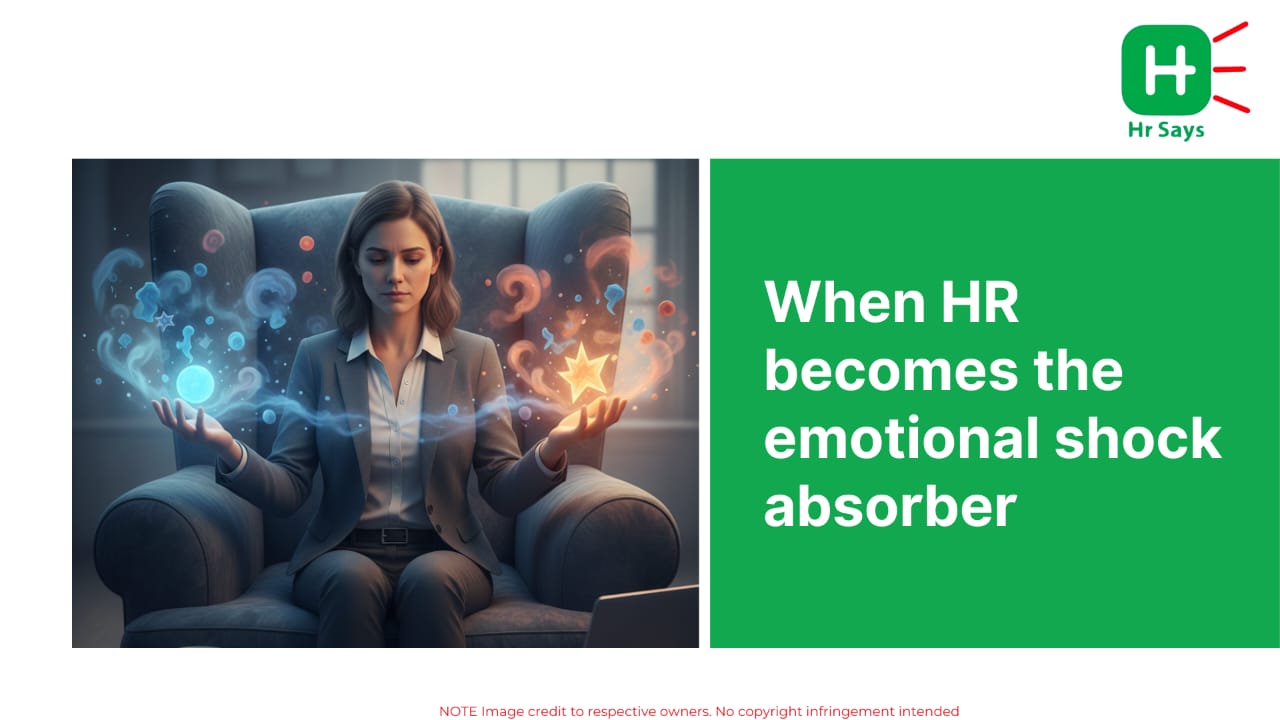
 As emotional conversations increasingly reach HR, the role is quietly reshaped. This blog
explores why HR becomes the emotional shock absorber, the cost of that shift, and how
healthier workplace boundaries can be created.
As emotional conversations increasingly reach HR, the role is quietly reshaped. This blog
explores why HR becomes the emotional shock absorber, the cost of that shift, and how
healthier workplace boundaries can be created.




Working places can hardly ever be about work only. Stress walks into meetings. Fears are just lying there in mailboxes. HR is held in between between policies and people and it is usually expected to take everything. Not loudly. Not visibly. Just steadily.
The quiet shift in HR’s role
After being defined in terms of compliance and processes, HR has gradually been put in the role of the emotional buffer of the organisation. Topics previously handled by managers are being channeled to the HR offices. Burnout and conflict and grief and confusion are imported, without much notice. This change has not been declared officially. It has simply happened.
Employees are made to voice out. Safe spaces are promoted. Mental health has been realized. Their emotions should spill; hence, HR is supposed to pick them up.
Why emotions land in HR’s lap
Several forces have pushed this responsibility toward HR.
● Managers are trained to deliver outcomes, not emotions
● Hybrid and remote work has blurred professional boundaries
● Psychological safety has become a workplace priority
● Employees seek neutral listeners within the system
HR is seen as accessible, confidential, and non threatening. As a result, emotional labour is quietly added to the job description, without limits being defined.
The hidden cost of emotional labour
Listening is not passive. Absorbing emotions carries weight.
Over time, HR professionals are affected in ways that are rarely acknowledged. Compassion fatigue is experienced. Decision making becomes heavier. Emotional neutrality becomes harder to maintain.
While employee wellbeing is discussed openly, HR wellbeing is often assumed. The expectation is that resilience will simply exist.
It is rarely asked who supports the supporters.
When support turns into expectation
There is a difference between being supportive and being responsible for emotional repair.
HR is often expected to:
● Mediate personal conflicts
● Hold space for emotional breakdowns
● Absorb frustration directed at leadership
● Remain calm while enforcing difficult policies
This work is rarely recognised as emotional labour. It is treated as part of being approachable. Over time, boundaries are softened, and emotional accountability is misplaced.
The risk of blurred boundaries
When HR becomes the default emotional outlet, trust can quietly erode.
Employees may begin to expect solutions where only listening was offered. Confidentiality can be misunderstood. HR can be perceived as a therapist, a mediator, and a decision maker at the same time.
These roles cannot coexist without friction.
Without clear boundaries, HR risks burnout, misalignment, and reduced effectiveness.
Creating healthier emotional systems at work
Emotional responsibility should be shared, not absorbed by one function.
Healthier systems are built when:
● Managers are trained in basic emotional intelligence
● Mental health resources are external and professional
● HR boundaries are clearly communicated
● Emotional wellbeing is treated as an organisational responsibility
HR works best as a connector, not a container.
Conclusion
HR was never meant to carry the emotional weight of an entire organisation. Support can be offered without silent absorption. When boundaries are respected and responsibility is shared, both employees and HR are allowed to function with clarity and balance.