Thursday, October 01, 2026
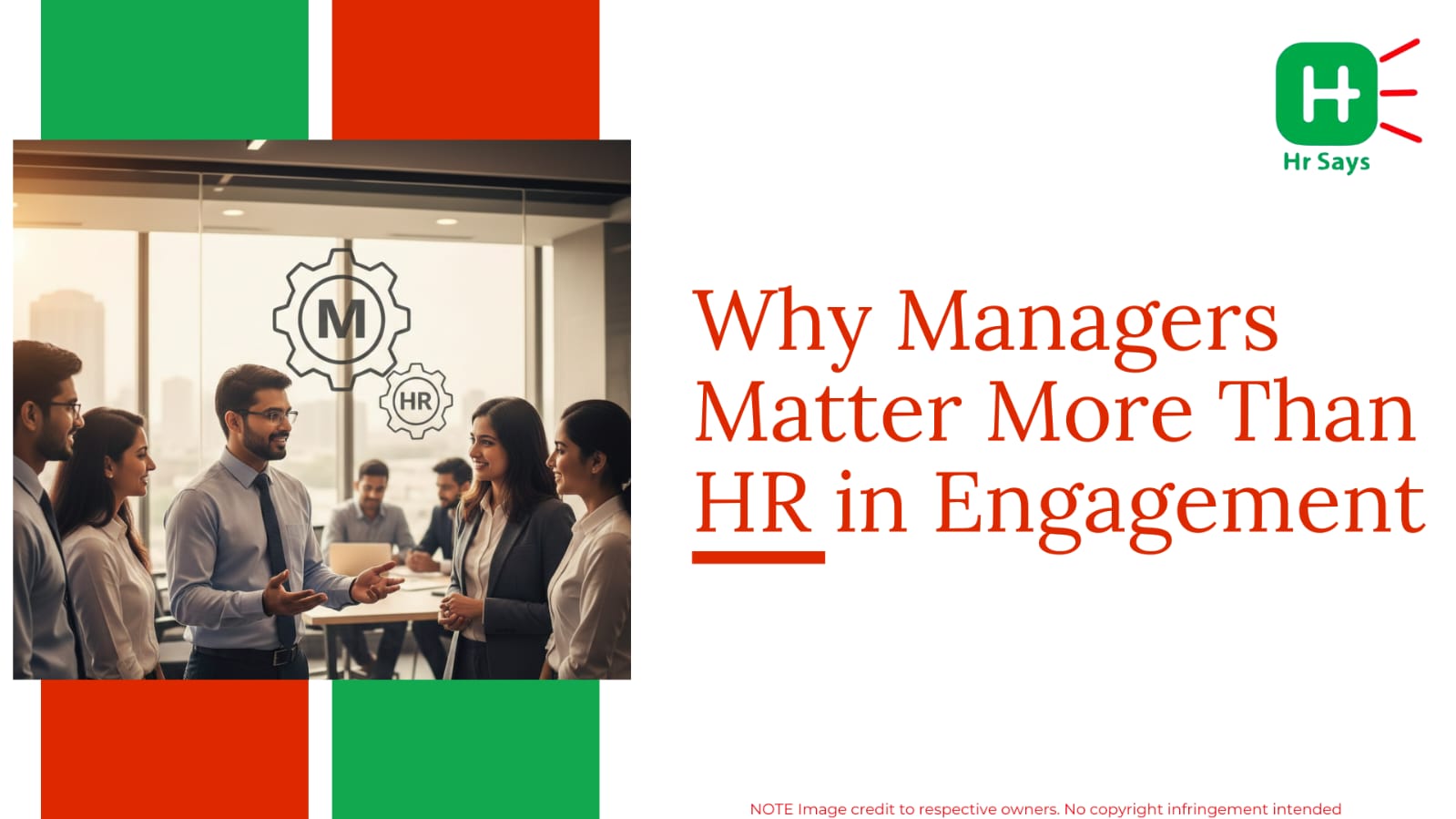
 Employee engagement is shaped less by HR initiatives and more by daily manager behavior.
This article explains why managers hold greater influence over trust, motivation, and retention,
and why engagement efforts succeed or fail at the team level.
Employee engagement is shaped less by HR initiatives and more by daily manager behavior.
This article explains why managers hold greater influence over trust, motivation, and retention,
and why engagement efforts succeed or fail at the team level.




The issue of employee engagement is frequently discussed in dashboard, surveys, and policies. However, it is not constructed in board rooms or HR literature. It is developed in a noiseless fashion on a daily basis, in discussions, through feedback and decision making by managers that are closest in proximity to work and people.
The Everyday Reality of Engagement
It is not an engagement that is made at the yearly reviews or quarterly pulse surveys. It is felt in little intervals. A task is explained clearly. Effort is noticed. Issues are raised without trepidation.
The organization is not an abstract system to the majority of the employees. It is their manager.
In instances when work is either meaningful or draining, it is often not a policy that causes it. It is the manner in which work is delegated, facilitated and checked.
Where HR’s Role Naturally Ends
HR teams are essential. Frameworks are designed. Engagement strategies are documented. Learning programs are launched. Compliance is ensured.
However, HR usually operates at a distance from daily work.
Policies can encourage engagement, but they cannot enforce trust.
Tools can measure sentiment, but they cannot change behavior.
Guidelines can exist, but they cannot replace human judgment.
Engagement is influenced by interpretation. That interpretation is done by managers, not HR.
Managers as the Real Engagement Drivers
Managers translate culture into action. What is written in values becomes real through their behavior.
Several engagement drivers are directly controlled by managers.
● Clarity of expectations
● Quality of feedback
● Psychological safety
● Recognition of effort
● Flexibility and empathy
If these are handled poorly, no engagement initiative can compensate.
If these are handled well, even weak systems are forgiven.
Trust Is Built Locally, Not Centrally
Trust is rarely built through company-wide messages. It is built in one-on-one conversations.
Employees decide whether to stay engaged based on simple questions.
Is my manager fair?
Is my work respected?
Am I supported when things go wrong?
These answers are shaped through daily interactions, not HR announcements.
A disengaged employee is often reacting to a relationship, not a role.
The Cost of Ignoring Manager Impact
When managers are not equipped or held accountable, engagement efforts quietly fail.
Burnout increases because workload is poorly managed.
Attrition rises because concerns are dismissed.
Performance drops because feedback is unclear.
HR is often blamed for low engagement scores, even when the root cause sits elsewhere.
Without strong people managers, engagement becomes a reporting exercise rather than a lived experience.
What Organizations Often Miss
Many organizations invest heavily in engagement platforms and employer branding, while underinvesting in manager capability.
Manager development is treated as optional.
Soft skills are assumed, not taught.
Coaching is delayed until problems appear.
Yet, engagement is sustained only when managers are supported, trained, and trusted to lead people, not just tasks.
Conclusion
HR may design the engagement strategy, but managers deliver it. Engagement is not implemented through policies. It is practiced through leadership. Until managers are treated as the primary drivers of employee experience, engagement will remain a concept rather than a culture.