Saturday, October 24, 2026
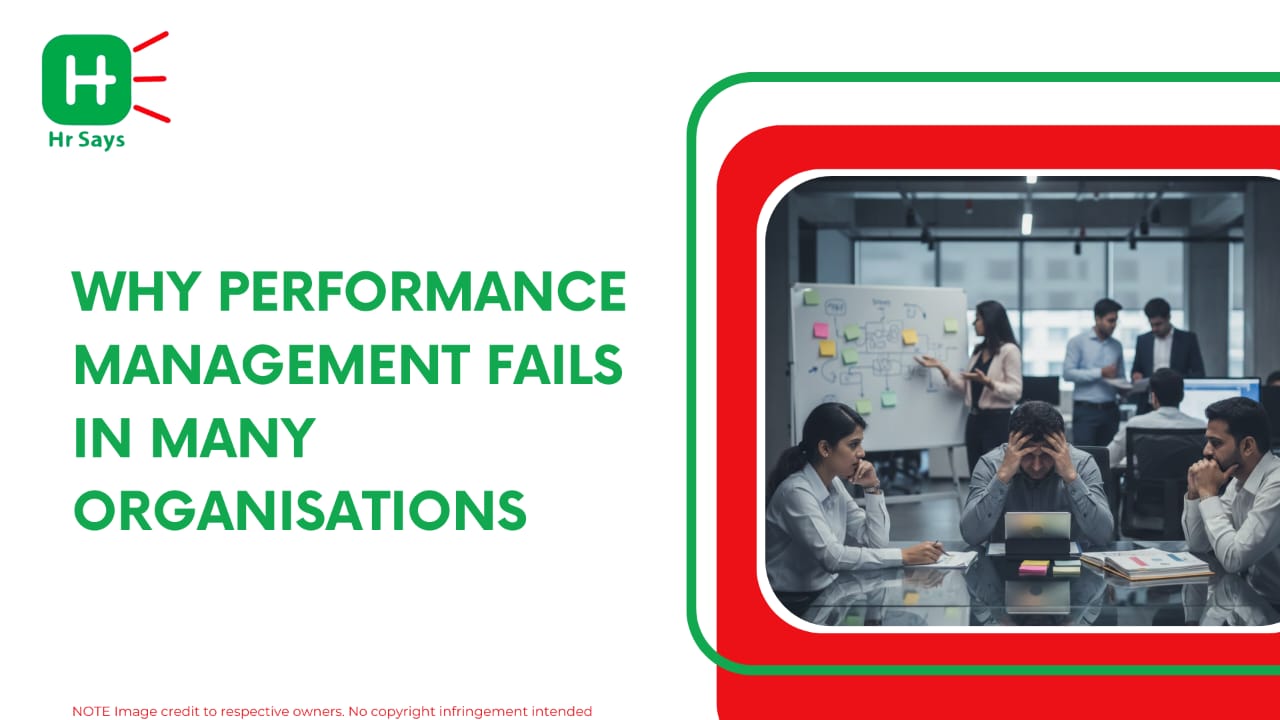
 Performance management often fails due to misaligned goals, outdated feedback cycles, and
overreliance on ratings. When systems lack flexibility, manager capability, and employee
ownership, performance becomes procedural rather than meaningful.
Performance management often fails due to misaligned goals, outdated feedback cycles, and
overreliance on ratings. When systems lack flexibility, manager capability, and employee
ownership, performance becomes procedural rather than meaningful.




Performance management is usually implemented well, but there is so much frustration on both ends of the table. Goals are established, appraisal is done, forms remain to be filled. Nevertheless, there is still a low impact. Between planning and implementation, somewhere strategy and execution have its watered down and the machine simply breaks down.
Misaligned Goals And Business Reality
Performance goals in most organisations are developed unilaterally. Tactical priorities can be revised in the middle of the year, whereas personal goals cannot be altered. It is then determined that the employees performed poorly on results that are irrelevant anymore.
This gap is usually caused by
● Top down goal setting with limited context
● Poor translation of business strategy into daily work
● Lack of flexibility in goal revision
When relevance is lost, effort becomes mechanical. Performance is tracked, but value is not created.
Overemphasis On Ratings Instead Of Growth
Performance management is often reduced to numbers. Ratings are assigned, curves are forced, and comparisons are made. What gets measured receives attention, while what truly matters gets ignored.
The Fear Factor In Reviews
When ratings dominate conversations, honesty is avoided. Feedback is softened. Risks are not taken. Learning is slowed.
As a result, performance discussions are treated as survival exercises rather than growth opportunities. Development quietly takes a back seat.
Infrequent And Delayed Feedback
Annual or biannual reviews are still widely used. By the time feedback is delivered, the moment has passed. Context is forgotten. Emotions have settled, or sometimes hardened.
Modern workplaces demand continuous feedback, yet systems remain outdated. Without timely inputs, performance issues are repeated, and good work often goes unrecognized.
Manager Capability Gaps
Performance management depends heavily on managers. Yet many are not trained to coach, guide, or evaluate fairly. Difficult conversations are avoided. Biases are unintentionally introduced.
Commonly Observed Issues
● Feedback is vague or inconsistent
● Expectations are not clearly communicated
● Personal preferences influence evaluation
When trust erodes, the process is questioned. Engagement slowly declines.
One Size Fits All Frameworks
Uniform performance frameworks are often applied across roles, teams, and functions. However, work is rarely uniform. Creative roles, operational roles, and strategic roles cannot be measured the same way.
When individuality is ignored, people feel unseen. Performance becomes about fitting into boxes rather than doing meaningful work.
Lack Of Employee Ownership
Performance management is frequently done to employees, not with them. Forms are filled because they must be. Goals are accepted because they are assigned.
Without ownership, accountability feels imposed. Motivation weakens. The process turns transactional.
Conclusion
Performance management fails not because people resist accountability, but because systems are designed without empathy, flexibility, and context. When growth is prioritized over control, and conversations replace checklists, performance is allowed to improve naturally.